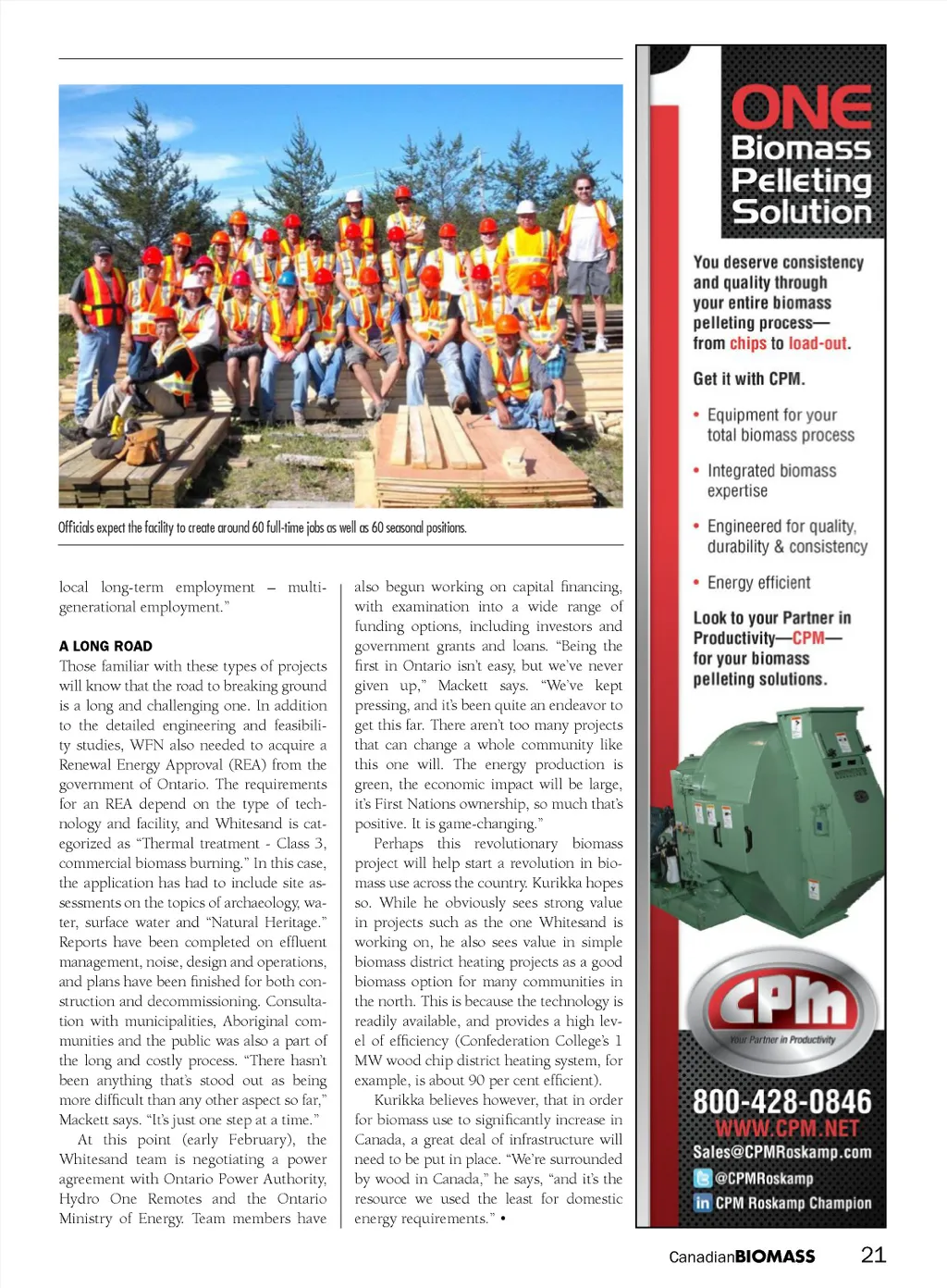
Officials expect the facility to create around 60 full-time jobs as well as 60 seasonal positions. local long-term employment – multi-generational employment.” A LONG ROAD Those familiar with these types of projects will know that the road to breaking ground is a long and challenging one. In addition to the detailed engineering and feasibili-ty studies, WFN also needed to acquire a Renewal Energy Approval (REA) from the government of Ontario. The requirements for an REA depend on the type of tech-nology and facility, and Whitesand is cat-egorized as “Thermal treatment -Class 3, commercial biomass burning.” In this case, the application has had to include site as-sessments on the topics of archaeology, wa-ter, surface water and “Natural Heritage.” Reports have been completed on effluent management, noise, design and operations, and plans have been finished for both con-struction and decommissioning. Consulta-tion with municipalities, Aboriginal com-munities and the public was also a part of the long and costly process. “There hasn’t been anything that’s stood out as being more difficult than any other aspect so far,” Mackett says. “It’s just one step at a time.” At this point (early February), the Whitesand team is negotiating a power agreement with Ontario Power Authority, Hydro One Remotes and the Ontario Ministry of Energy. Team members have also begun working on capital financing, with examination into a wide range of funding options, including investors and government grants and loans. “Being the first in Ontario isn’t easy, but we’ve never given up,” Mackett says. “We’ve kept pressing, and it’s been quite an endeavor to get this far. There aren’t too many projects that can change a whole community like this one will. The energy production is green, the economic impact will be large, it’s First Nations ownership, so much that’s positive. It is game-changing.” Perhaps this revolutionary biomass project will help start a revolution in bio-mass use across the country. Kurikka hopes so. While he obviously sees strong value in projects such as the one Whitesand is working on, he also sees value in simple biomass district heating projects as a good biomass option for many communities in the north. This is because the technology is readily available, and provides a high lev-el of efficiency (Confederation College’s 1 MW wood chip district heating system, for example, is about 90 per cent efficient). Kurikka believes however, that in order for biomass use to significantly increase in Canada, a great deal of infrastructure will need to be put in place. “We’re surrounded by wood in Canada,” he says, “and it’s the resource we used the least for domestic energy requirements.” • Canadian BIOMASS 21
Canadian Biomass March-April 2015: Page 21