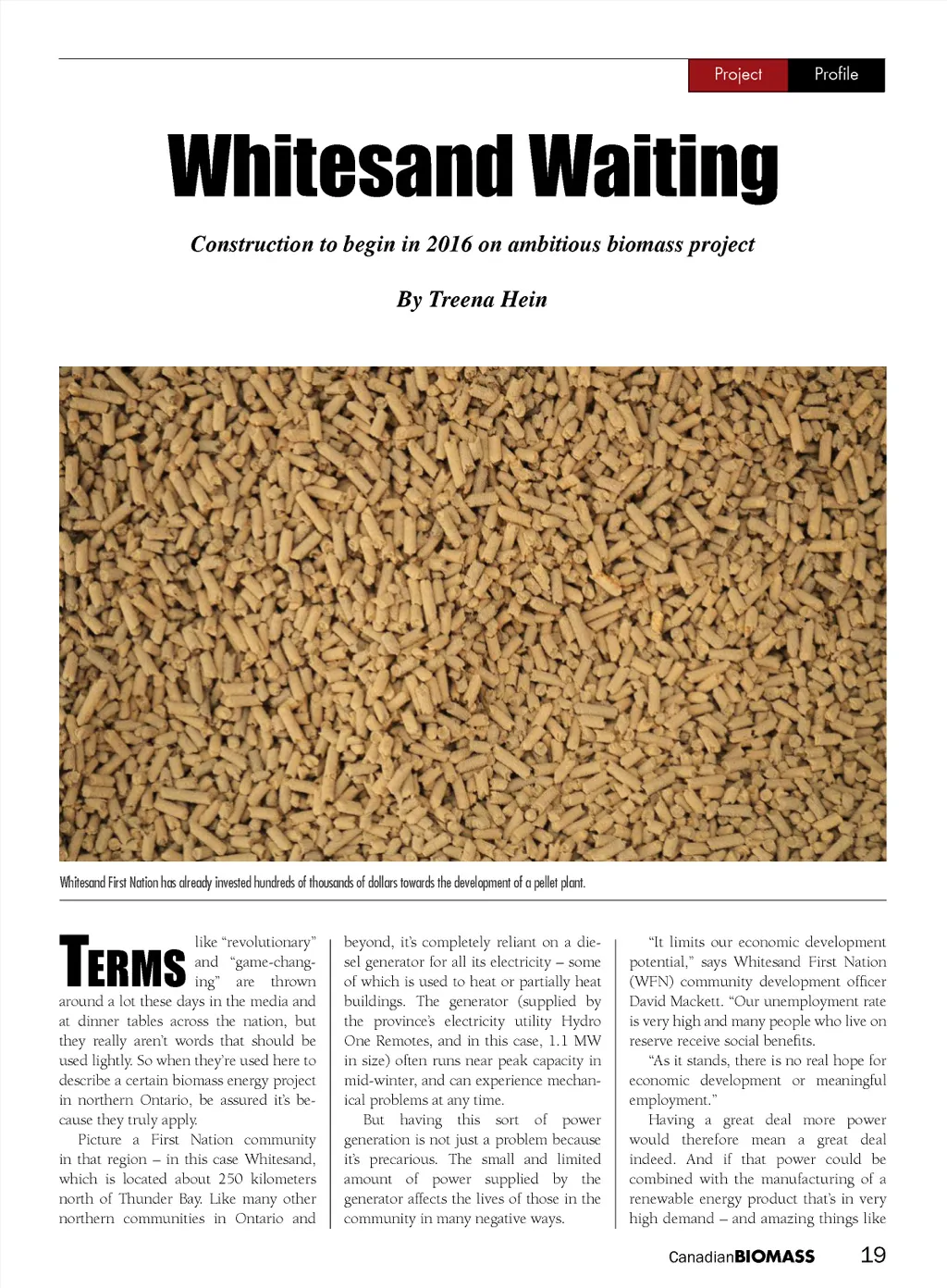
Project Profile Whitesand Waiting Construction to begin in 2016 on ambitious biomass project By Treena Hein Whitesand First Nation has already invested hundreds of thousands of dollars towards the development of a pellet plant. T erms like “revolutionary” and “game-chang-ing” are thrown around a lot these days in the media and at dinner tables across the nation, but they really aren’t words that should be used lightly. So when they’re used here to describe a certain biomass energy project in northern Ontario, be assured it’s be-cause they truly apply. Picture a First Nation community in that region – in this case Whitesand, which is located about 250 kilometers north of Thunder Bay. Like many other northern communities in Ontario and beyond, it’s completely reliant on a die-sel generator for all its electricity – some of which is used to heat or partially heat buildings. The generator (supplied by the province’s electricity utility Hydro One Remotes, and in this case, 1.1 MW in size) often runs near peak capacity in mid-winter, and can experience mechan-ical problems at any time. But having this sort of power generation is not just a problem because it’s precarious. The small and limited amount of power supplied by the generator affects the lives of those in the community in many negative ways. “It limits our economic development potential,” says Whitesand First Nation (WFN) community development officer David Mackett. “Our unemployment rate is very high and many people who live on reserve receive social benefits. “As it stands, there is no real hope for economic development or meaningful employment.” Having a great deal more power would therefore mean a great deal indeed. And if that power could be combined with the manufacturing of a renewable energy product that’s in very high demand – and amazing things like Canadian BIOMASS 19
Canadian Biomass March-April 2015: Page 19