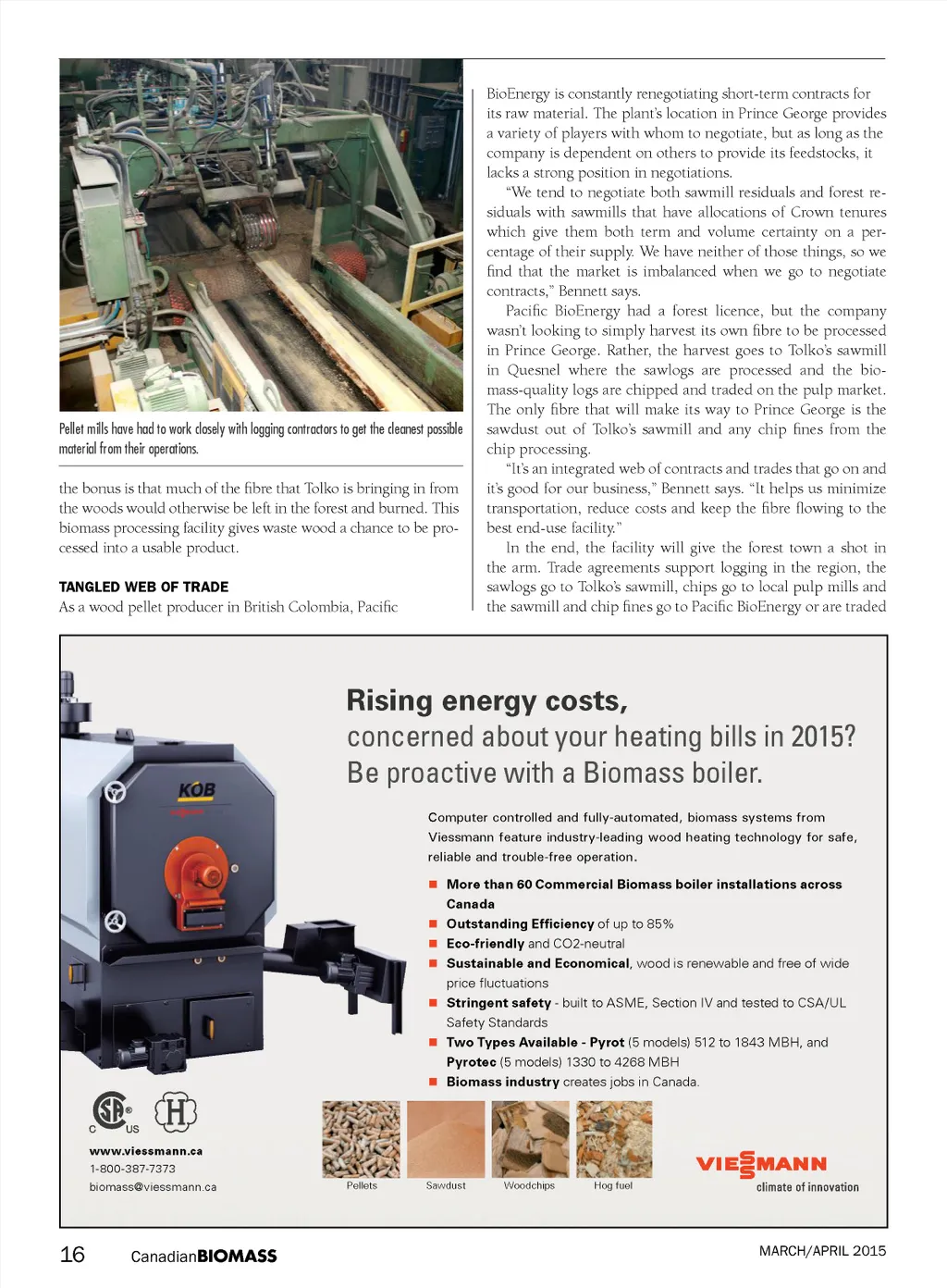
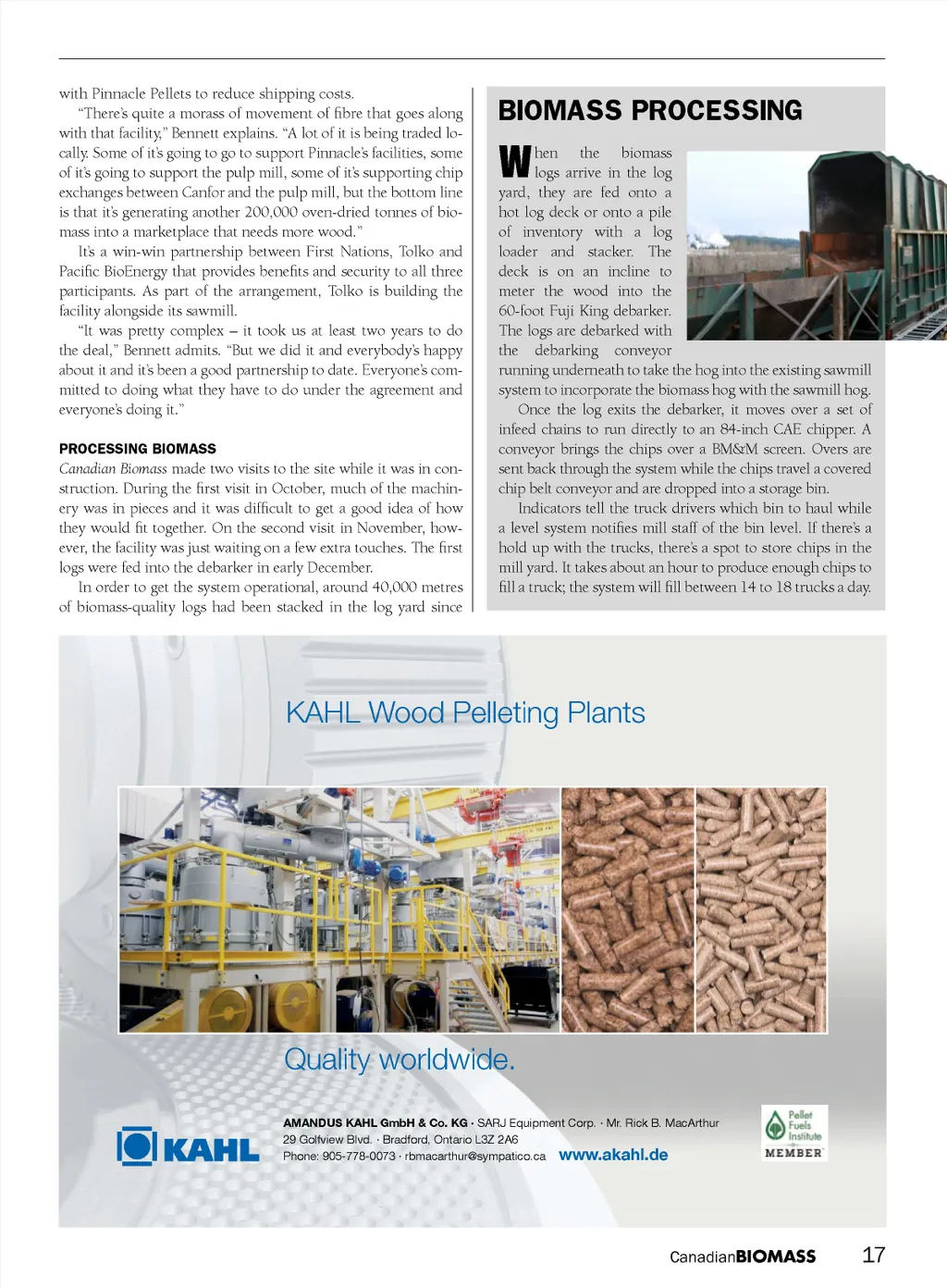
with Pinnacle Pellets to reduce shipping costs. “There’s quite a morass of movement of fibre that goes along with that facility,” Bennett explains. “A lot of it is being traded lo-cally. Some of it’s going to go to support Pinnacle’s facilities, some of it’s going to support the pulp mill, some of it’s supporting chip exchanges between Canfor and the pulp mill, but the bottom line is that it’s generating another 200,000 oven-dried tonnes of bio-mass into a marketplace that needs more wood.” It’s a win-win partnership between First Nations, Tolko and Pacific BioEnergy that provides benefits and security to all three participants. As part of the arrangement, Tolko is building the facility alongside its sawmill. “It was pretty complex – it took us at least two years to do the deal,” Bennett admits. “But we did it and everybody’s happy about it and it’s been a good partnership to date. Everyone’s com-mitted to doing what they have to do under the agreement and everyone’s doing it.” PROCESSING BIOMASS BIOMASS PROCESSING hen the biomass logs arrive in the log yard, they are fed onto a hot log deck or onto a pile of inventory with a log loader and stacker. The deck is on an incline to meter the wood into the 60-foot Fuji King debarker. The logs are debarked with the debarking conveyor running underneath to take the hog into the existing sawmill system to incorporate the biomass hog with the sawmill hog. Once the log exits the debarker, it moves over a set of infeed chains to run directly to an 84-inch CAE chipper. A conveyor brings the chips over a BM&M screen. Overs are sent back through the system while the chips travel a covered chip belt conveyor and are dropped into a storage bin. Indicators tell the truck drivers which bin to haul while a level system notifies mill staff of the bin level. If there’s a hold up with the trucks, there’s a spot to store chips in the mill yard. It takes about an hour to produce enough chips to fill a truck; the system will fill between 14 to 18 trucks a day. W Canadian Biomass made two visits to the site while it was in con-struction. During the first visit in October, much of the machin-ery was in pieces and it was difficult to get a good idea of how they would fit together. On the second visit in November, how-ever, the facility was just waiting on a few extra touches. The first logs were fed into the debarker in early December. In order to get the system operational, around 40,000 metres CanBiom0315-Kahl-2 21.11.14 10:15 Seite 1 of biomass-quality logs had been stacked in the log yard since KAHL Wood Pelleting Plants Quality worldwide. AMANDUS KAHL GmbH & Co. KG · SARJ Equipment Corp. · Mr. Rick B. MacArthur 29 Golfview Blvd. · Bradford, Ontario L3Z 2A6 Phone: 905-778-0073 · [email protected] www.akahl.de Canadian BIOMASS 17
Canadian Biomass March-April 2015: Page 17