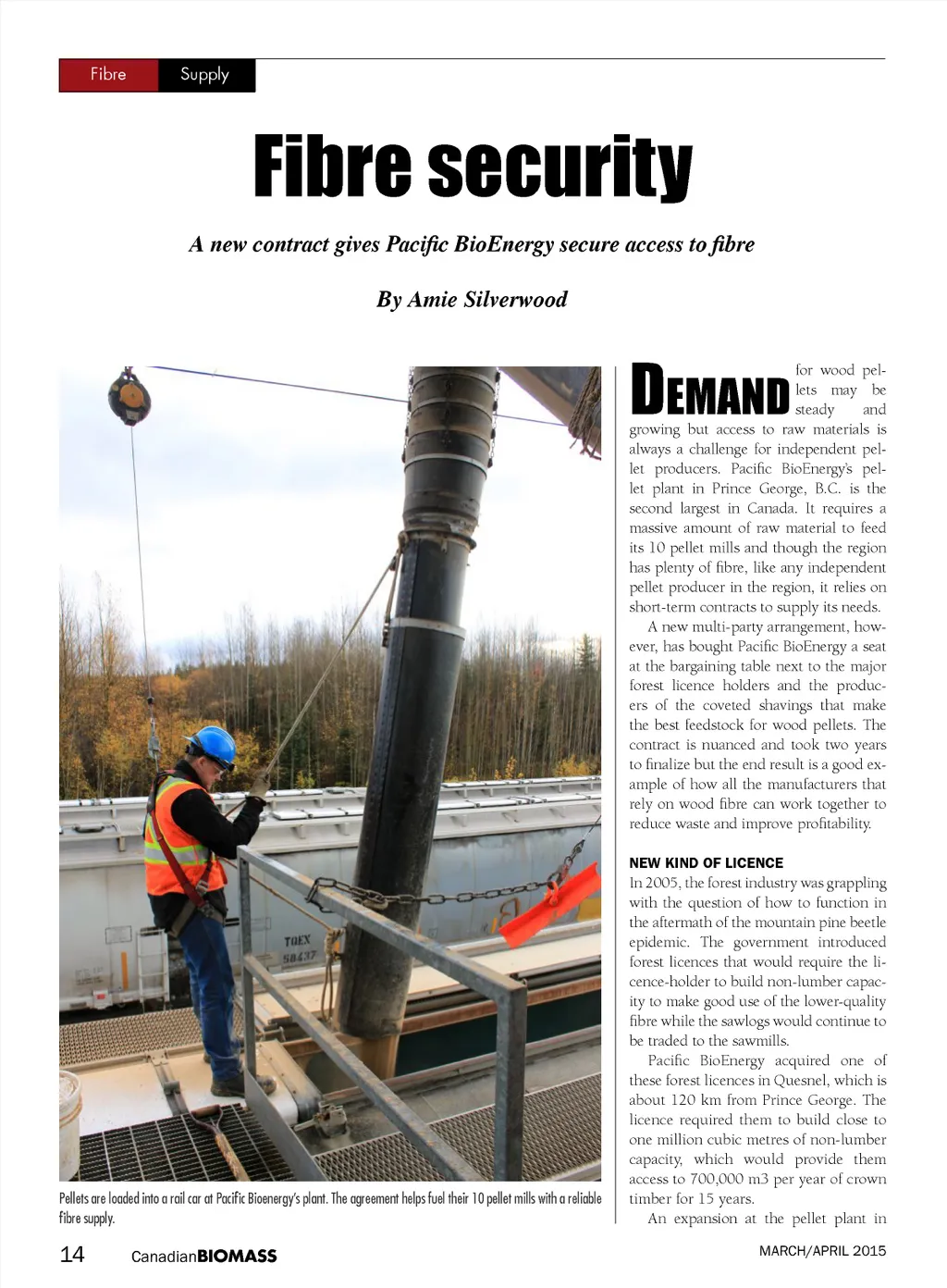
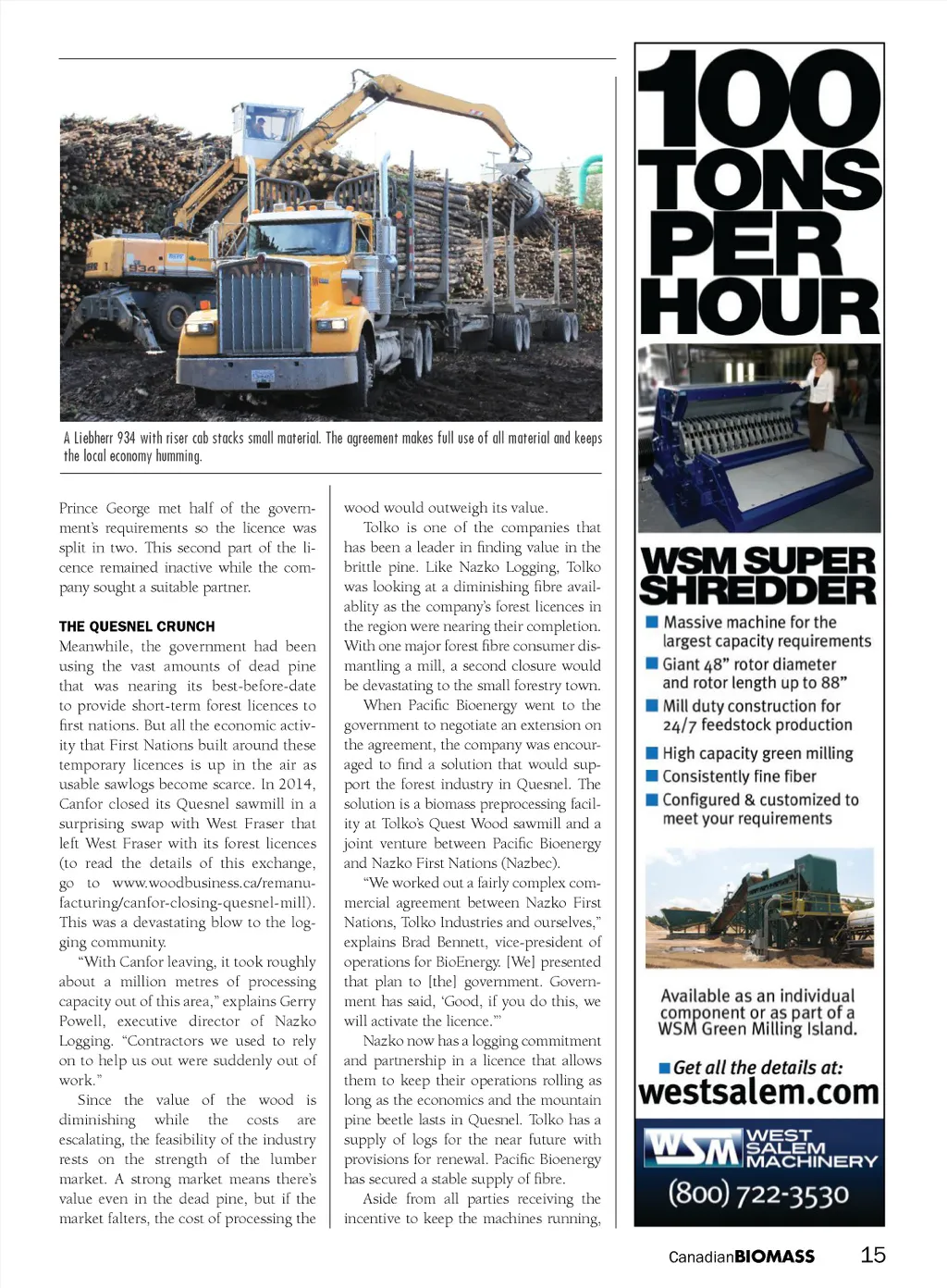
A Liebherr 934 with riser cab stacks small material. The agreement makes full use of all material and keeps the local economy humming. Prince George met half of the govern-ment’s requirements so the licence was split in two. This second part of the li-cence remained inactive while the com-pany sought a suitable partner. THE QUESNEL CRUNCH Meanwhile, the government had been using the vast amounts of dead pine that was nearing its best-before-date to provide short-term forest licences to first nations. But all the economic activ-ity that First Nations built around these temporary licences is up in the air as usable sawlogs become scarce. In 2014, Canfor closed its Quesnel sawmill in a surprising swap with West Fraser that left West Fraser with its forest licences (to read the details of this exchange, go to www.woodbusiness.ca/remanu-facturing/canfor-closing-quesnel-mill). This was a devastating blow to the log-ging community. “With Canfor leaving, it took roughly about a million metres of processing capacity out of this area,” explains Gerry Powell, executive director of Nazko Logging. “Contractors we used to rely on to help us out were suddenly out of work.” Since the value of the wood is diminishing while the costs are escalating, the feasibility of the industry rests on the strength of the lumber market. A strong market means there’s value even in the dead pine, but if the market falters, the cost of processing the wood would outweigh its value. Tolko is one of the companies that has been a leader in finding value in the brittle pine. Like Nazko Logging, Tolko was looking at a diminishing fibre avail-ablity as the company’s forest licences in the region were nearing their completion. With one major forest fibre consumer dis-mantling a mill, a second closure would be devastating to the small forestry town. When Pacific Bioenergy went to the government to negotiate an extension on the agreement, the company was encour-aged to find a solution that would sup-port the forest industry in Quesnel. The solution is a biomass preprocessing facil-ity at Tolko’s Quest Wood sawmill and a joint venture between Pacific Bioenergy and Nazko First Nations (Nazbec). “We worked out a fairly complex com-mercial agreement between Nazko First Nations, Tolko Industries and ourselves,” explains Brad Bennett, vice-president of operations for BioEnergy. [We] presented that plan to [the] government. Govern-ment has said, ‘Good, if you do this, we will activate the licence.”’ Nazko now has a logging commitment and partnership in a licence that allows them to keep their operations rolling as long as the economics and the mountain pine beetle lasts in Quesnel. Tolko has a supply of logs for the near future with provisions for renewal. Pacific Bioenergy has secured a stable supply of fibre. Aside from all parties receiving the incentive to keep the machines running, Canadian BIOMASS 15
Canadian Biomass March-April 2015: Page 15