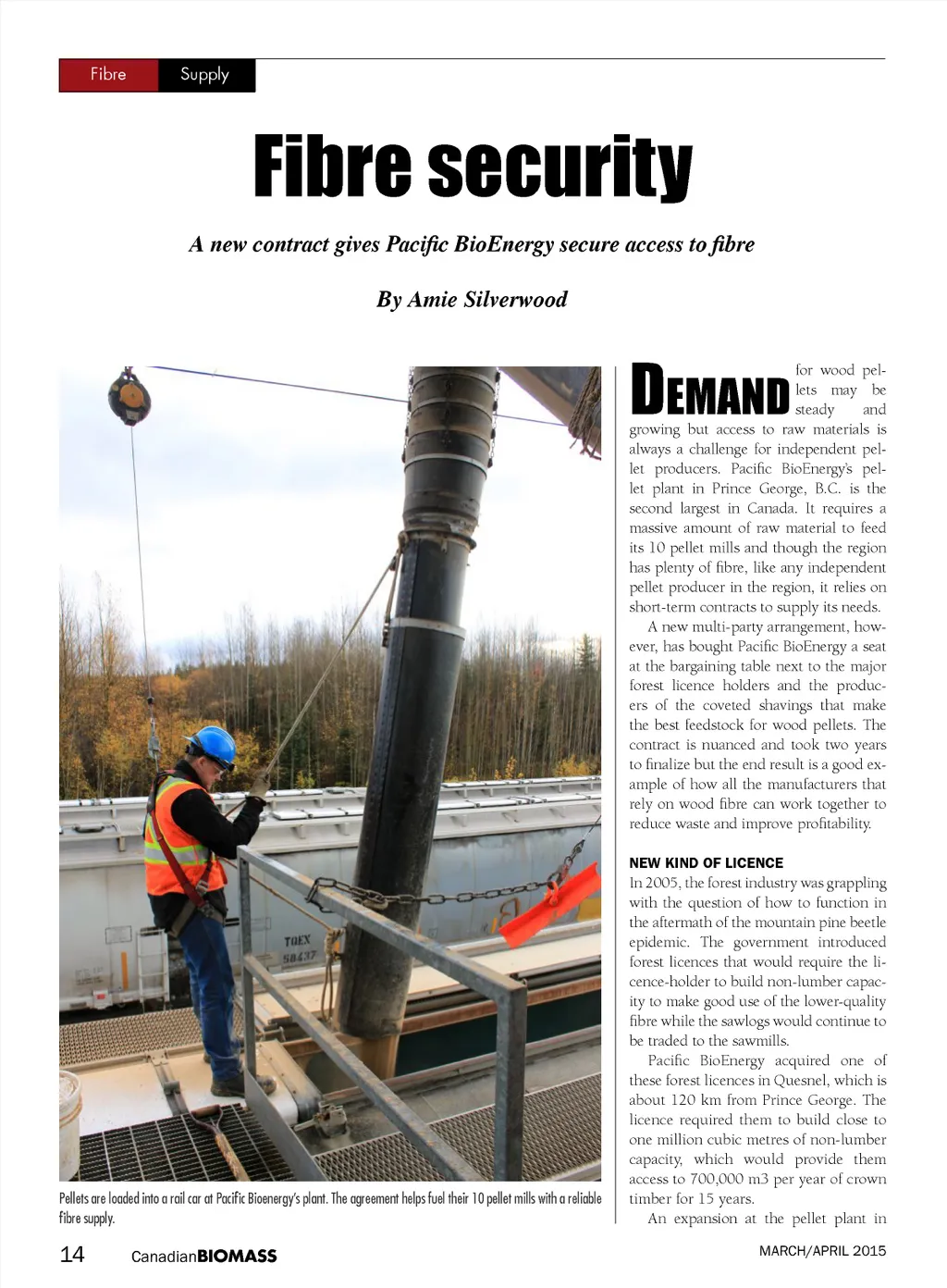
Fibre Supply Fibre security A new contract gives Pacific BioEnergy secure access to fibre By Amie Silverwood D emand for wood pel-lets may be steady and growing but access to raw materials is always a challenge for independent pel-let producers. Pacific BioEnergy’s pel-let plant in Prince George, B.C. is the second largest in Canada. It requires a massive amount of raw material to feed its 10 pellet mills and though the region has plenty of fibre, like any independent pellet producer in the region, it relies on short-term contracts to supply its needs. A new multi-party arrangement, how-ever, has bought Pacific BioEnergy a seat at the bargaining table next to the major forest licence holders and the produc-ers of the coveted shavings that make the best feedstock for wood pellets. The contract is nuanced and took two years to finalize but the end result is a good ex-ample of how all the manufacturers that rely on wood fibre can work together to reduce waste and improve profitability. NEW KIND OF LICENCE Pellets are loaded into a rail car at Pacific Bioenergy’s plant. The agreement helps fuel their 10 pellet mills with a reliable fibre supply. In 2005, the forest industry was grappling with the question of how to function in the aftermath of the mountain pine beetle epidemic. The government introduced forest licences that would require the li-cence-holder to build non-lumber capac-ity to make good use of the lower-quality fibre while the sawlogs would continue to be traded to the sawmills. Pacific BioEnergy acquired one of these forest licences in Quesnel, which is about 120 km from Prince George. The licence required them to build close to one million cubic metres of non-lumber capacity, which would provide them access to 700,000 m3 per year of crown timber for 15 years. An expansion at the pellet plant in MARCH/APRIL 2015 14 Canadian BIOMASS
Canadian Biomass March-April 2015: Page 14