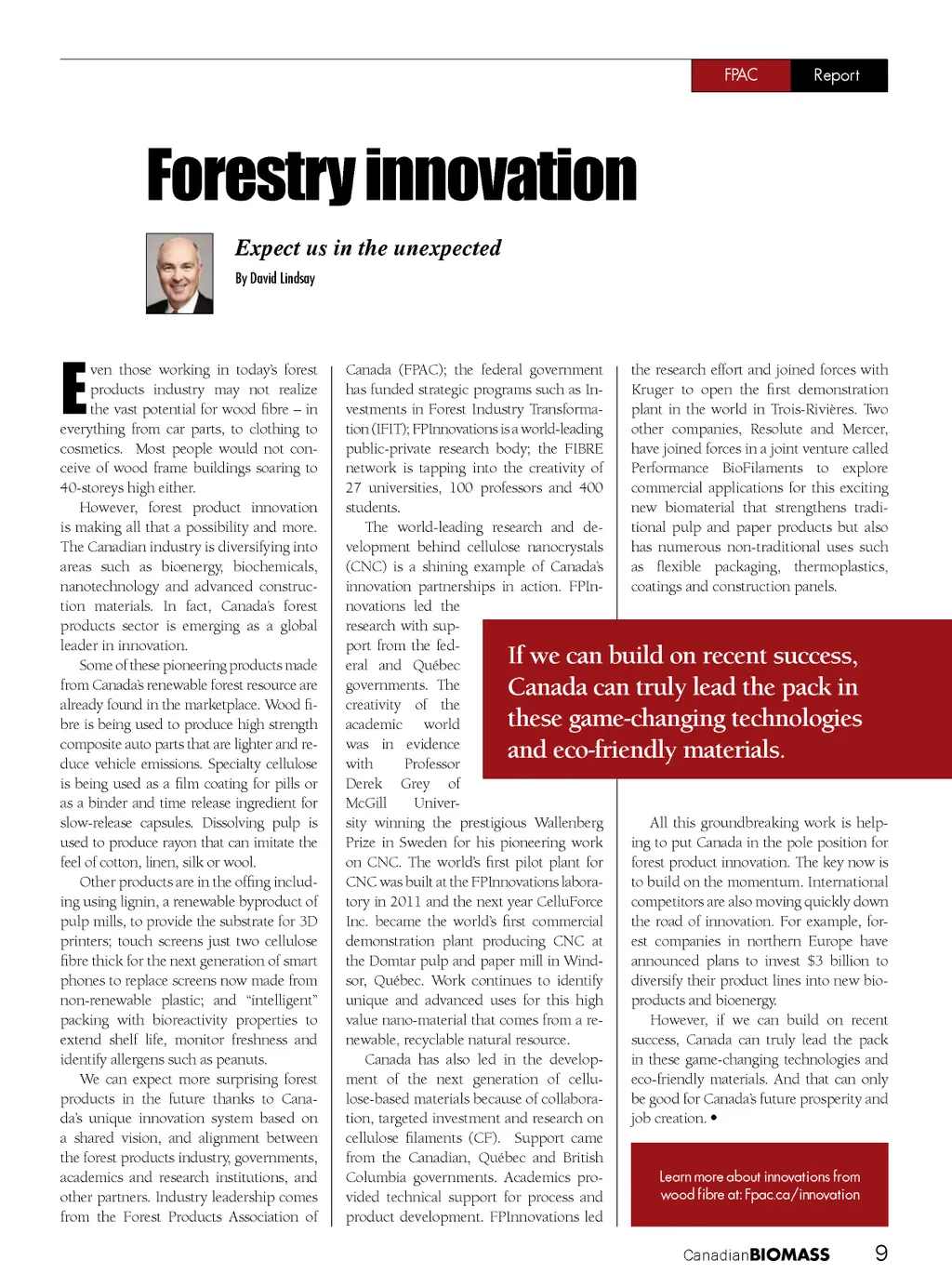
FPAC Report Forestry innovation Expect us in the unexpected By David Lindsay E ven those working in today’s forest products industry may not realize the vast potential for wood fibre – in everything from car parts, to clothing to cosmetics. Most people would not con-ceive of wood frame buildings soaring to 40-storeys high either. However, forest product innovation is making all that a possibility and more. The Canadian industry is diversifying into areas such as bioenergy, biochemicals, nanotechnology and advanced construc-tion materials. In fact, Canada’s forest products sector is emerging as a global leader in innovation. Some of these pioneering products made from Canada’s renewable forest resource are already found in the marketplace. Wood fi-bre is being used to produce high strength composite auto parts that are lighter and re-duce vehicle emissions. Specialty cellulose is being used as a film coating for pills or as a binder and time release ingredient for slow-release capsules. Dissolving pulp is used to produce rayon that can imitate the feel of cotton, linen, silk or wool. Other products are in the offing includ-ing using lignin, a renewable byproduct of pulp mills, to provide the substrate for 3D printers; touch screens just two cellulose fibre thick for the next generation of smart phones to replace screens now made from non-renewable plastic; and “intelligent” packing with bioreactivity properties to extend shelf life, monitor freshness and identify allergens such as peanuts. We can expect more surprising forest products in the future thanks to Cana-da’s unique innovation system based on a shared vision, and alignment between the forest products industry, governments, academics and research institutions, and other partners. Industry leadership comes from the Forest Products Association of Canada (FPAC); the federal government has funded strategic programs such as In-vestments in Forest Industry Transforma-tion (IFIT); FPInnovations is a world-leading public-private research body; the FIBRE network is tapping into the creativity of 27 universities, 100 professors and 400 students. The world-leading research and de-velopment behind cellulose nanocrystals (CNC) is a shining example of Canada’s innovation partnerships in action. FPIn-novations led the research with sup-port from the fed-eral and Québec governments. The creativity of the academic world was in evidence with Professor Derek Grey of McGill Univer-sity winning the prestigious Wallenberg Prize in Sweden for his pioneering work on CNC. The world’s first pilot plant for CNC was built at the FPInnovations labora-tory in 2011 and the next year CelluForce Inc. became the world’s first commercial demonstration plant producing CNC at the Domtar pulp and paper mill in Wind-sor, Québec. Work continues to identify unique and advanced uses for this high value nano-material that comes from a re-newable, recyclable natural resource. Canada has also led in the develop-ment of the next generation of cellu-lose-based materials because of collabora-tion, targeted investment and research on cellulose filaments (CF). Support came from the Canadian, Québec and British Columbia governments. Academics pro-vided technical support for process and product development. FPInnovations led the research effort and joined forces with Kruger to open the first demonstration plant in the world in Trois-Rivières. Two other companies, Resolute and Mercer, have joined forces in a joint venture called Performance BioFilaments to explore commercial applications for this exciting new biomaterial that strengthens tradi-tional pulp and paper products but also has numerous non-traditional uses such as flexible packaging, thermoplastics, coatings and construction panels. If we can build on recent success, Canada can truly lead the pack in these game-changing technologies and eco-friendly materials. All this groundbreaking work is help-ing to put Canada in the pole position for forest product innovation. The key now is to build on the momentum. International competitors are also moving quickly down the road of innovation. For example, for-est companies in northern Europe have announced plans to invest $3 billion to diversify their product lines into new bio-products and bioenergy. However, if we can build on recent success, Canada can truly lead the pack in these game-changing technologies and eco-friendly materials. And that can only be good for Canada’s future prosperity and job creation. • Learn more about innovations from wood fibre at: Fpac.ca/innovation Canadian BIOMASS 9
Canadian Biomass January-February 2015: Page 9