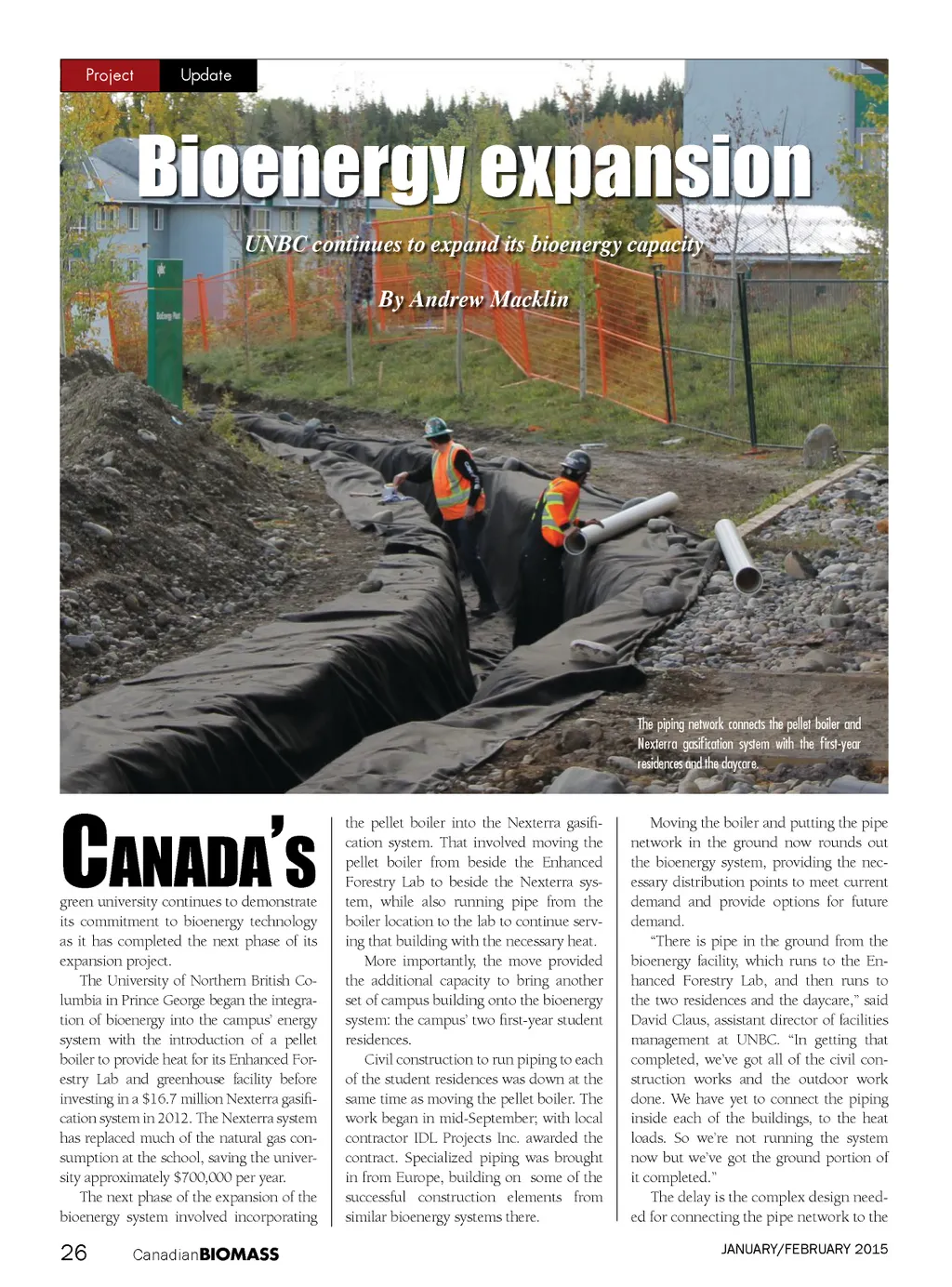
Your global equipment supplier for the biomass industry The foundation for the pellet boiler next to the Nexterra system. The roof of its former location, at the Enhanced Forestry Lab, can be seen in the background. existing natural gas heating systems in place in each of the residences. That design is ex-pected to be done shortly, which will allow the work to go out for tender. The hope is that the work can be done in the spring, but renovations planned for each of the residences following this school year could delay the work until the summer. FUTURE EXPANSION EDUCATION FIRST By moving the boiler, and running the pipe network to the residences, the bio-energy system is in a position to facilitate future expansion. Claus admits that there are few buildings to currently expand the network, but it does open up energy supply for expansion opportunities that the campus could be considering. Two things discussed at length in the university community are the potential for adding upper-year residences, as well as buildings to house food production that could help make the area more self-sustainable. Claus recognizes that more heat could also be captured through the Nexterra sys-tem. The flue gas from the system is not condensed, causing a lot of heat to come off of it. There is energy in the hot water vapour that is not being utilized and, by condensing the flue gas, additional heat can be recovered without burning any more fuel. “That is what, on the supply side, I would like to see as the next step,” said Claus. “It looks like we could probably boost the output by about 10 per cent by doing that.” There has always been an educational com-ponent to the bioenergy system at UNBC. The Nexterra system provided an example of a small-scale biomass heating system that could be used in remote communities throughout northern B.C., and the current expansion will provide information on how to expand the system to surrounding build-ings that may need to be brought online. Now the university is in development of a video series that will help teach re-mote communities about district heating. Grad student Titi Kunkel is helping to pro-duce the videos while travelling to remote communities, particularly First Nations communities, to provide an understand-ing of the benefits of district heating using biomass. She has already brought leaders from a few remote First Nations commu-nities to UNBC to show them how the bio-energy system works, and to teach them about how the system could work in their respective communities based on the ex-isting wood waste supply in the area. The videos, now in production, will be an educational tool for providing an over-view of community heat using biomass. Once those videos are released, Kunkel and her colleagues hope that they will be distributed beyond the current campus’ reach in B.C. to interested communities for nationally and internationally. That will help the university’s contin-ued push as Canada’s green university, and become a model for community bioenergy systems across Canada. • ANDRITZ is one of the world’s leading suppliers of techno logies, systems, and services re lating to equipment for the bio mass pelleting industry. We offer single machines for the production of solid and liquid biofuel and waste pellets. We have the abili ty to manu-facture and supply each and every key processing machine in the pel-let production line. ANDRITZ Feed & Biofuel A/S Europe, Asia, and South America: [email protected] USA and Canada: [email protected] www.andritz.com Canadian BIOMASS 27
Canadian Biomass January-February 2015: Page 27