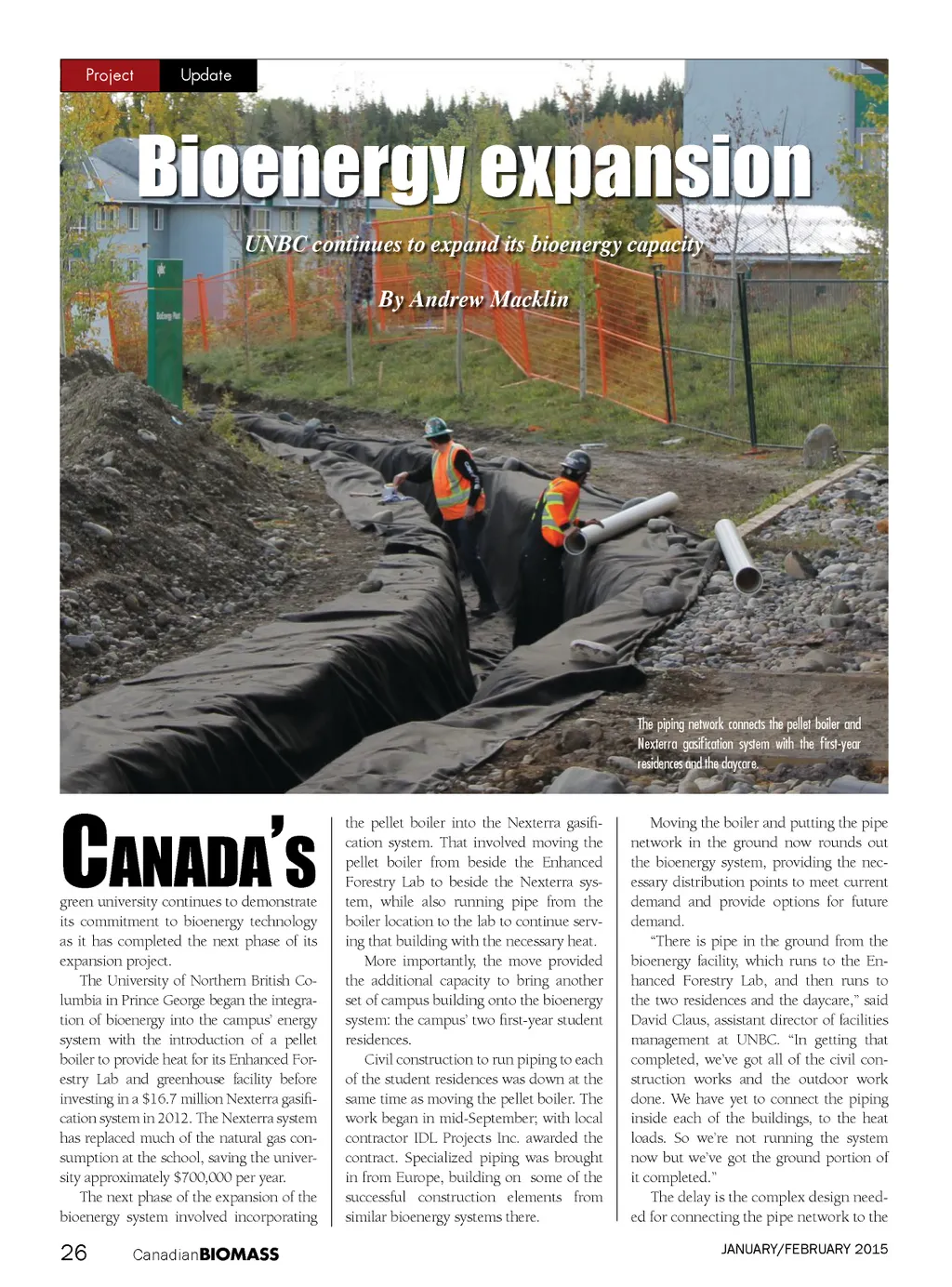
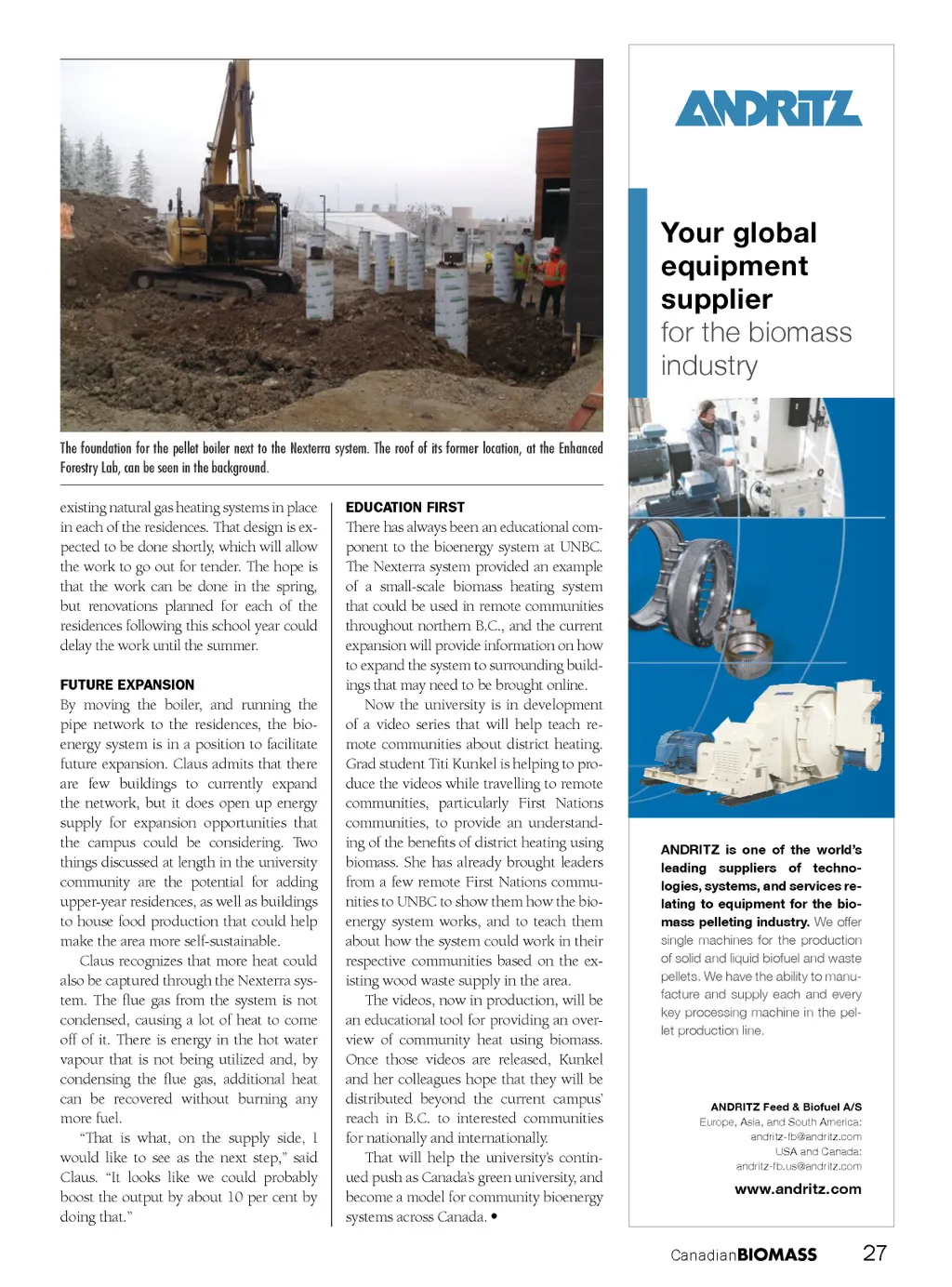
Project Update Bioenergy expansion UNBC continues to expand its bioenergy capacity By Andrew Macklin The piping network connects the pellet boiler and Nexterra gasification system with the first-year residences and the daycare. C anaDa ’ s green university continues to demonstrate its commitment to bioenergy technology as it has completed the next phase of its expansion project. The University of Northern British Co-lumbia in Prince George began the integra-tion of bioenergy into the campus’ energy system with the introduction of a pellet boiler to provide heat for its Enhanced For-estry Lab and greenhouse facility before investing in a $16.7 million Nexterra gasifi-cation system in 2012. The Nexterra system has replaced much of the natural gas con-sumption at the school, saving the univer-sity approximately $700,000 per year. The next phase of the expansion of the bioenergy system involved incorporating the pellet boiler into the Nexterra gasifi-cation system. That involved moving the pellet boiler from beside the Enhanced Forestry Lab to beside the Nexterra sys-tem, while also running pipe from the boiler location to the lab to continue serv-ing that building with the necessary heat. More importantly, the move provided the additional capacity to bring another set of campus building onto the bioenergy system: the campus’ two first-year student residences. Civil construction to run piping to each of the student residences was down at the same time as moving the pellet boiler. The work began in mid-September; with local contractor IDL Projects Inc. awarded the contract. Specialized piping was brought in from Europe, building on some of the successful construction elements from similar bioenergy systems there. Moving the boiler and putting the pipe network in the ground now rounds out the bioenergy system, providing the nec-essary distribution points to meet current demand and provide options for future demand. “There is pipe in the ground from the bioenergy facility, which runs to the En-hanced Forestry Lab, and then runs to the two residences and the daycare,” said David Claus, assistant director of facilities management at UNBC. “In getting that completed, we’ve got all of the civil con-struction works and the outdoor work done. We have yet to connect the piping inside each of the buildings, to the heat loads. So we’re not running the system now but we’ve got the ground portion of it completed.” The delay is the complex design need-ed for connecting the pipe network to the JANUARY/FEBRUARY 2015 26 Canadian BIOMASS
Canadian Biomass January-February 2015: Page 26