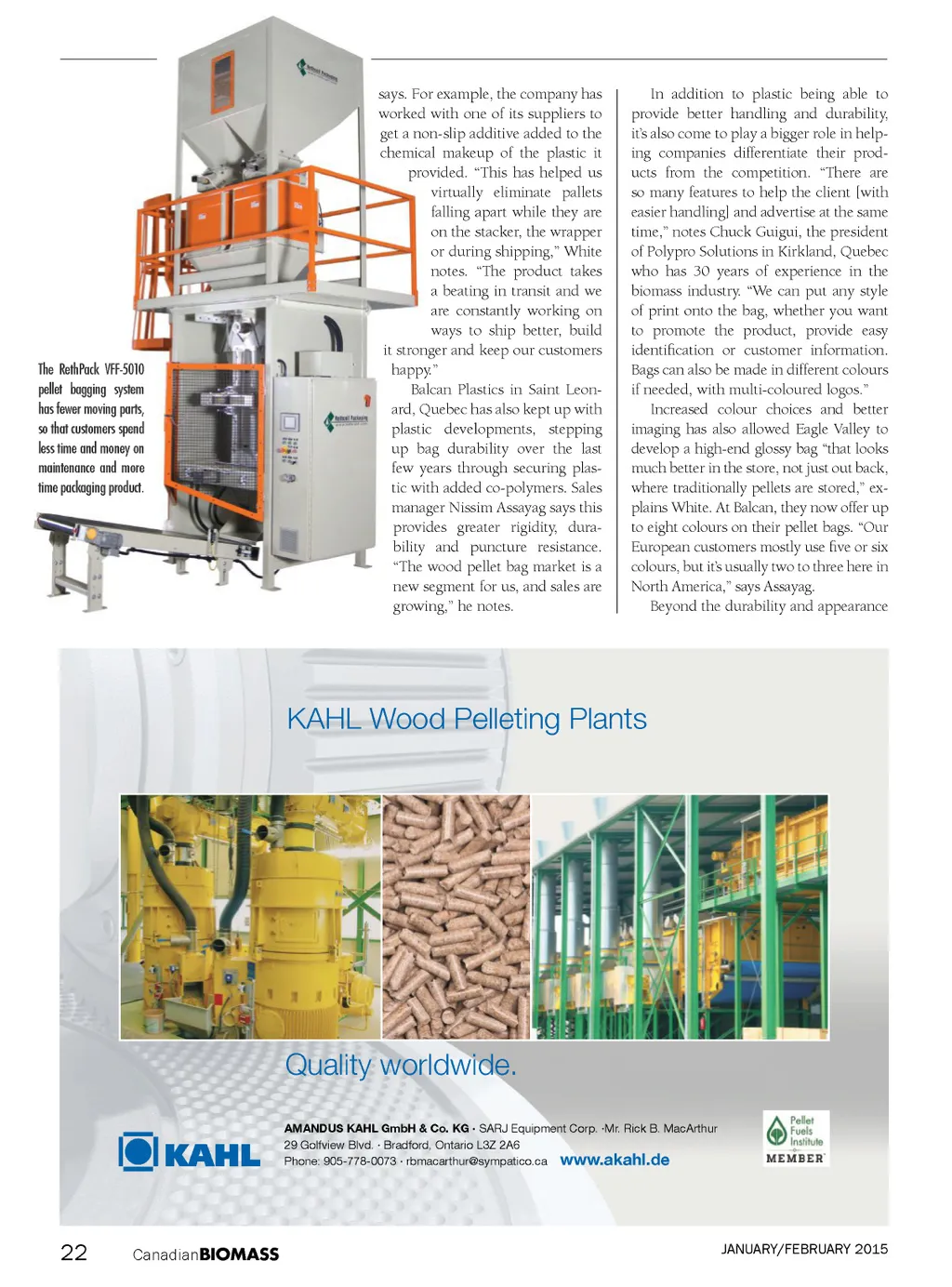
changes, pellet bags today also offer easier handling for end-use customers. A wider range in sizes, especially for the cooking appliance market, is the biggest pellet bag change that Rethceif Packaging of Ossian, Indiana has seen in the recent past. “Our machines allow for quick changeovers and accommodate a wide range of sizes,” says sales manager Jeremy Collins. “It is no longer just a standard bag which serves for every industry,” agrees Guigui at Polypro. “Bags are made to measure for each individual client, tai-lored to what would work the best for the machines they have at hand.” In the last few years, Balcan has gone to offering two pellet bag sizes, 15 kg and 18 kg, with the smaller ones going mostly into the Euro-pean market according to Assayag. In addition to different sizes, other features have been added to bags to make handling safer and easier. “Spout top, spout bottom, duffel top, flat bottom, different-sized lifting loops – the vari-ety of bag you can get goes on and on,” Guigui explains. He adds that pellet bags can now come in a baffled format, so that they don’t bulge out and can easily fit into containers. Another option available these days is a liner that can be sewn di-rectly into the bag so moisture can’t pen-etrate and ruin the product. “There are also UV stabilizers, so the bags can stay in the sunlight without deteriorating, los-ing valuable product and avoiding costly claims,” Guigui notes. “Bags can be coated as well for extra protection against the elements.” BAGGING PROCESS When Eagle Valley decided to get involved in bagging, staff spent time researching options. “Hamer was our choice then and if we were to start again we would stay with Hamer,” White says. “The machin-ery is durable, the maintenance is doable and affordable, and the technical support is fantastic.” Rethceif is a bagging machine maker, and now offers two models of vertical free-flow machines with capacities rang-ing from 14 to 24 tons per hour. Their baggers are designed to remove all un-necessary movement, which Collins says has proven to be a robust and long-lasting approach. “With fewer moving parts, our customers spend less time and money on maintenance and more time packaging product,” he explains.” Of all the things he’s noticed over the last few years having to do with pellet bagging, handling and transport, Collins notes that automated palletizing has be-come a significant priority among Reth-ceif customers, and the company has taken action to meet these needs. “We are a Kawasaki robot integrator and offer a full range of palletizing solutions,” he notes. “We also build our own conveyors and pallet dispensers, which allows us to control the quality. For transportation and storage, a stable stack with a com-plete moisture barrier is a must.” Whether you have been using the same bags for a year or a decade, it might be worth looking at how they could be up-dated in order to boost sales. Customers appreciate packaging that meets their needs and is easy to use, and the invest-ment you make in research time and new bag features may well be worth the effort. • 866-746-8385 | [email protected] #IBCE15 -Follow Us: twitter.com/biomassmagazine BBI biomaass janfeb15.indd 1 2015-01-30 Canadian BIOMASS 11:30 AM 23
Canadian Biomass January-February 2015: Page 23