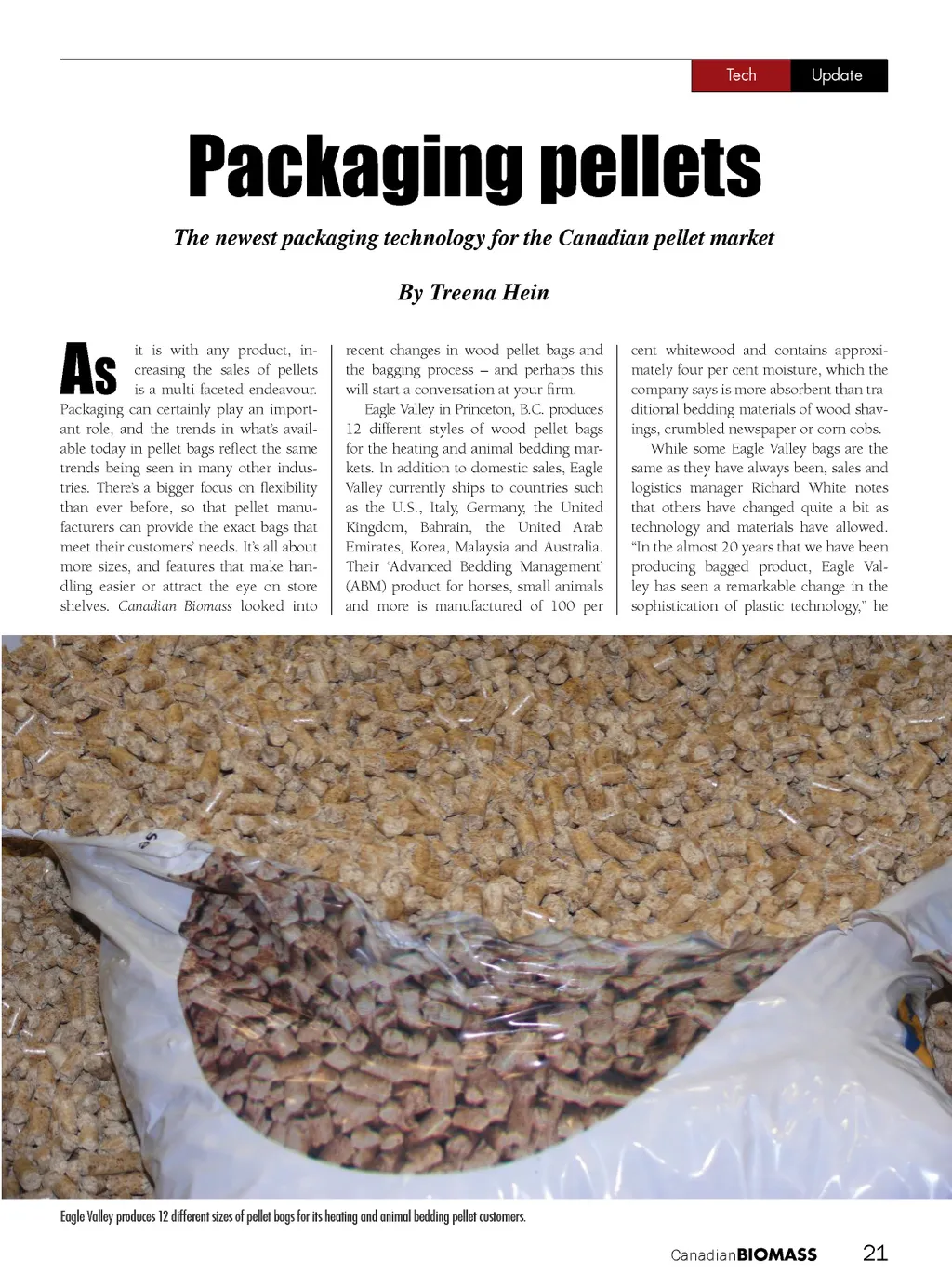
Tech Update Packaging pellets The newest packaging technology for the Canadian pellet market By Treena Hein a s it is with any product, in-creasing the sales of pellets is a multi-faceted endeavour. Packaging can certainly play an import-ant role, and the trends in what’s avail-able today in pellet bags reflect the same trends being seen in many other indus-tries. There’s a bigger focus on flexibility than ever before, so that pellet manu-facturers can provide the exact bags that meet their customers’ needs. It’s all about more sizes, and features that make han-dling easier or attract the eye on store shelves. Canadian Biomass looked into recent changes in wood pellet bags and the bagging process – and perhaps this will start a conversation at your firm. Eagle Valley in Princeton, B.C. produces 12 different styles of wood pellet bags for the heating and animal bedding mar-kets. In addition to domestic sales, Eagle Valley currently ships to countries such as the U.S., Italy, Germany, the United Kingdom, Bahrain, the United Arab Emirates, Korea, Malaysia and Australia. Their ‘Advanced Bedding Management’ (ABM) product for horses, small animals and more is manufactured of 100 per cent whitewood and contains approxi-mately four per cent moisture, which the company says is more absorbent than tra-ditional bedding materials of wood shav-ings, crumbled newspaper or corn cobs. While some Eagle Valley bags are the same as they have always been, sales and logistics manager Richard White notes that others have changed quite a bit as technology and materials have allowed. “In the almost 20 years that we have been producing bagged product, Eagle Val-ley has seen a remarkable change in the sophistication of plastic technology,” he Eagle Valley produces 12 different sizes of pellet bags for its heating and animal bedding pellet customers. Canadian BIOMASS 21
Canadian Biomass January-February 2015: Page 21