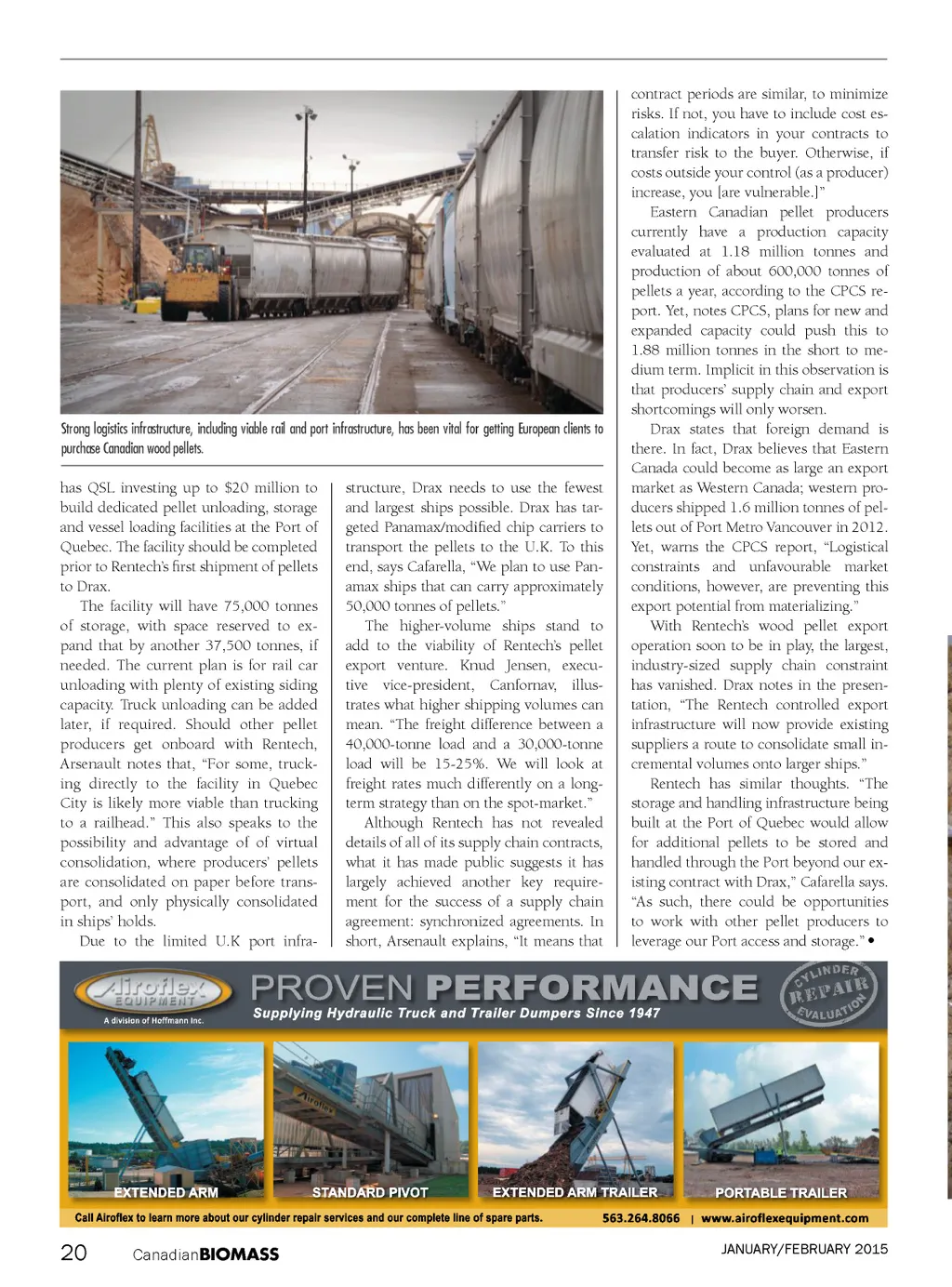
Strong logistics infrastructure, including viable rail and port infrastructure, has been vital for getting European clients to purchase Canadian wood pellets. has QSL investing up to $20 million to build dedicated pellet unloading, storage and vessel loading facilities at the Port of Quebec. The facility should be completed prior to Rentech’s first shipment of pellets to Drax. The facility will have 75,000 tonnes of storage, with space reserved to ex-pand that by another 37,500 tonnes, if needed. The current plan is for rail car unloading with plenty of existing siding capacity. Truck unloading can be added later, if required. Should other pellet producers get onboard with Rentech, Arsenault notes that, “For some, truck-ing directly to the facility in Quebec City is likely more viable than trucking to a railhead.” This also speaks to the possibility and advantage of of virtual consolidation, where producers’ pellets are consolidated on paper before trans-port, and only physically consolidated in ships’ holds. Due to the limited U.K port infra-structure, Drax needs to use the fewest and largest ships possible. Drax has tar-geted Panamax/modified chip carriers to transport the pellets to the U.K. To this end, says Cafarella, “We plan to use Pan-amax ships that can carry approximately 50,000 tonnes of pellets.” The higher-volume ships stand to add to the viability of Rentech’s pellet export venture. Knud Jensen, execu-tive vice-president, Canfornav, illus-trates what higher shipping volumes can mean. “The freight difference between a 40,000-tonne load and a 30,000-tonne load will be 15-25%. We will look at freight rates much differently on a long-term strategy than on the spot-market.” Although Rentech has not revealed details of all of its supply chain contracts, what it has made public suggests it has largely achieved another key require-ment for the success of a supply chain agreement: synchronized agreements. In short, Arsenault explains, “It means that contract periods are similar, to minimize risks. If not, you have to include cost es-calation indicators in your contracts to transfer risk to the buyer. Otherwise, if costs outside your control (as a producer) increase, you [are vulnerable.]” Eastern Canadian pellet producers currently have a production capacity evaluated at 1.18 million tonnes and production of about 600,000 tonnes of pellets a year, according to the CPCS re-port. Yet, notes CPCS, plans for new and expanded capacity could push this to 1.88 million tonnes in the short to me-dium term. Implicit in this observation is that producers’ supply chain and export shortcomings will only worsen. Drax states that foreign demand is there. In fact, Drax believes that Eastern Canada could become as large an export market as Western Canada; western pro-ducers shipped 1.6 million tonnes of pel-lets out of Port Metro Vancouver in 2012. Yet, warns the CPCS report, “Logistical constraints and unfavourable market conditions, however, are preventing this export potential from materializing.” With Rentech’s wood pellet export operation soon to be in play, the largest, industry-sized supply chain constraint has vanished. Drax notes in the presen-tation, “The Rentech controlled export infrastructure will now provide existing suppliers a route to consolidate small in-cremental volumes onto larger ships.” Rentech has similar thoughts. “The storage and handling infrastructure being built at the Port of Quebec would allow for additional pellets to be stored and handled through the Port beyond our ex-isting contract with Drax,” Cafarella says. “As such, there could be opportunities to work with other pellet producers to leverage our Port access and storage.” • 20 Canadian BIOMASS JANUARY/FEBRUARY 2015
Canadian Biomass January-February 2015: Page 20