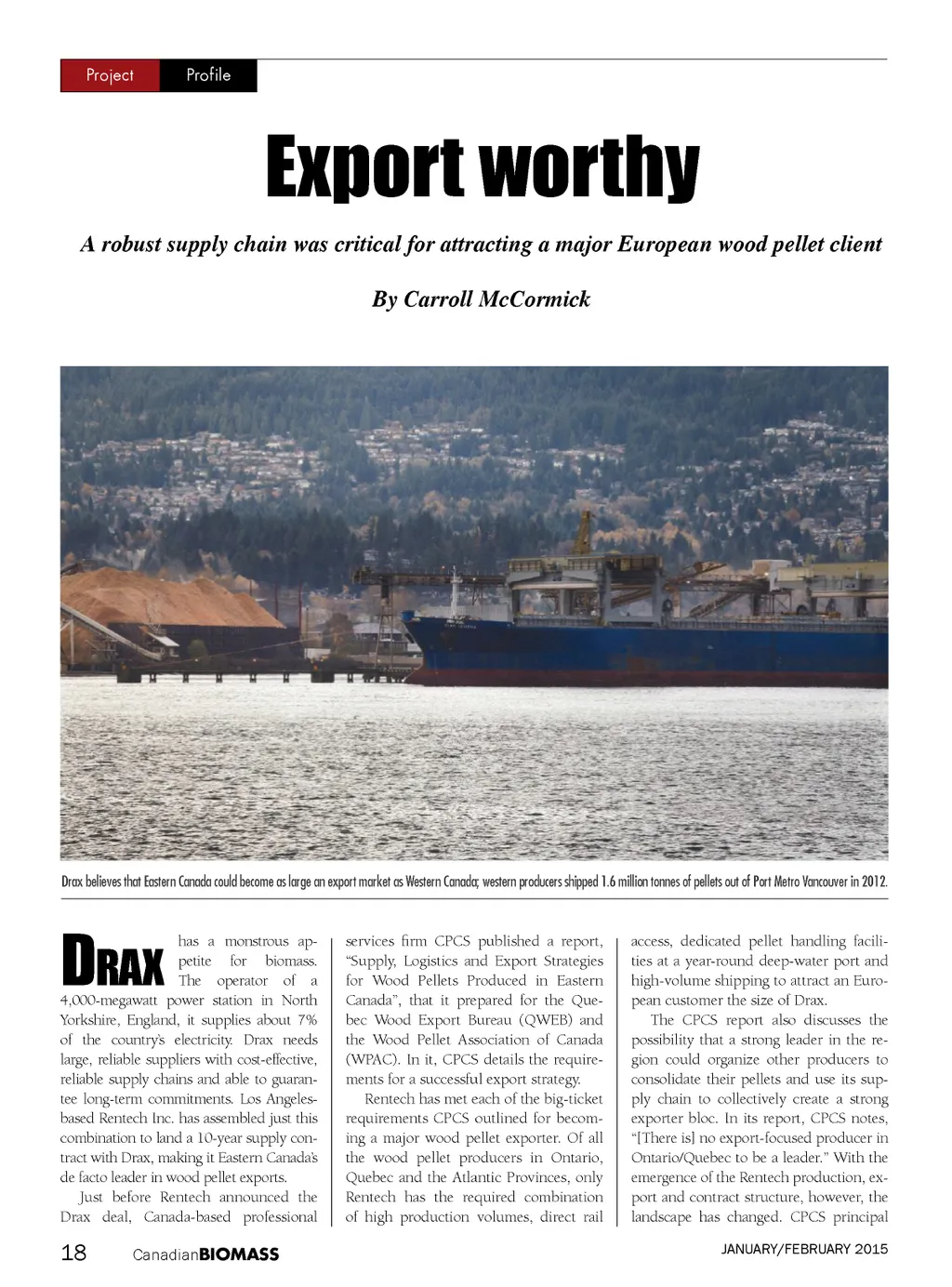
Project Profile Export worthy A robust supply chain was critical for attracting a major European wood pellet client By Carroll McCormick Drax believes that Eastern Canada could become as large an export market as Western Canada; western producers shipped 1.6 million tonnes of pellets out of Port Metro Vancouver in 2012. D rax has a monstrous ap-petite for biomass. The operator of a 4,000-megawatt power station in North Yorkshire, England, it supplies about 7% of the country’s electricity. Drax needs large, reliable suppliers with cost-effective, reliable supply chains and able to guaran-tee long-term commitments. Los Angeles-based Rentech Inc. has assembled just this combination to land a 10-year supply con-tract with Drax, making it Eastern Canada’s de facto leader in wood pellet exports. Just before Rentech announced the Drax deal, Canada-based professional services firm CPCS published a report, “Supply, Logistics and Export Strategies for Wood Pellets Produced in Eastern Canada”, that it prepared for the Que-bec Wood Export Bureau (QWEB) and the Wood Pellet Association of Canada (WPAC). In it, CPCS details the require-ments for a successful export strategy. Rentech has met each of the big-ticket requirements CPCS outlined for becom-ing a major wood pellet exporter. Of all the wood pellet producers in Ontario, Quebec and the Atlantic Provinces, only Rentech has the required combination of high production volumes, direct rail access, dedicated pellet handling facili-ties at a year-round deep-water port and high-volume shipping to attract an Euro-pean customer the size of Drax. The CPCS report also discusses the possibility that a strong leader in the re-gion could organize other producers to consolidate their pellets and use its sup-ply chain to collectively create a strong exporter bloc. In its report, CPCS notes, “[There is] no export-focused producer in Ontario/Quebec to be a leader.” With the emergence of the Rentech production, ex-port and contract structure, however, the landscape has changed. CPCS principal JANUARY/FEBRUARY 2015 18 Canadian BIOMASS
Canadian Biomass January-February 2015: Page 18