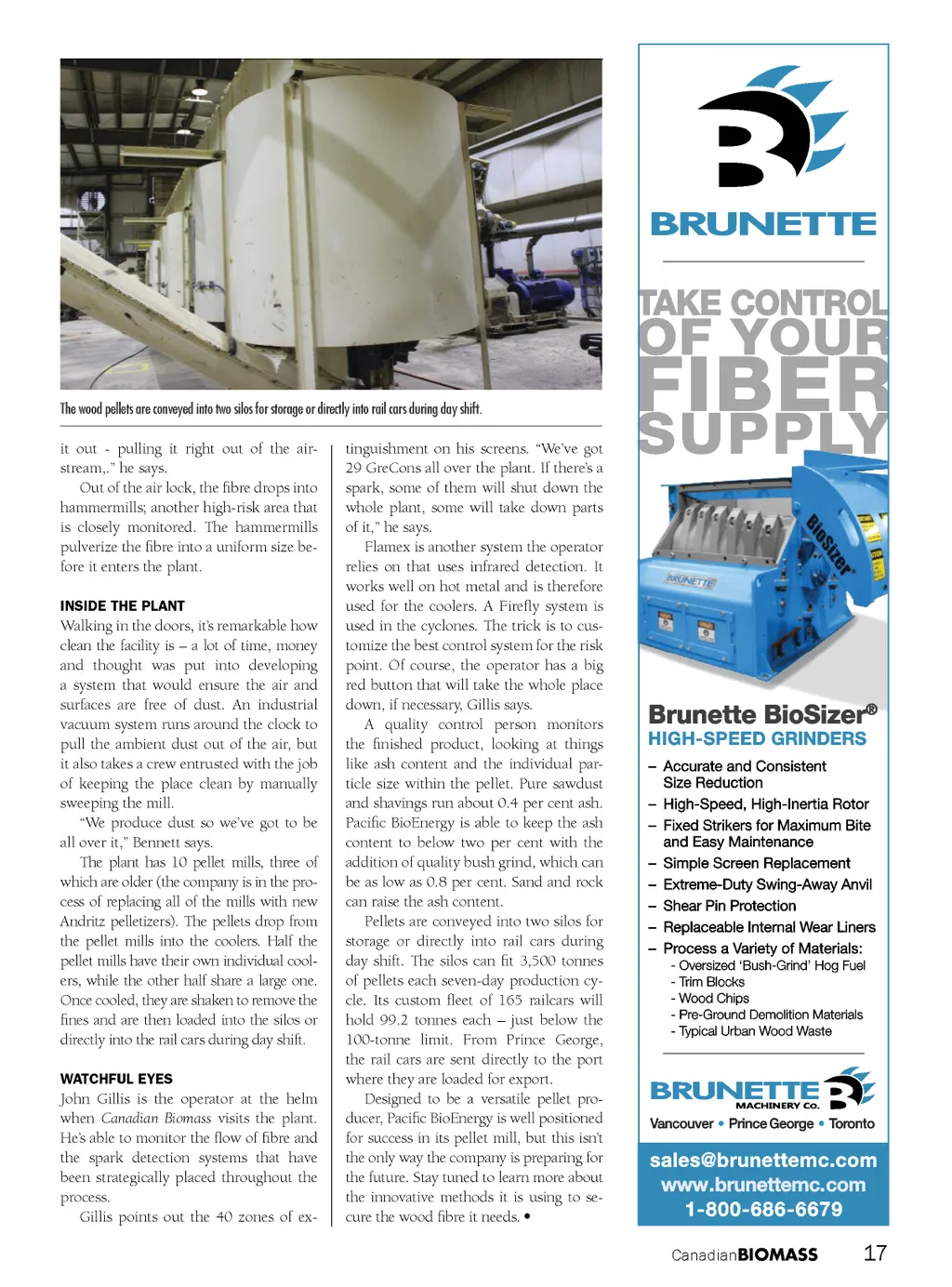
The wood pellets are conveyed into two silos for storage or directly into rail cars during day shift. it out -pulling it right out of the air-stream,.” he says. Out of the air lock, the fibre drops into hammermills; another high-risk area that is closely monitored. The hammermills pulverize the fibre into a uniform size be-fore it enters the plant. INSIDE THE PLANT Walking in the doors, it’s remarkable how clean the facility is – a lot of time, money and thought was put into developing a system that would ensure the air and surfaces are free of dust. An industrial vacuum system runs around the clock to pull the ambient dust out of the air, but it also takes a crew entrusted with the job of keeping the place clean by manually sweeping the mill. “We produce dust so we’ve got to be all over it,” Bennett says. The plant has 10 pellet mills, three of which are older (the company is in the pro-cess of replacing all of the mills with new Andritz pelletizers). The pellets drop from the pellet mills into the coolers. Half the pellet mills have their own individual cool-ers, while the other half share a large one. Once cooled, they are shaken to remove the fines and are then loaded into the silos or directly into the rail cars during day shift. WATCHFUL EYES John Gillis is the operator at the helm when Canadian Biomass visits the plant. He’s able to monitor the flow of fibre and the spark detection systems that have been strategically placed throughout the process. Gillis points out the 40 zones of ex-tinguishment on his screens. “We’ve got 29 GreCons all over the plant. If there’s a spark, some of them will shut down the whole plant, some will take down parts of it,” he says. Flamex is another system the operator relies on that uses infrared detection. It works well on hot metal and is therefore used for the coolers. A Firefly system is used in the cyclones. The trick is to cus-tomize the best control system for the risk point. Of course, the operator has a big red button that will take the whole place down, if necessary, Gillis says. A quality control person monitors the finished product, looking at things like ash content and the individual par-ticle size within the pellet. Pure sawdust and shavings run about 0.4 per cent ash. Pacific BioEnergy is able to keep the ash content to below two per cent with the addition of quality bush grind, which can be as low as 0.8 per cent. Sand and rock can raise the ash content. Pellets are conveyed into two silos for storage or directly into rail cars during day shift. The silos can fit 3,500 tonnes of pellets each seven-day production cy-cle. Its custom fleet of 165 railcars will hold 99.2 tonnes each – just below the 100-tonne limit. From Prince George, the rail cars are sent directly to the port where they are loaded for export. Designed to be a versatile pellet pro-ducer, Pacific BioEnergy is well positioned for success in its pellet mill, but this isn’t the only way the company is preparing for the future. Stay tuned to learn more about the innovative methods it is using to se-cure the wood fibre it needs. • Canadian BIOMASS 17
Canadian Biomass January-February 2015: Page 17