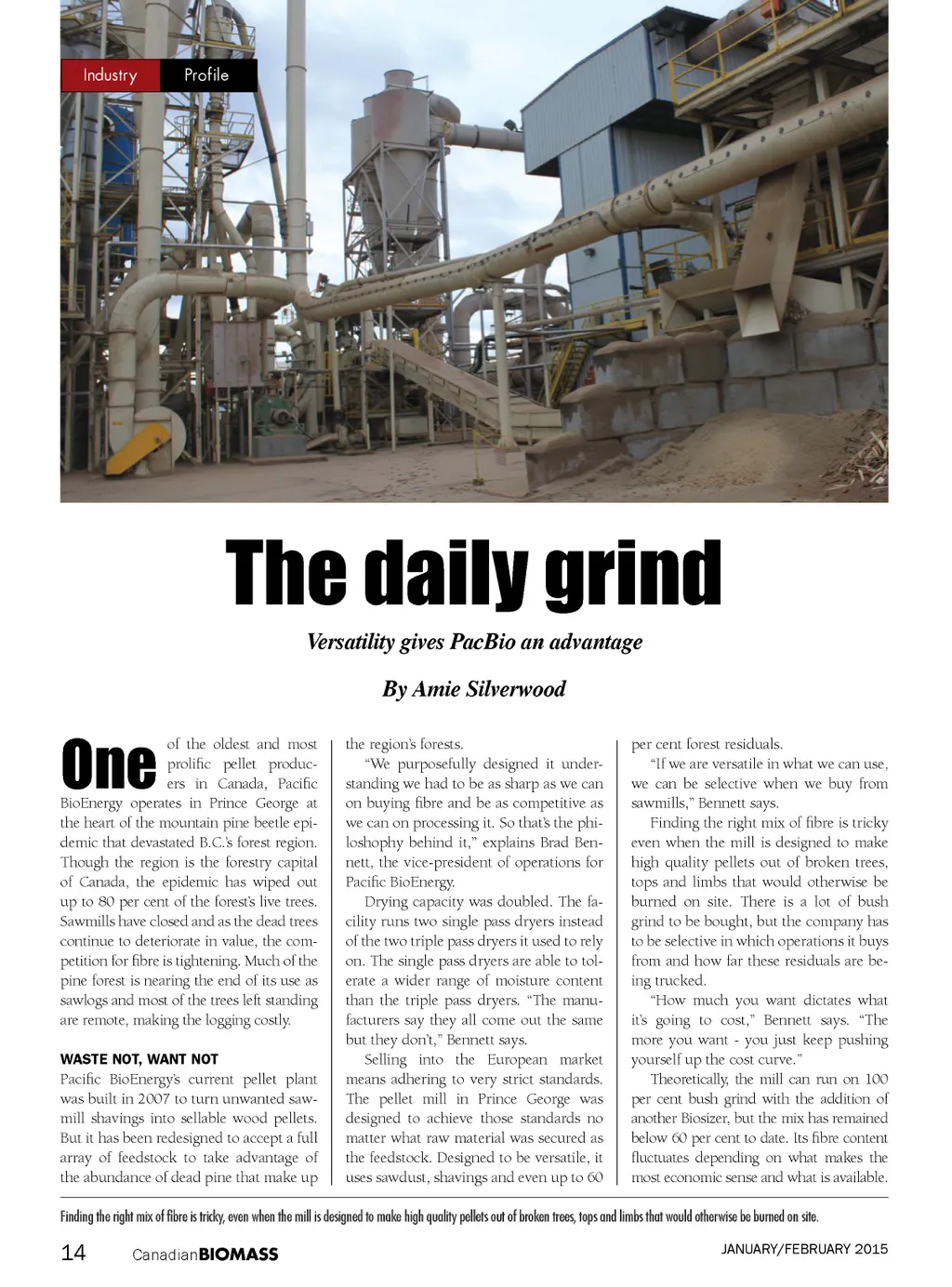
Pacific Bioenergy’s custom fleet of 165 rail cars will hold 99.2 tonnes of wood pellets each – just below the 100-tonne limit. NOT ALL WASTE IS FIT FOR PELLETIZING The most important part of pelletizing bush grind is staying on top of the quality of the raw material. It is important to take the time to pre-select the material before it is harvested. “We’ve learned operating in the field you don’t want to get every last stick. If the guy is picking the dirt out and mixing it into the ground material, it will just end up in our plant.” Some sites are at a higher risk of contamination and a lot of the company’s quality control includes making sure the raw ma-terial is managed properly from the get-go. Bennet explains, “We’re starting to evolve into a cycle so peo-ple are providing us with their plans beforehand so we can select blocks that we think make sense for us. We communicate with them what we need from a quality perspective and ask that they prepare it so we have the best chance of success with the ma-terial. The worst thing would be to get good raw material but because it’s been prepared improperly, we turn our nose up at it and say, go ahead and burn it because we can’t use it.” Rocks, root balls and dirt resulting from pushing the residuals into a pile can cause havoc in the pellet mill. But, the company has started making strides and Bennett believes the primary li-cence holders are now more attuned to what pellet mills need – which is for them to handle the material as little as possible. The company has three grinding contractors who grind roughly 120,000 tonnes a year in total. When pre-selecting blocks, Bennett looks for pine ones be-cause they tend to have a higher level of breakage and are drier than greener stands. Some of the dead pine can have a moisture content as low as 20 per cent versus sawdust from sawmills that can have a moisture content as high as 50 per cent. When it comes to affordability of raw material, moisture con-tent and distance can determine the best value. “Forest residuals are actually better in some cases than wet sawdust that’s brought Canadian BIOMASS 15
Canadian Biomass January-February 2015: Page 15