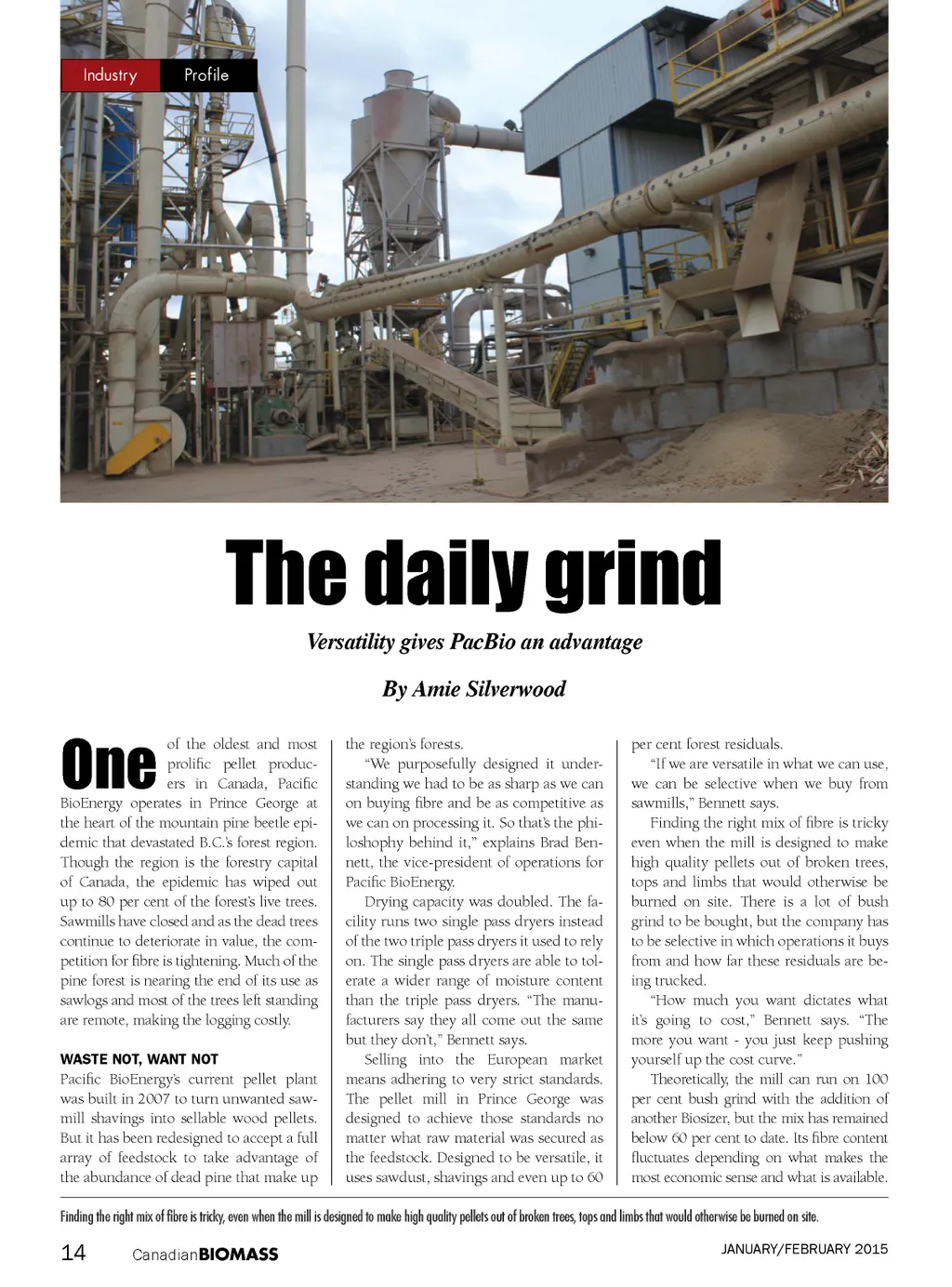
Industry Profile The daily grind Versatility gives PacBio an advantage By Amie Silverwood One of the oldest and most prolific pellet produc-ers in Canada, Pacific BioEnergy operates in Prince George at the heart of the mountain pine beetle epi-demic that devastated B.C.’s forest region. Though the region is the forestry capital of Canada, the epidemic has wiped out up to 80 per cent of the forest’s live trees. Sawmills have closed and as the dead trees continue to deteriorate in value, the com-petition for fibre is tightening. Much of the pine forest is nearing the end of its use as sawlogs and most of the trees left standing are remote, making the logging costly. WASTE NOT, WANT NOT Pacific BioEnergy’s current pellet plant was built in 2007 to turn unwanted saw-mill shavings into sellable wood pellets. But it has been redesigned to accept a full array of feedstock to take advantage of the abundance of dead pine that make up the region’s forests. “We purposefully designed it under-standing we had to be as sharp as we can on buying fibre and be as competitive as we can on processing it. So that’s the phi-loshophy behind it,” explains Brad Ben-nett, the vice-president of operations for Pacific BioEnergy. Drying capacity was doubled. The fa-cility runs two single pass dryers instead of the two triple pass dryers it used to rely on. The single pass dryers are able to tol-erate a wider range of moisture content than the triple pass dryers. “The manu-facturers say they all come out the same but they don’t,” Bennett says. Selling into the European market means adhering to very strict standards. The pellet mill in Prince George was designed to achieve those standards no matter what raw material was secured as the feedstock. Designed to be versatile, it uses sawdust, shavings and even up to 60 per cent forest residuals. “If we are versatile in what we can use, we can be selective when we buy from sawmills,” Bennett says. Finding the right mix of fibre is tricky even when the mill is designed to make high quality pellets out of broken trees, tops and limbs that would otherwise be burned on site. There is a lot of bush grind to be bought, but the company has to be selective in which operations it buys from and how far these residuals are be-ing trucked. “How much you want dictates what it’s going to cost,” Bennett says. “The more you want -you just keep pushing yourself up the cost curve.” Theoretically, the mill can run on 100 per cent bush grind with the addition of another Biosizer, but the mix has remained below 60 per cent to date. Its fibre content fluctuates depending on what makes the most economic sense and what is available. Finding the right mix of fibre is tricky, even when the mill is designed to make high quality pellets out of broken trees, tops and limbs that would otherwise be burned on site. 14 Canadian BIOMASS JANUARY/FEBRUARY 2015
Canadian Biomass January-February 2015: Page 14