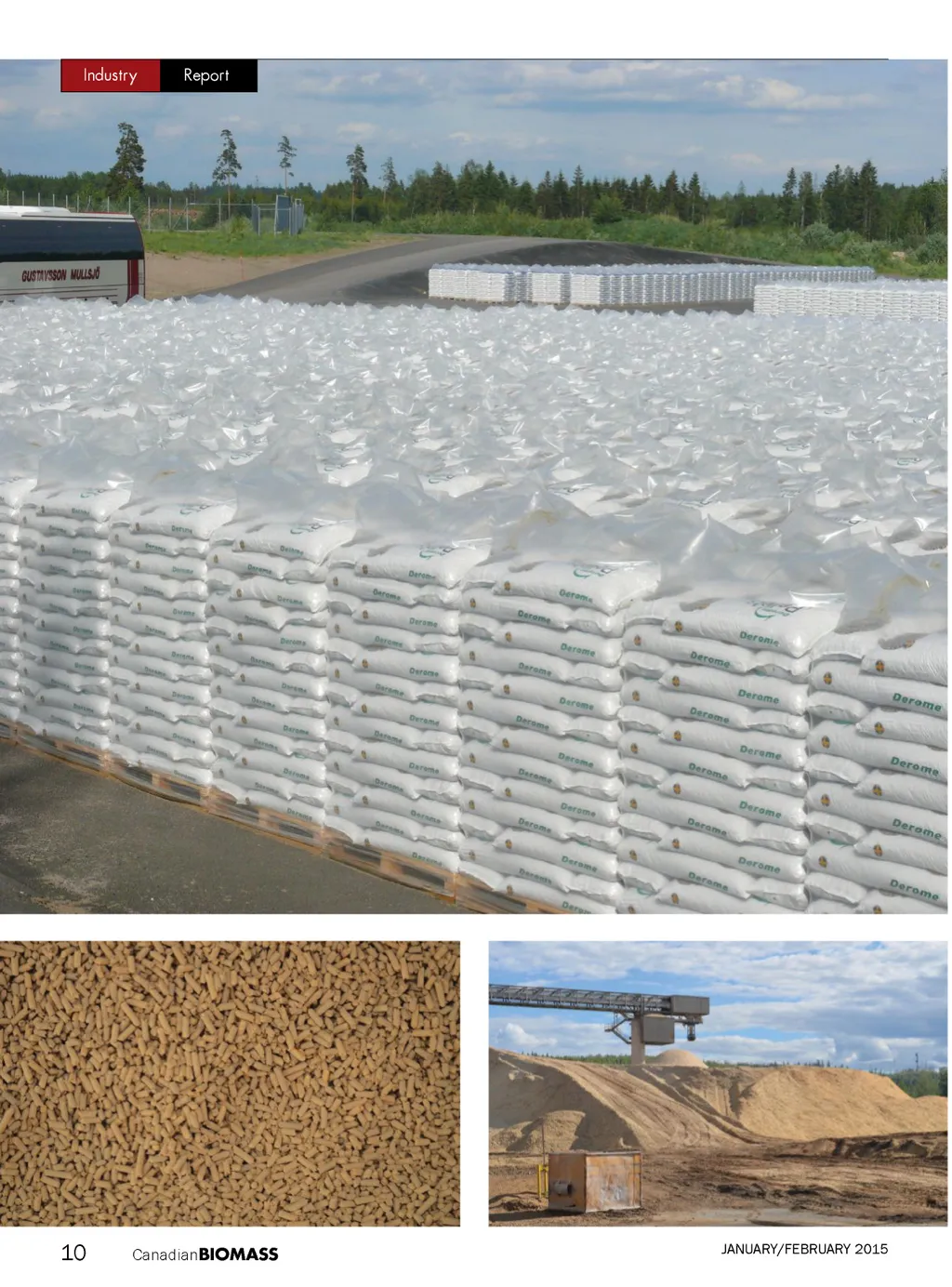
Wood pellets in demand European markets remain strong while new markets in Asia emerge By Amie Silverwood In 2015, European demand for Canadian wood pellets will re-main strong for both the util-ity and heat markets while new markets open up in Asia. Canadian wood pellets are produced from waste products and are primarily sourced from certified for-ests, making them a premium pellet on the world market even as the weaken-ing Canadian dollar makes them more affordable. The low oil prices are dragging energy stocks down but the wood pellet indus-try will continue to grow because pellet demand is tied to regulations, sustainable energy policies and long-term contracts rather than being subject to the volatility of oil and gas prices. As such, pellet pro-duction in Canada will be steady through 2015 with an uptick in exports coming from Ontario as Rentech comes online at its Atikokan and Wawa pellet plants. PELLET PRODUCTION IN CANADA In 2015, there will be a substantial in-crease in pellet shipments from Rentech out of the Port of Quebec. If the company is able to ramp up into full production in Atikokan and Wawa this year, the number of pellets exported from Ontario through Quebec will swell. Rentech, however, is still relatively new to the industry and any new plants are bound to have a few hurdles to cross in the first year of production, explains Gordon Murray, executive director of the Wood Pellet Association of Canada. “You design a plant to run at a certain capacity but you never actually get to the designed capacity in the first year. They’re new in the business, it’s a new plant, new location and there aren’t many other plants around for them to share information with.” Seth Walker, a bioenergy economist with RISI, is watching developments in Ontario and neighbouring provinces with interest. He sees plenty of potential for amalgamation now that the infrastructure is in place to ship pellets from the Port of Quebec. “What happens to the smaller and midsize producers all over Eastern Can-ada that aren’t necessarily close to any markets and don’t have any long-term contracts? Do they somehow benefit from all this? That still remains to be seen,” says Walker. “I think that once Rentech gets all their operations running smoothly, they’re going to see that they have a good opportunity to aggregate from other pro-ducers in Eastern Canada and ship out of their facility in Quebec. But I think it’s going to take a bit of time.” While there wasn’t much growth in 2014 in B.C. (production was flat around 1.7 million tonnes according to Walker’s data), a number of new projects have been planned. Tolko and Pinnacle recently an-nounced that they would begin construc-tion on their project in Lavington, Timber-West is considering adding a pellet plant to pelletize their residuals from their log-ging operations on Vancouver Island and Canfor and Pacific Bioenergy have plans for two pellet mills together in northern B.C. But Murray doesn’t expect produc-tion at these plants to begin until 2016. HOT SPOTS IN EUROPE The European commitment to wood pel-lets is strong and the United Kingdom is the world leader in wood pellet con-sumption. It will continue to import vast amounts of pellets as Drax, the power station in North England that has been converting from coal to wood pellets, continues to secure new contracts. “It’s all Drax that’s sucking everything up for the next two years or so until they finish the next version,” explains Seth Walker. Drax’s second unit has been do-ing enhanced cofiring (which means it was burning a mix of 85 per cent wood pellets and 15 per cent coal) until the end of 2014. It plans to convert the third of its six generating units by the end of 2016. MAIN: Unlike European countries like Sweden, few pellets produced in this country are used for the domestic heating market. BOTTOM LEFT: Pellet growth in Canada in 2015 will be dictated by what capacity current mills run at, at which proposed new projects are able to get up and running. BOTTOM RIGHT: An emphasis on price versus quality will make it difficult for producers to expand their exports into some Asian nations. Canadian BIOMASS 11
Canadian Biomass January-February 2015: Page 11