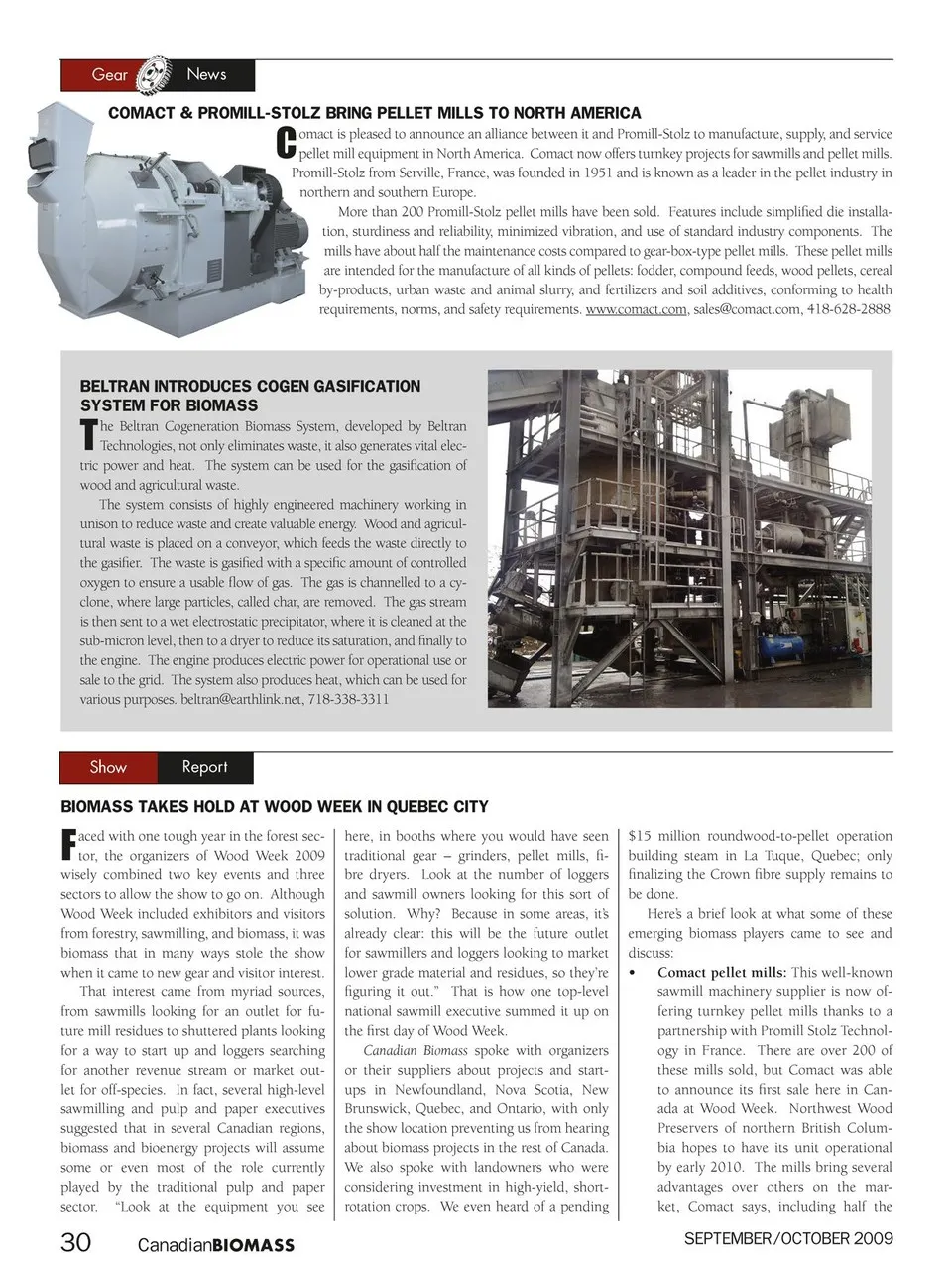
maintenance costs compared to gear box type pellet mills, simplified die installation by thermal expansion to reduce pellet mill vibration, and stan- dard components that are well known in the industry. • Hurst boiler options for wood waste and other bio- mass: The U.S. supplier was on hand with its eastern Can- adian agent R. Nantel of Mont- real. Nantel has experience in a wide range of installs using various feedstocks and has been work- ing to educate clients on the import- ance of marrying feedstock to boiler type and design. • Anderson’s BioBaler series of bio- mass harvesting and compaction equipment: The Canadian supplier has machines to manage feedstocks that in- clude short-rotation woody crops (com- plete with sawhead) and over-stocked wooded areas (complete with mulcher head). • Simoneau Group’s Hybrid Solid Fuel Boiler: The boiler is designed to handle a wide range of “by-product” fuels, in- cluding wood, biomass, manure, etc. As a consumer of such products, the boiler often opens the door to tax incentives or a reduction in disposal fees. The boiler combines a full waterfall furnace with a steam-generating firetube section. steady growth Continued from page 23 The first of the two projects, which will be led by UBC’s Jack Saddler and will have a budget of $1.1 million, will use genomics to determine the most efficient methods of liberating fermentable sugars from dead pine. This will involve breaking down the sug- ars with enzymes and then creating ethanol through a fermentation process. The second project, which has a budget of $7.7 million, will aim to use genomics to optimize breed- ing and selection of poplars to improve their potential as a biofuel resource. Drs. Carl Douglas and Shawn Mansfield, both of UBC, will carry out the work. Mansfield says that poplars, which grow quickly and produce wood that is easier to convert to fermentable sugars for ethanol production than conifers, may be a viable alternative to pine once the dead pine reserves are used up. “We need to be thinking about feedstock supply 10 to 15 years from now, so that we will have poplars ready to be harvested, which will allow us to keep up with industry demand,” he says. In addition to the presentations, attend- ees had the opportunity to participate in post-conference events, including a two-day tour to the Prince George area to witness the effects of the mountain pine beetle infesta- tion. The tour, which was hosted by For- est Innovation Investment, included visits to forest operations, sawmills, pulp mills, wood pellet manufacturers, and cogenera- tion facilities. A half-day tour of the univer- sity, including a visit to the FPInnovations biorefinery/bioenergy/biomaterials facilities was also an option. • LessoNs from swedeN Continued from page 9 Wood chip and pellet moisture metres from Gaston Richard give precise readings on the spot and in 11 seconds. • Gaston Richard: This Canadian dis- tributor has added to its long list of biomass and bioenergy equipment and was showing two of its newest gadgets at Wood Week. The Wood Chip Humidity metre is portable, easy to use, precise, and gives the moisture level of incoming or process wood chips within 11 seconds. Also new is the Humidity Sensor for Pellets, which works on fabricated fire logs, sawdust, and pellets. Like the chip version, it is portable and gets precise results in 11 seconds. Wood Week 2010 takes place in Dol- beau, Quebec, next September. • – Scott Jamieson AD INDEX Amandus Kahl Hamburg Anderson Group Bioscan Tech Bliss Industries Buhler, Inc Comact, Inc Combustion Expert, Inc. DelTech Gaston Richard, Inc Jeffrey Rader Corp Teaford Canada World Bioenergy 32 29 28 6 14 8 2 28 7, 18 13 26 22 canadianBIOMASS 31 Well, there is no mitigation measure (drying of residues, ash recycling) that can be used easily as a blanket solution to offset all impacts of bio- mass harvesting on every type of site. Also, guidelines aimed at conserving a certain amount of residues on-site, e.g., one in five tree tops left on fer- tile sites, and one in two tops left on less fertile sites, are probably the most practical to apply in the field. This is actually acknowledged in Sweden’s guidelines. Such guidelines are also likely the most relevant from an eco- logical point of view because they ex- clude any assumptions of how forest residues help in the functioning of the forest ecosystem. Is it their nitrogen content? Calcium? Organic matter? Bug-and-fungus-friendly dwellings? No one knows exactly. But to take a leaf from my book as well as that of Sweden, it surely is better to be on the safe side. • Dr. Evelyne Thiffault is a research scientist in forest biomass at Natural Resources Canada and provides Canadian Biomass with her thoughts on sustain- able biomass harvesting.
Canadian Biomass September/October 2009: Page 31