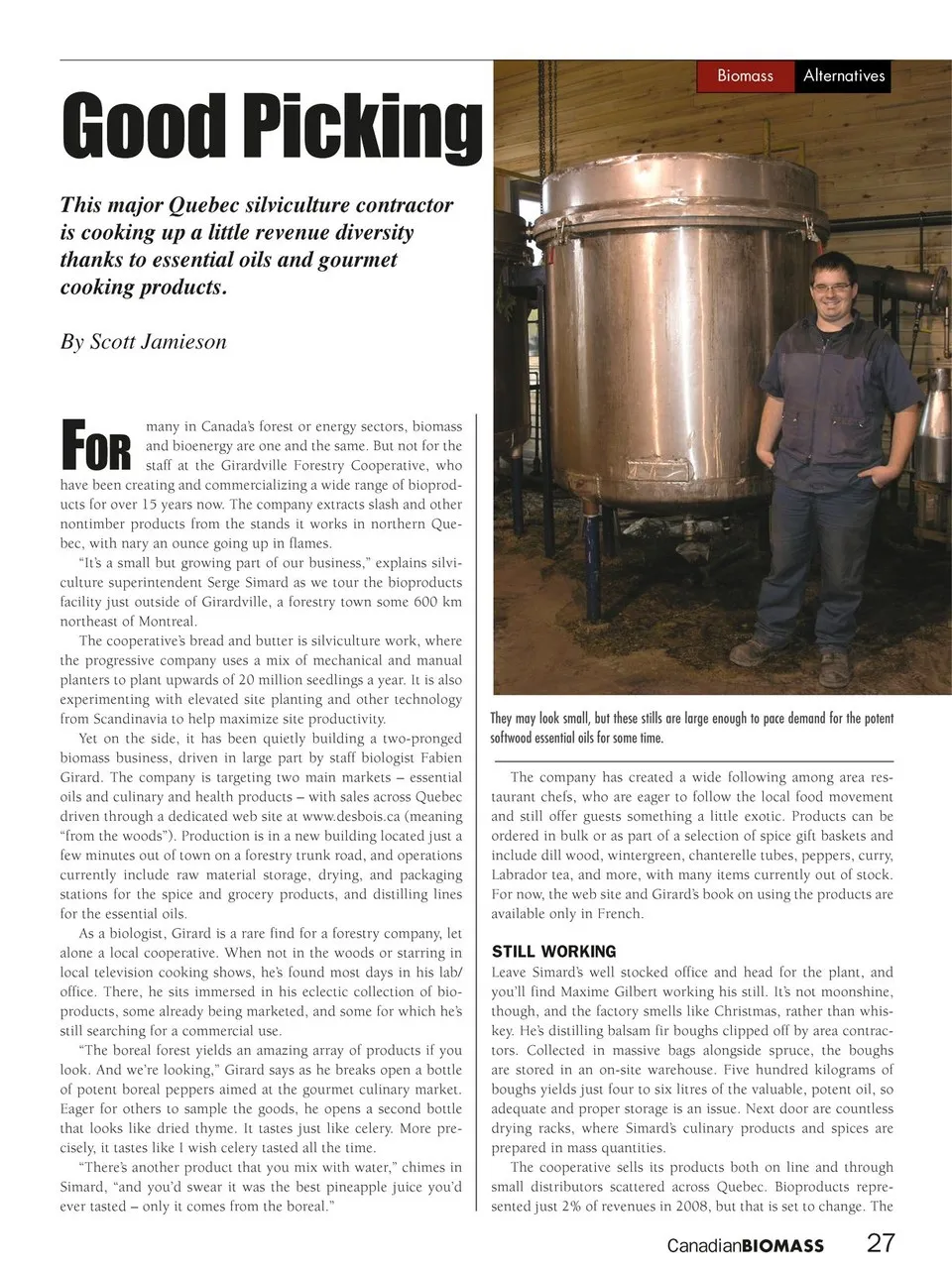
Biomass Good Picking This major Quebec silviculture contractor is cooking up a little revenue diversity thanks to essential oils and gourmet cooking products. By Scott Jamieson For many in Canada’s forest or energy sectors, biomass and bioenergy are one and the same. But not for the staff at the Girardville Forestry Cooperative, who have been creating and commercializing a wide range of bioprod- ucts for over 15 years now. The company extracts slash and other nontimber products from the stands it works in northern Que- bec, with nary an ounce going up in flames. “It’s a small but growing part of our business,” explains silvi- culture superintendent Serge Simard as we tour the bioproducts facility just outside of Girardville, a forestry town some 600 km northeast of Montreal. The cooperative’s bread and butter is silviculture work, where the progressive company uses a mix of mechanical and manual planters to plant upwards of 20 million seedlings a year. It is also experimenting with elevated site planting and other technology from Scandinavia to help maximize site productivity. Yet on the side, it has been quietly building a two-pronged biomass business, driven in large part by staff biologist Fabien Girard. The company is targeting two main markets – essential oils and culinary and health products – with sales across Quebec driven through a dedicated web site at www.desbois.ca (meaning “from the woods”). Production is in a new building located just a few minutes out of town on a forestry trunk road, and operations currently include raw material storage, drying, and packaging stations for the spice and grocery products, and distilling lines for the essential oils. As a biologist, Girard is a rare find for a forestry company, let alone a local cooperative. When not in the woods or starring in local television cooking shows, he’s found most days in his lab/ office. There, he sits immersed in his eclectic collection of bio- products, some already being marketed, and some for which he’s still searching for a commercial use. “The boreal forest yields an amazing array of products if you look. And we’re looking,” Girard says as he breaks open a bottle of potent boreal peppers aimed at the gourmet culinary market. Eager for others to sample the goods, he opens a second bottle that looks like dried thyme. It tastes just like celery. More pre- cisely, it tastes like I wish celery tasted all the time. “There’s another product that you mix with water,” chimes in Simard, “and you’d swear it was the best pineapple juice you’d ever tasted – only it comes from the boreal.” Alternatives They may look small, but these stills are large enough to pace demand for the potent softwood essential oils for some time. The company has created a wide following among area res- taurant chefs, who are eager to follow the local food movement and still offer guests something a little exotic. Products can be ordered in bulk or as part of a selection of spice gift baskets and include dill wood, wintergreen, chanterelle tubes, peppers, curry, Labrador tea, and more, with many items currently out of stock. For now, the web site and Girard’s book on using the products are available only in French. stiLL workiNg Leave Simard’s well stocked office and head for the plant, and you’ll find Maxime Gilbert working his still. It’s not moonshine, though, and the factory smells like Christmas, rather than whis- key. He’s distilling balsam fir boughs clipped off by area contrac- tors. Collected in massive bags alongside spruce, the boughs are stored in an on-site warehouse. Five hundred kilograms of boughs yields just four to six litres of the valuable, potent oil, so adequate and proper storage is an issue. Next door are countless drying racks, where Simard’s culinary products and spices are prepared in mass quantities. The cooperative sells its products both on line and through small distributors scattered across Quebec. Bioproducts repre- sented just 2% of revenues in 2008, but that is set to change. The canadianBIOMASS 27
Canadian Biomass September/October 2009: Page 27