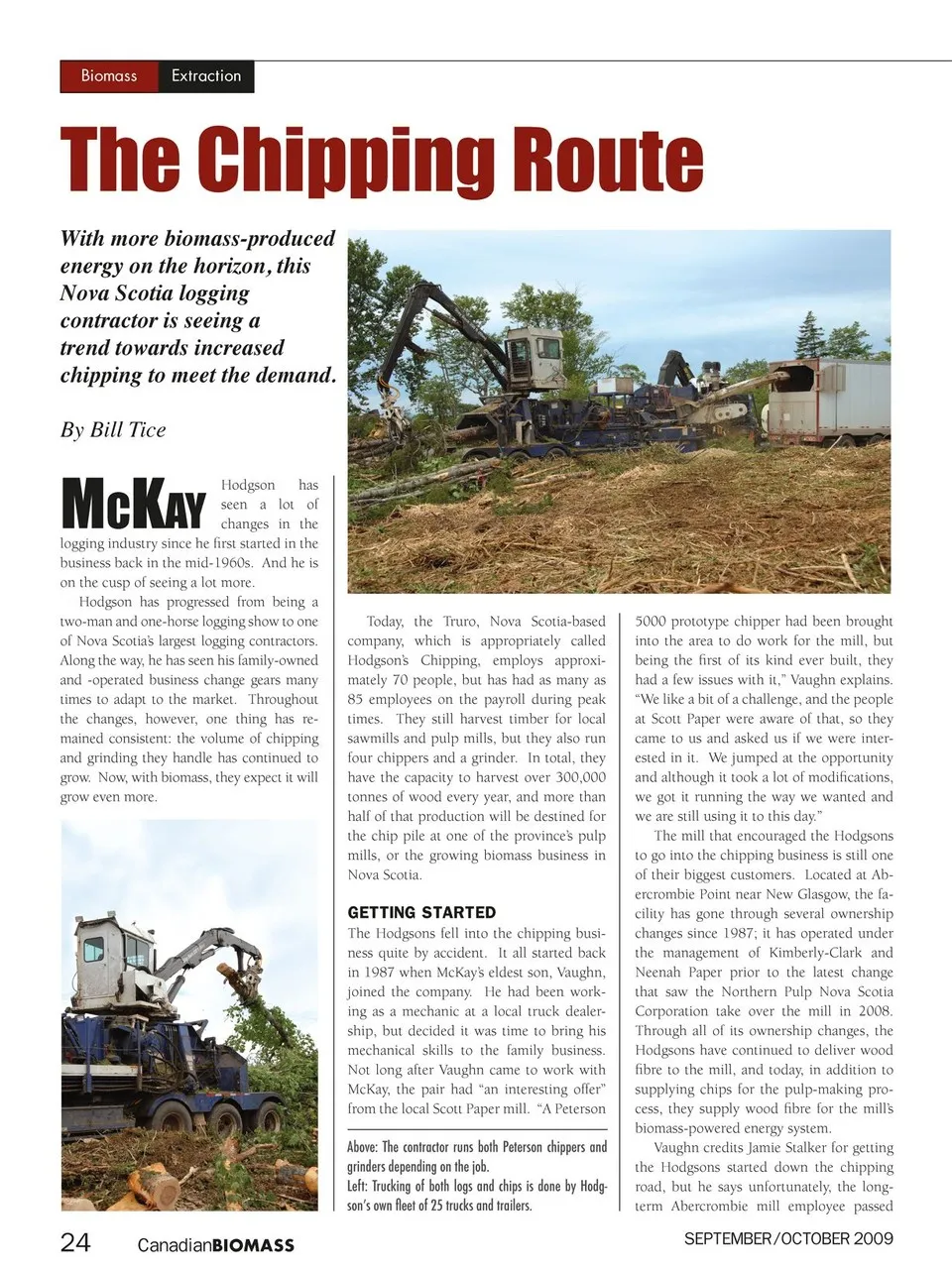
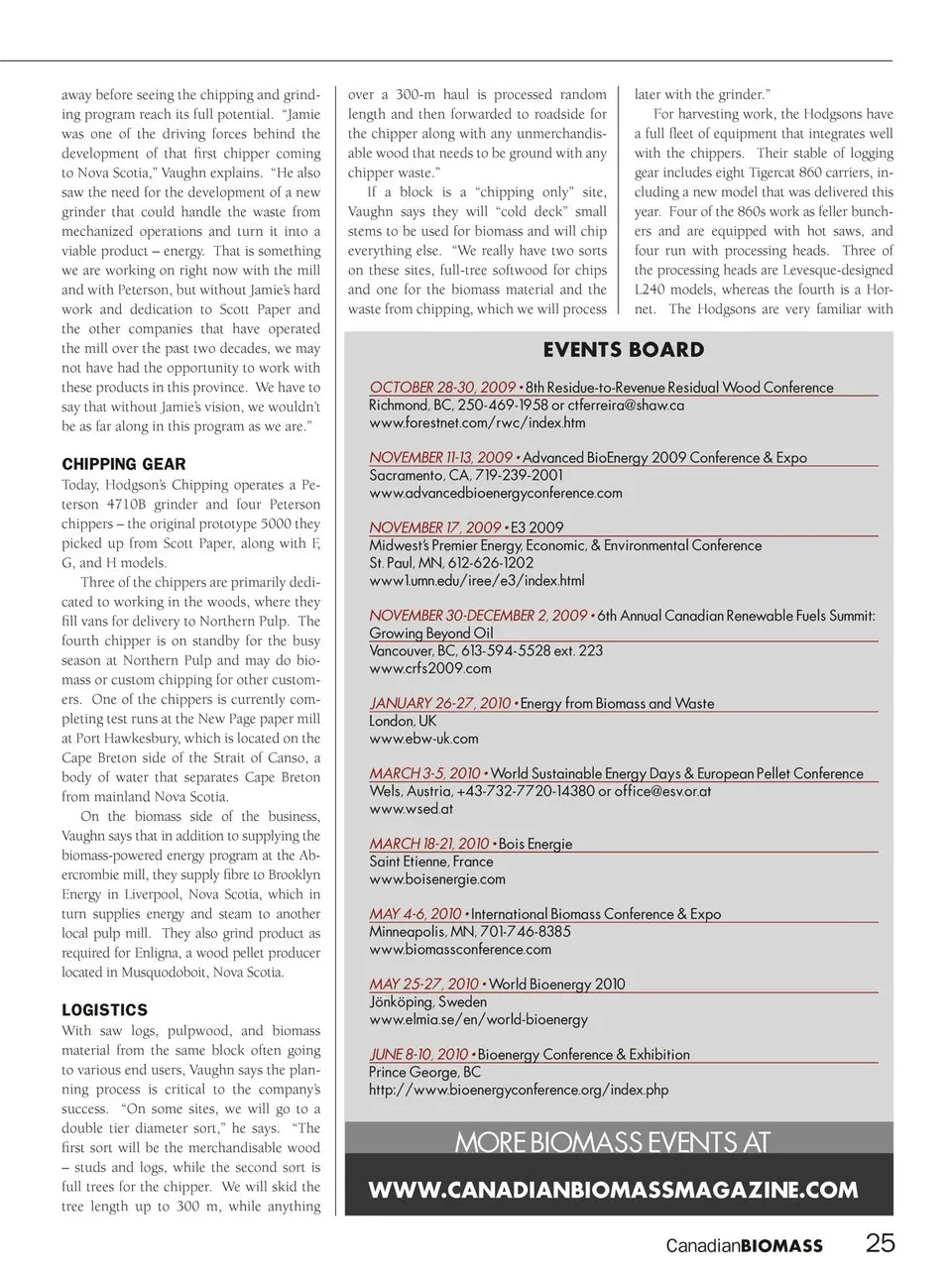
Biomass Extraction The Chipping Route With more biomass-produced energy on the horizon, this Nova Scotia logging contractor is seeing a trend towards increased chipping to meet the demand. By Bill Tice MCKay Hodgson has seen a lot of changes in the logging industry since he first started in the business back in the mid-1960s. And he is on the cusp of seeing a lot more. Hodgson has progressed from being a two-man and one-horse logging show to one of Nova Scotia’s largest logging contractors. Along the way, he has seen his family-owned and -operated business change gears many times to adapt to the market. Throughout the changes, however, one thing has re- mained consistent: the volume of chipping and grinding they handle has continued to grow. Now, with biomass, they expect it will grow even more. Today, the Truro, Nova Scotia-based company, which is appropriately called Hodgson’s Chipping, employs approxi- mately 70 people, but has had as many as 85 employees on the payroll during peak times. They still harvest timber for local sawmills and pulp mills, but they also run four chippers and a grinder. In total, they have the capacity to harvest over 300,000 tonnes of wood every year, and more than half of that production will be destined for the chip pile at one of the province’s pulp mills, or the growing biomass business in Nova Scotia. gettiNg started The Hodgsons fell into the chipping busi- ness quite by accident. It all started back in 1987 when McKay’s eldest son, Vaughn, joined the company. He had been work- ing as a mechanic at a local truck dealer- ship, but decided it was time to bring his mechanical skills to the family business. Not long after Vaughn came to work with McKay, the pair had “an interesting offer” from the local Scott Paper mill. “A Peterson Above: The contractor runs both Peterson chippers and grinders depending on the job. Left: Trucking of both logs and chips is done by Hodg- son’s own fleet of 25 trucks and trailers. 24 canadianBIOMASS 5000 prototype chipper had been brought into the area to do work for the mill, but being the first of its kind ever built, they had a few issues with it,” Vaughn explains. “We like a bit of a challenge, and the people at Scott Paper were aware of that, so they came to us and asked us if we were inter- ested in it. We jumped at the opportunity and although it took a lot of modifications, we got it running the way we wanted and we are still using it to this day.” The mill that encouraged the Hodgsons to go into the chipping business is still one of their biggest customers. Located at Ab- ercrombie Point near New Glasgow, the fa- cility has gone through several ownership changes since 1987; it has operated under the management of Kimberly-Clark and Neenah Paper prior to the latest change that saw the Northern Pulp Nova Scotia Corporation take over the mill in 2008. Through all of its ownership changes, the Hodgsons have continued to deliver wood fibre to the mill, and today, in addition to supplying chips for the pulp-making pro- cess, they supply wood fibre for the mill’s biomass-powered energy system. Vaughn credits Jamie Stalker for getting the Hodgsons started down the chipping road, but he says unfortunately, the long- term Abercrombie mill employee passed SepteMBeR/OctOBeR 2009
Canadian Biomass September/October 2009: Page 24