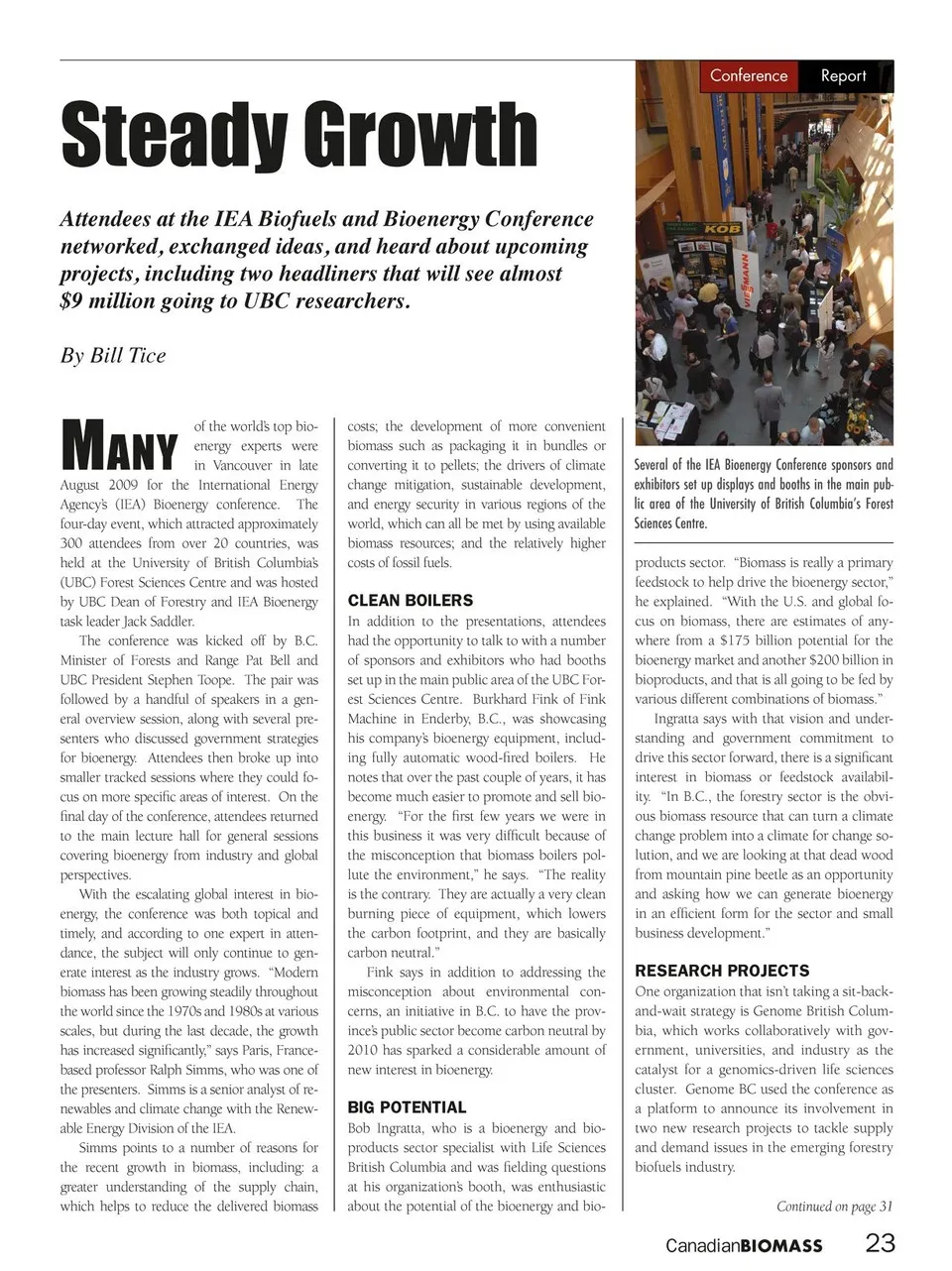
Conference Steady Growth Attendees at the IEA Biofuels and Bioenergy Conference networked, exchanged ideas, and heard about upcoming projects, including two headliners that will see almost $9 million going to UBC researchers. By Bill Tice August 2009 for the International Energy Agency’s (IEA) Bioenergy conference. The four-day event, which attracted approximately 300 attendees from over 20 countries, was held at the University of British Columbia’s (UBC) Forest Sciences Centre and was hosted by UBC Dean of Forestry and IEA Bioenergy task leader Jack Saddler. The conference was kicked off by B.C. Many Minister of Forests and Range Pat Bell and UBC President Stephen Toope. The pair was followed by a handful of speakers in a gen- eral overview session, along with several pre- senters who discussed government strategies for bioenergy. Attendees then broke up into smaller tracked sessions where they could fo- cus on more specific areas of interest. On the final day of the conference, attendees returned to the main lecture hall for general sessions covering bioenergy from industry and global perspectives. With the escalating global interest in bio- energy, the conference was both topical and timely, and according to one expert in atten- dance, the subject will only continue to gen- erate interest as the industry grows. “Modern biomass has been growing steadily throughout the world since the 1970s and 1980s at various scales, but during the last decade, the growth has increased significantly,” says Paris, France- based professor Ralph Simms, who was one of the presenters. Simms is a senior analyst of re- newables and climate change with the Renew- able Energy Division of the IEA. Simms points to a number of reasons for the recent growth in biomass, including: a greater understanding of the supply chain, which helps to reduce the delivered biomass of the world’s top bio- energy experts were in Vancouver in late costs; the development of more convenient biomass such as packaging it in bundles or converting it to pellets; the drivers of climate change mitigation, sustainable development, and energy security in various regions of the world, which can all bemet by using available biomass resources; and the relatively higher costs of fossil fuels. CLeaN BoiLers In addition to the presentations, attendees had the opportunity to talk to with a number of sponsors and exhibitors who had booths set up in the main public area of the UBC For- est Sciences Centre. Burkhard Fink of Fink Machine in Enderby, B.C., was showcasing his company’s bioenergy equipment, includ- ing fully automatic wood-fired boilers. He notes that over the past couple of years, it has become much easier to promote and sell bio- energy. “For the first few years we were in this business it was very difficult because of the misconception that biomass boilers pol- lute the environment,” he says. “The reality is the contrary. They are actually a very clean burning piece of equipment, which lowers the carbon footprint, and they are basically carbon neutral.” Fink says in addition to addressing the misconception about environmental con- cerns, an initiative in B.C. to have the prov- ince’s public sector become carbon neutral by 2010 has sparked a considerable amount of new interest in bioenergy. Big poteNtiaL Bob Ingratta, who is a bioenergy and bio- products sector specialist with Life Sciences British Columbia and was fielding questions at his organization’s booth, was enthusiastic about the potential of the bioenergy and bio- Several of the IEA Bioenergy Conference sponsors and exhibitors set up displays and booths in the main pub- lic area of the University of British Columbia’s Forest Sciences Centre. products sector. “Biomass is really a primary feedstock to help drive the bioenergy sector,” he explained. “With the U.S. and global fo- cus on biomass, there are estimates of any- where from a $175 billion potential for the bioenergy market and another $200 billion in bioproducts, and that is all going to be fed by various different combinations of biomass.” Ingratta says with that vision and under- standing and government commitment to drive this sector forward, there is a significant interest in biomass or feedstock availabil- ity. “In B.C., the forestry sector is the obvi- ous biomass resource that can turn a climate change problem into a climate for change so- lution, and we are looking at that dead wood from mountain pine beetle as an opportunity and asking how we can generate bioenergy in an efficient form for the sector and small business development.” researCh projeCts One organization that isn’t taking a sit-back- and-wait strategy is Genome British Colum- bia, which works collaboratively with gov- ernment, universities, and industry as the catalyst for a genomics-driven life sciences cluster. Genome BC used the conference as a platform to announce its involvement in two new research projects to tackle supply and demand issues in the emerging forestry biofuels industry. Continued on page 31 canadianBIOMASS 23 Report
Canadian Biomass September/October 2009: Page 23