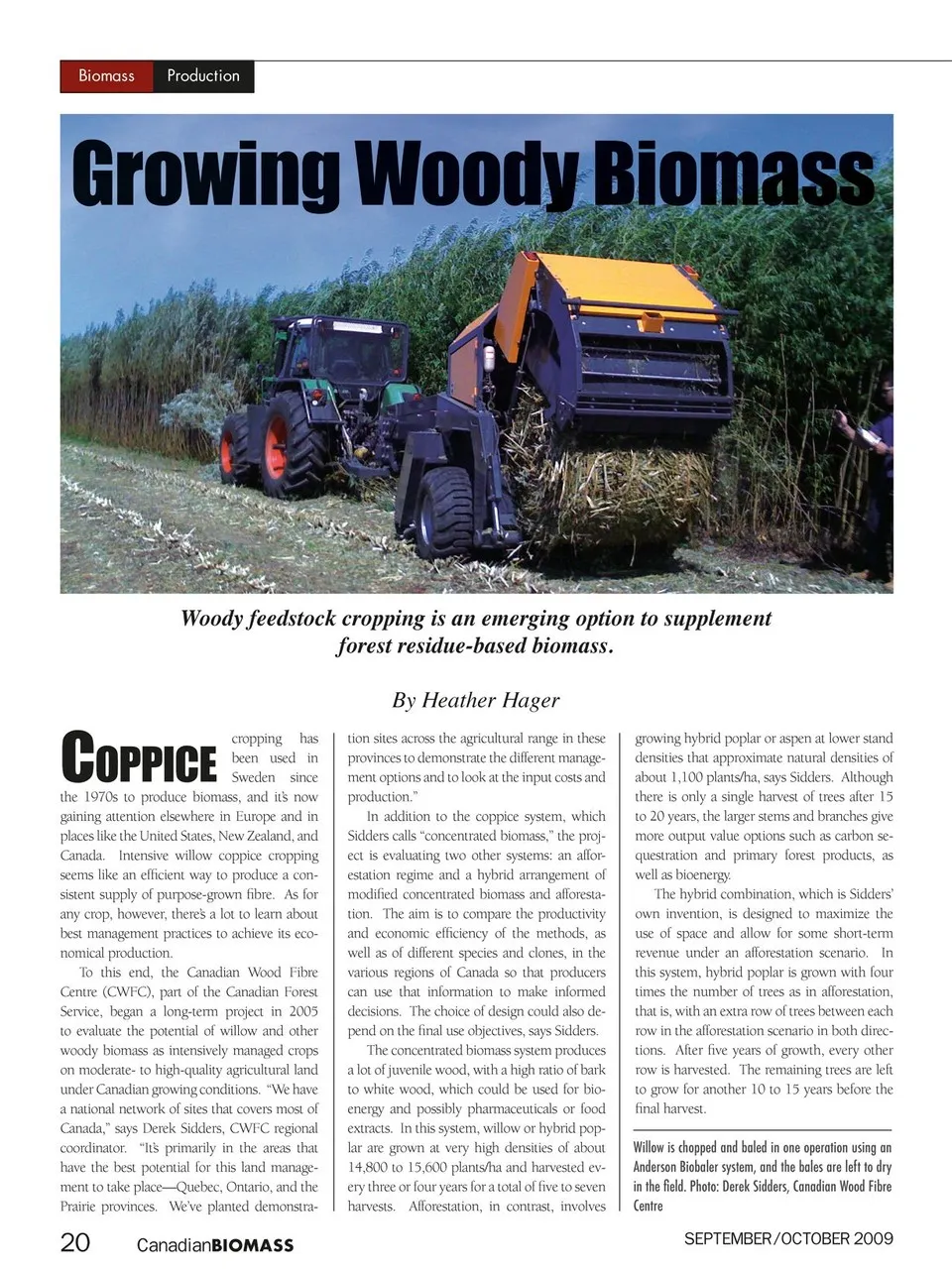
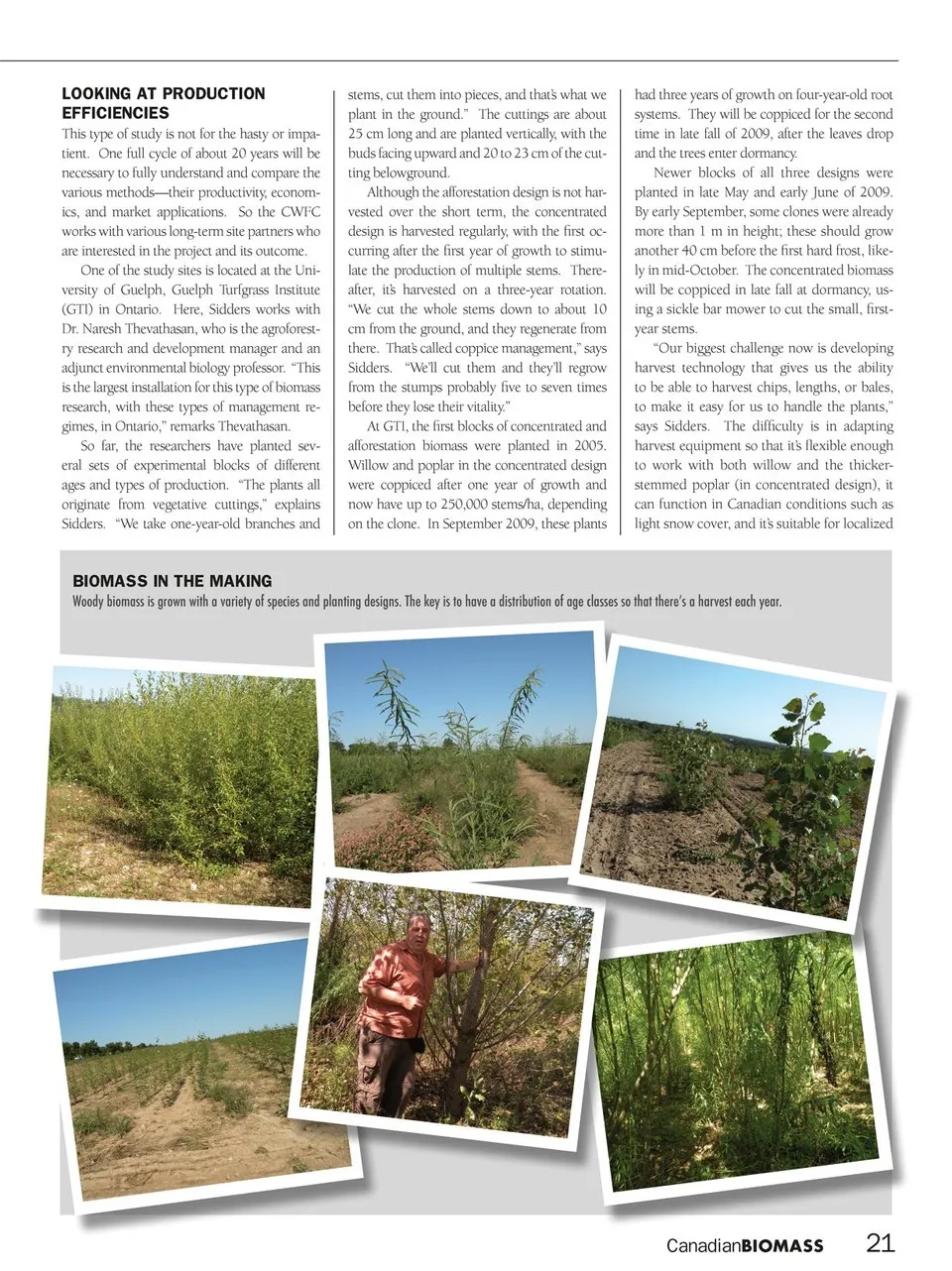
LookiNg at produCtioN effiCieNCies This type of study is not for the hasty or impa- tient. One full cycle of about 20 years will be necessary to fully understand and compare the various methods—their productivity, econom- ics, and market applications. So the CWFC works with various long-term site partners who are interested in the project and its outcome. One of the study sites is located at the Uni- versity of Guelph, Guelph Turfgrass Institute (GTI) in Ontario. Here, Sidders works with Dr. Naresh Thevathasan, who is the agroforest- ry research and development manager and an adjunct environmental biology professor. “This is the largest installation for this type of biomass research, with these types of management re- gimes, in Ontario,” remarks Thevathasan. So far, the researchers have planted sev- eral sets of experimental blocks of different ages and types of production. “The plants all originate from vegetative cuttings,” explains Sidders. “We take one-year-old branches and stems, cut them into pieces, and that’s what we plant in the ground.” The cuttings are about 25 cm long and are planted vertically, with the buds facing upward and 20 to 23 cm of the cut- ting belowground. Although the afforestation design is not har- vested over the short term, the concentrated design is harvested regularly, with the first oc- curring after the first year of growth to stimu- late the production of multiple stems. There- after, it’s harvested on a three-year rotation. “We cut the whole stems down to about 10 cm from the ground, and they regenerate from there. That’s called coppice management,” says Sidders. “We’ll cut them and they’ll regrow from the stumps probably five to seven times before they lose their vitality.” At GTI, the first blocks of concentrated and afforestation biomass were planted in 2005. Willow and poplar in the concentrated design were coppiced after one year of growth and now have up to 250,000 stems/ha, depending on the clone. In September 2009, these plants had three years of growth on four-year-old root systems. They will be coppiced for the second time in late fall of 2009, after the leaves drop and the trees enter dormancy. Newer blocks of all three designs were planted in late May and early June of 2009. By early September, some clones were already more than 1 m in height; these should grow another 40 cm before the first hard frost, like- ly in mid-October. The concentrated biomass will be coppiced in late fall at dormancy, us- ing a sickle bar mower to cut the small, first- year stems. “Our biggest challenge now is developing harvest technology that gives us the ability to be able to harvest chips, lengths, or bales, to make it easy for us to handle the plants,” says Sidders. The difficulty is in adapting harvest equipment so that it’s flexible enough to work with both willow and the thicker- stemmed poplar (in concentrated design), it can function in Canadian conditions such as light snow cover, and it’s suitable for localized Biomass iN the makiNg Woody biomass is grown with a variety of species and planting designs. The key is to have a distribution of age classes so that there’s a harvest each year. canadianBIOMASS 21
Canadian Biomass September/October 2009: Page 21