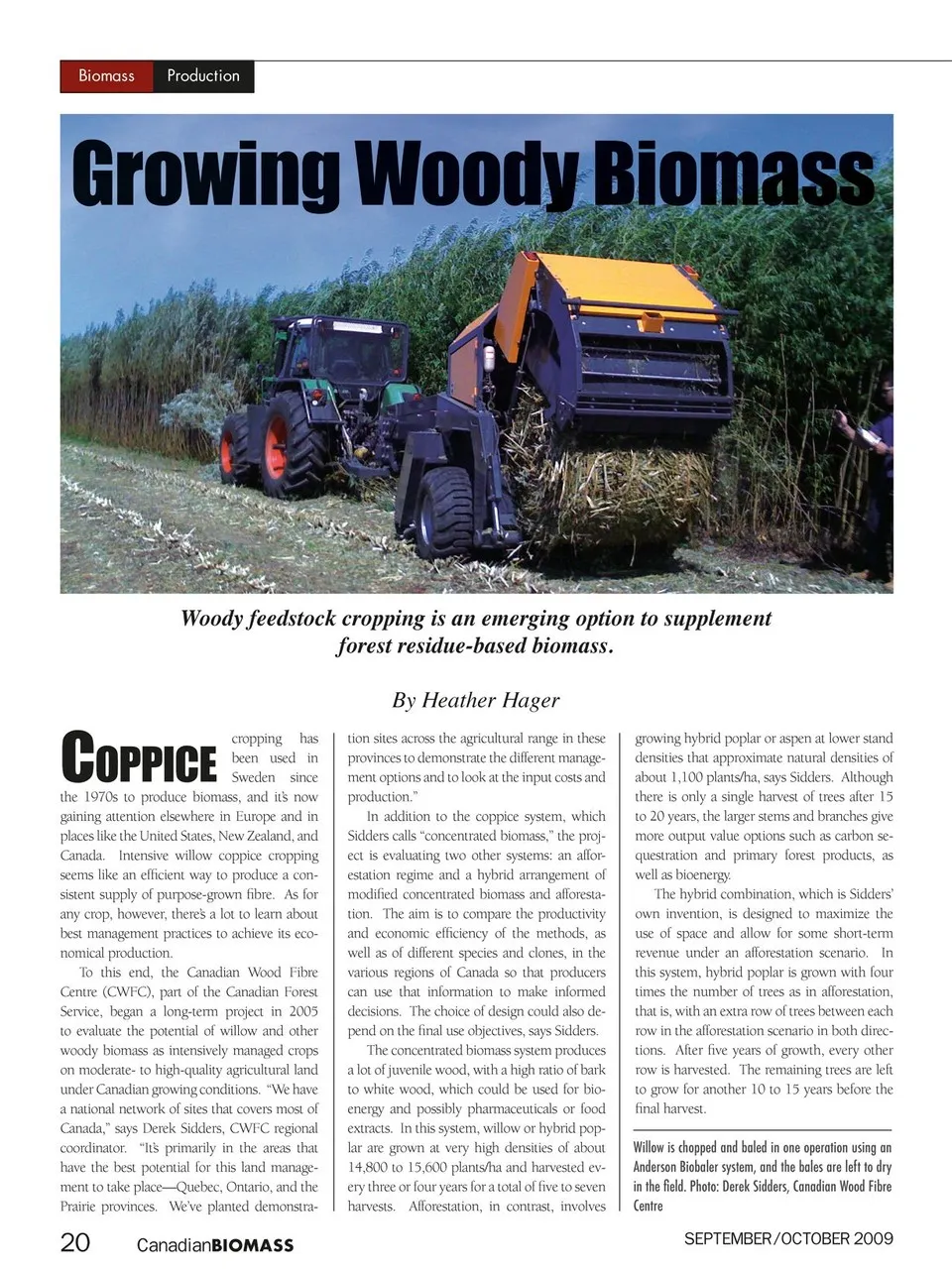
Biomass Production Growing Woody Biomass Woody feedstock cropping is an emerging option to supplement forest residue-based biomass. By Heather Hager the 1970s to produce biomass, and it’s now gaining attention elsewhere in Europe and in places like the United States, New Zealand, and Canada. Intensive willow coppice cropping seems like an efficient way to produce a con- sistent supply of purpose-grown fibre. As for any crop, however, there’s a lot to learn about best management practices to achieve its eco- nomical production. To this end, the Canadian Wood Fibre CoppiCe Centre (CWFC), part of the Canadian Forest Service, began a long-term project in 2005 to evaluate the potential of willow and other woody biomass as intensively managed crops on moderate- to high-quality agricultural land under Canadian growing conditions. “We have a national network of sites that covers most of Canada,” says Derek Sidders, CWFC regional coordinator. “It’s primarily in the areas that have the best potential for this land manage- ment to take place—Quebec, Ontario, and the Prairie provinces. We’ve planted demonstra- 20 canadianBIOMASS cropping has been used in Sweden since tion sites across the agricultural range in these provinces to demonstrate the different manage- ment options and to look at the input costs and production.” In addition to the coppice system, which Sidders calls “concentrated biomass,” the proj- ect is evaluating two other systems: an affor- estation regime and a hybrid arrangement of modified concentrated biomass and afforesta- tion. The aim is to compare the productivity and economic efficiency of the methods, as well as of different species and clones, in the various regions of Canada so that producers can use that information to make informed decisions. The choice of design could also de- pend on the final use objectives, says Sidders. The concentrated biomass system produces a lot of juvenile wood, with a high ratio of bark to white wood, which could be used for bio- energy and possibly pharmaceuticals or food extracts. In this system, willow or hybrid pop- lar are grown at very high densities of about 14,800 to 15,600 plants/ha and harvested ev- ery three or four years for a total of five to seven harvests. Afforestation, in contrast, involves growing hybrid poplar or aspen at lower stand densities that approximate natural densities of about 1,100 plants/ha, says Sidders. Although there is only a single harvest of trees after 15 to 20 years, the larger stems and branches give more output value options such as carbon se- questration and primary forest products, as well as bioenergy. The hybrid combination, which is Sidders’ own invention, is designed to maximize the use of space and allow for some short-term revenue under an afforestation scenario. In this system, hybrid poplar is grown with four times the number of trees as in afforestation, that is, with an extra row of trees between each row in the afforestation scenario in both direc- tions. After five years of growth, every other row is harvested. The remaining trees are left to grow for another 10 to 15 years before the final harvest. Willow is chopped and baled in one operation using an Anderson Biobaler system, and the bales are left to dry in the field. Photo: Derek Sidders, Canadian Wood Fibre Centre SepteMBeR/OctOBeR 2009
Canadian Biomass September/October 2009: Page 20