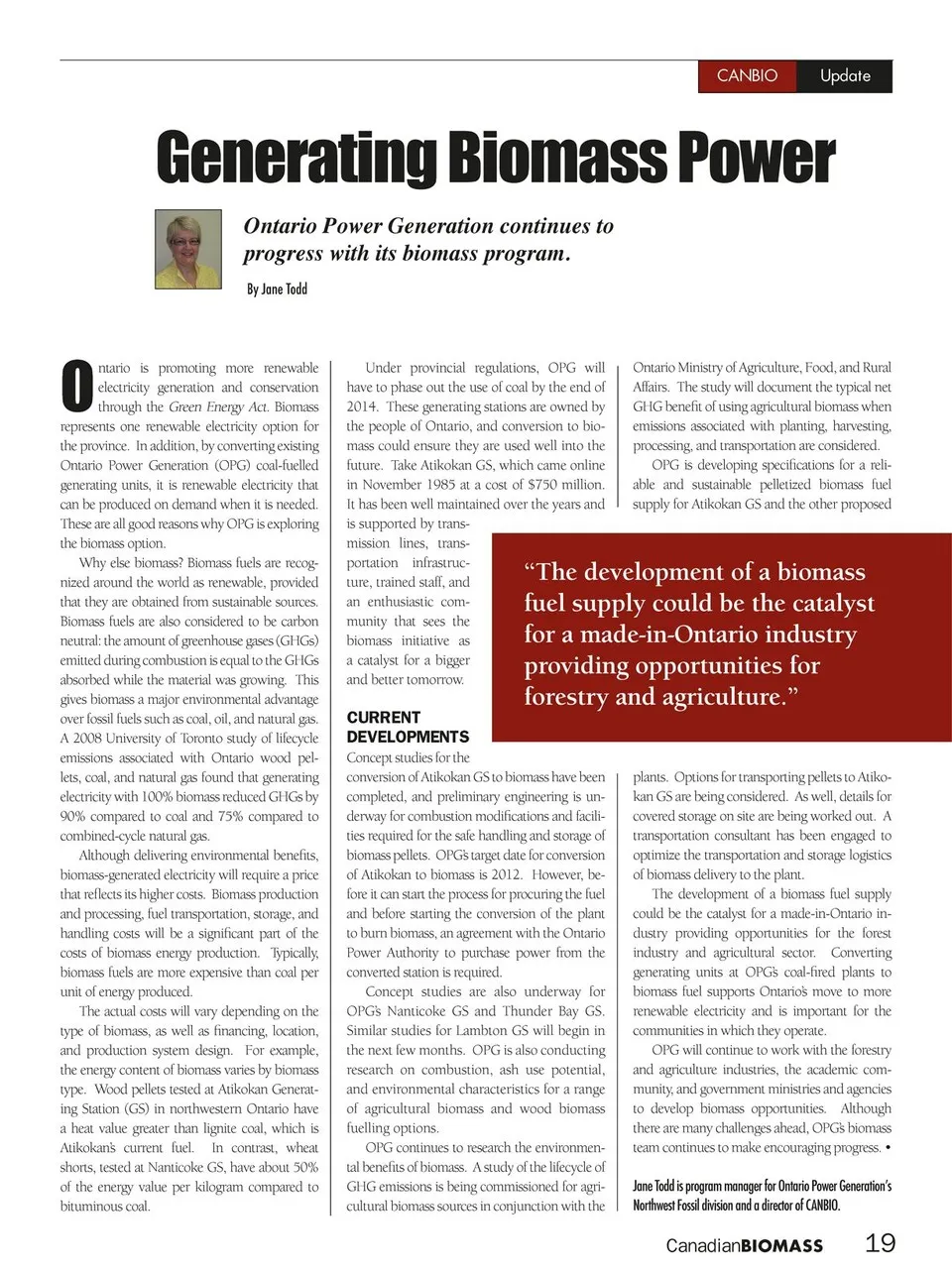
exhaust system. The gases are then released through the chimney. “Concerning air emissions, they are lower than the acceptable stan- dards,” says Roy. He says that the last air quality tests conducted showed approximately 250 mg/m3 standard of 600 mg/m3 . A 200-foot tunnel was built to accommodate the pipes that trans- port the steam to the mill. Two pipes were installed: one carries the steam, and another much thinner one transports the overflow of water that returns from the mill. All the electrical wiring also passes through the tunnel and is protected by a steel cage. An extension link was added to avoid pipe distortion. A local contractor, GSL Construc- tion, built both the building that houses the cogeneration unit and the adjoining tunnel. Next steps Groupe Dynaco is already looking towards other improvements. The next project will be to use the biomass system to dry seed. This process presently runs with a 10-million BTU burner. A Law-Marot air exchange system has been purchased and will be installed in the coming months. Among other future projects, the biomass system could eventually burn agricultural biomass. Studies towards this end are well on their way, with a focus on corn stover and willow. The mill’s managers are very pleased with the system. According to Jean-Yves Lavoie, executive director of Groupe Dynaco, the biomass ther- mal power unit is a great success. “We are very satisfied. We predicted that we would be able to go green and, at the same time, save on our energy costs. We have handled that challenge.” • of particles, which is far better than the allowed The next project will be to use the biomass system to dry seed. This process presently runs with a 10-million BTU burner. A Law-Marot air exchange system has been purchased and will be installed in the coming months. 18 canadianBIOMASS SepteMBeR/OctOBeR 2009
Canadian Biomass September/October 2009: Page 18