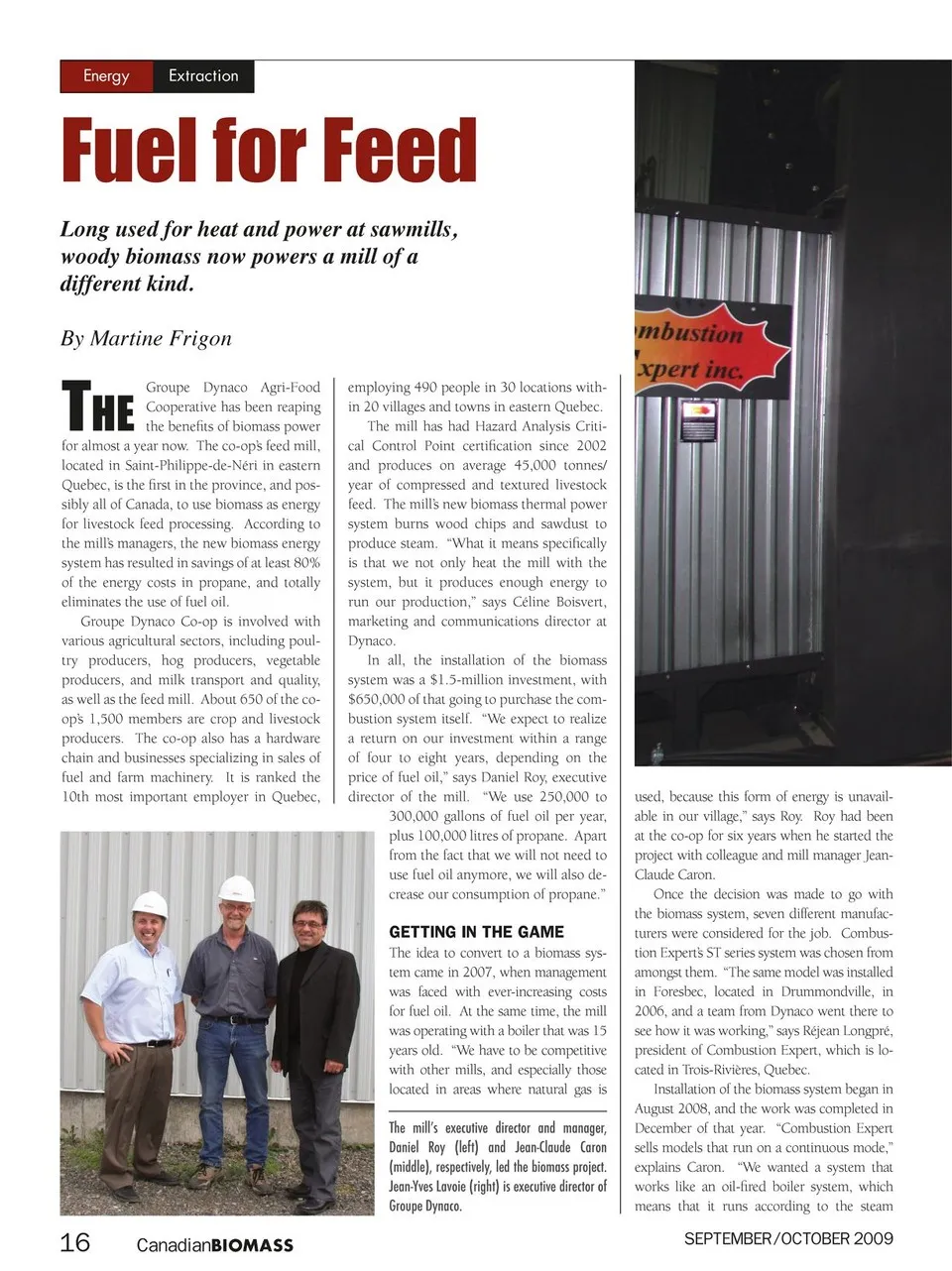
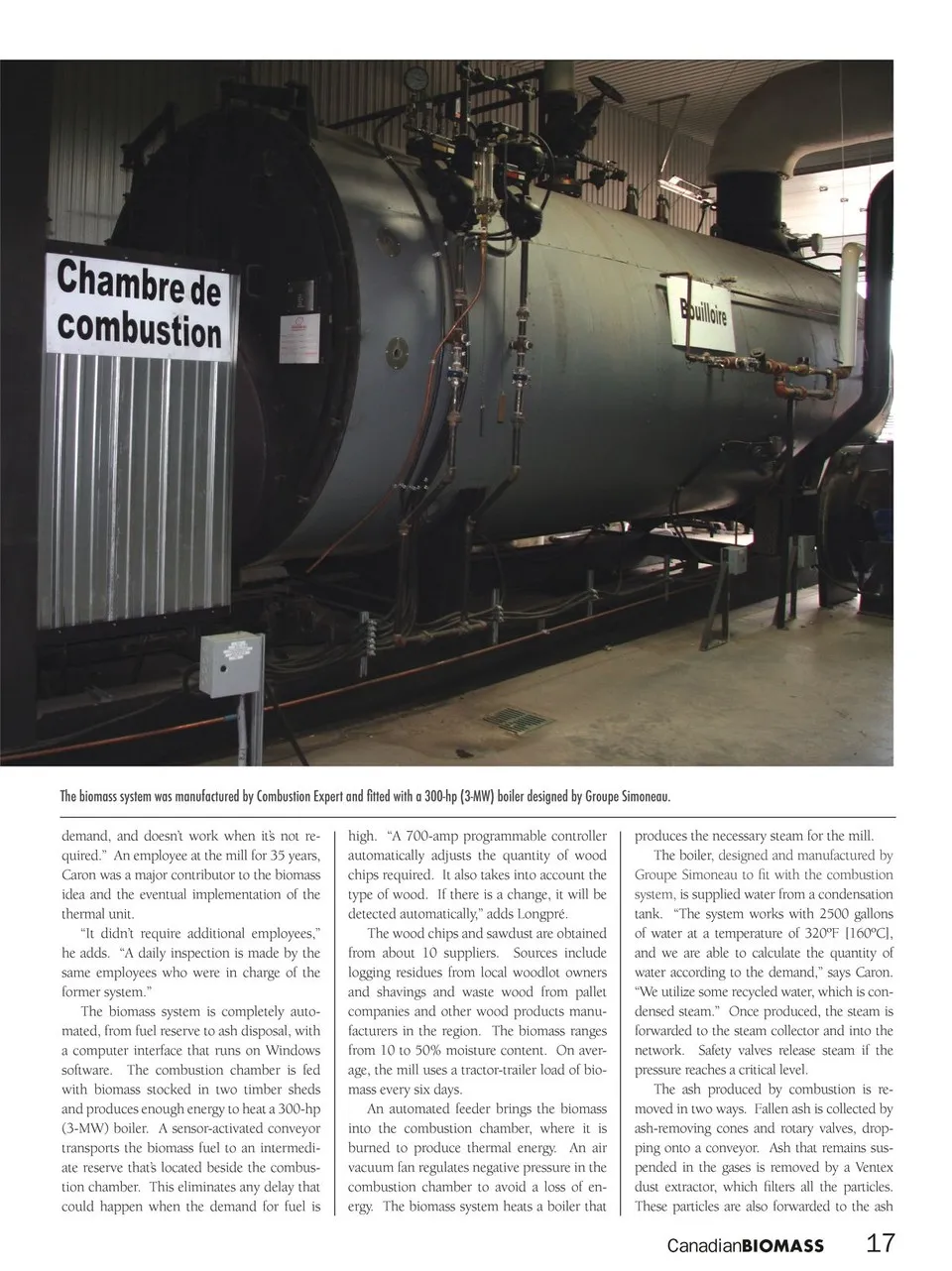
The biomass system was manufactured by Combustion Expert and fitted with a 300-hp (3-MW) boiler designed by Groupe Simoneau. demand, and doesn’t work when it’s not re- quired.” An employee at the mill for 35 years, Caron was a major contributor to the biomass idea and the eventual implementation of the thermal unit. “It didn’t require additional employees,” he adds. “A daily inspection is made by the same employees who were in charge of the former system.” The biomass system is completely auto- mated, from fuel reserve to ash disposal, with a computer interface that runs on Windows software. The combustion chamber is fed with biomass stocked in two timber sheds and produces enough energy to heat a 300-hp (3-MW) boiler. A sensor-activated conveyor transports the biomass fuel to an intermedi- ate reserve that’s located beside the combus- tion chamber. This eliminates any delay that could happen when the demand for fuel is high. “A 700-amp programmable controller automatically adjusts the quantity of wood chips required. It also takes into account the type of wood. If there is a change, it will be detected automatically,” adds Longpré. The wood chips and sawdust are obtained from about 10 suppliers. Sources include logging residues from local woodlot owners and shavings and waste wood from pallet companies and other wood products manu- facturers in the region. The biomass ranges from 10 to 50% moisture content. On aver- age, the mill uses a tractor-trailer load of bio- mass every six days. An automated feeder brings the biomass into the combustion chamber, where it is burned to produce thermal energy. An air vacuum fan regulates negative pressure in the combustion chamber to avoid a loss of en- ergy. The biomass system heats a boiler that produces the necessary steam for the mill. The boiler, designed and manufactured by Groupe Simoneau to fit with the combustion system, is supplied water from a condensation tank. “The system works with 2500 gallons of water at a temperature of 320ºF [160ºC], and we are able to calculate the quantity of water according to the demand,” says Caron. “We utilize some recycled water, which is con- densed steam.” Once produced, the steam is forwarded to the steam collector and into the network. Safety valves release steam if the pressure reaches a critical level. The ash produced by combustion is re- moved in two ways. Fallen ash is collected by ash-removing cones and rotary valves, drop- ping onto a conveyor. Ash that remains sus- pended in the gases is removed by a Ventex dust extractor, which filters all the particles. These particles are also forwarded to the ash canadianBIOMASS 17
Canadian Biomass September/October 2009: Page 17