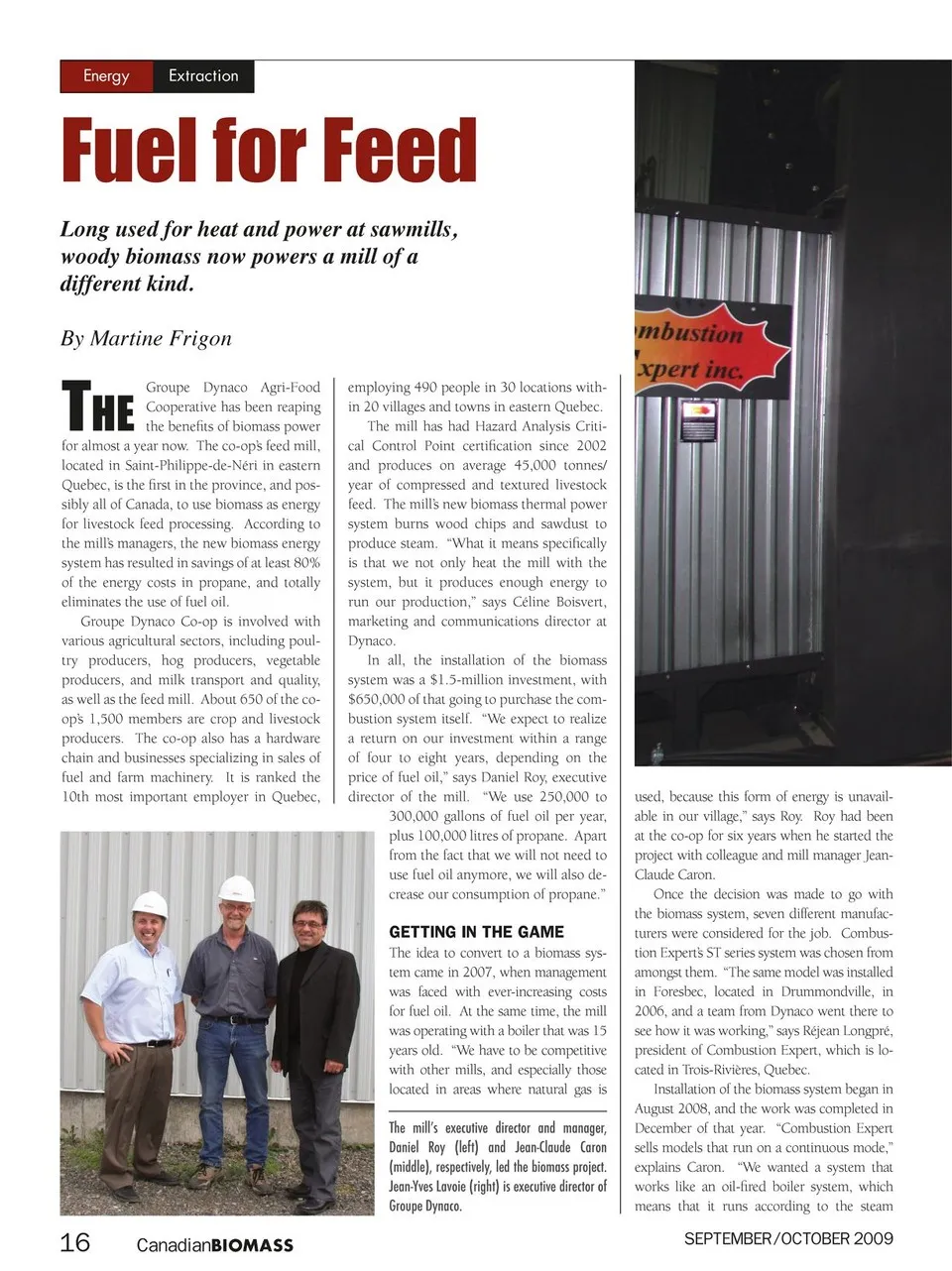
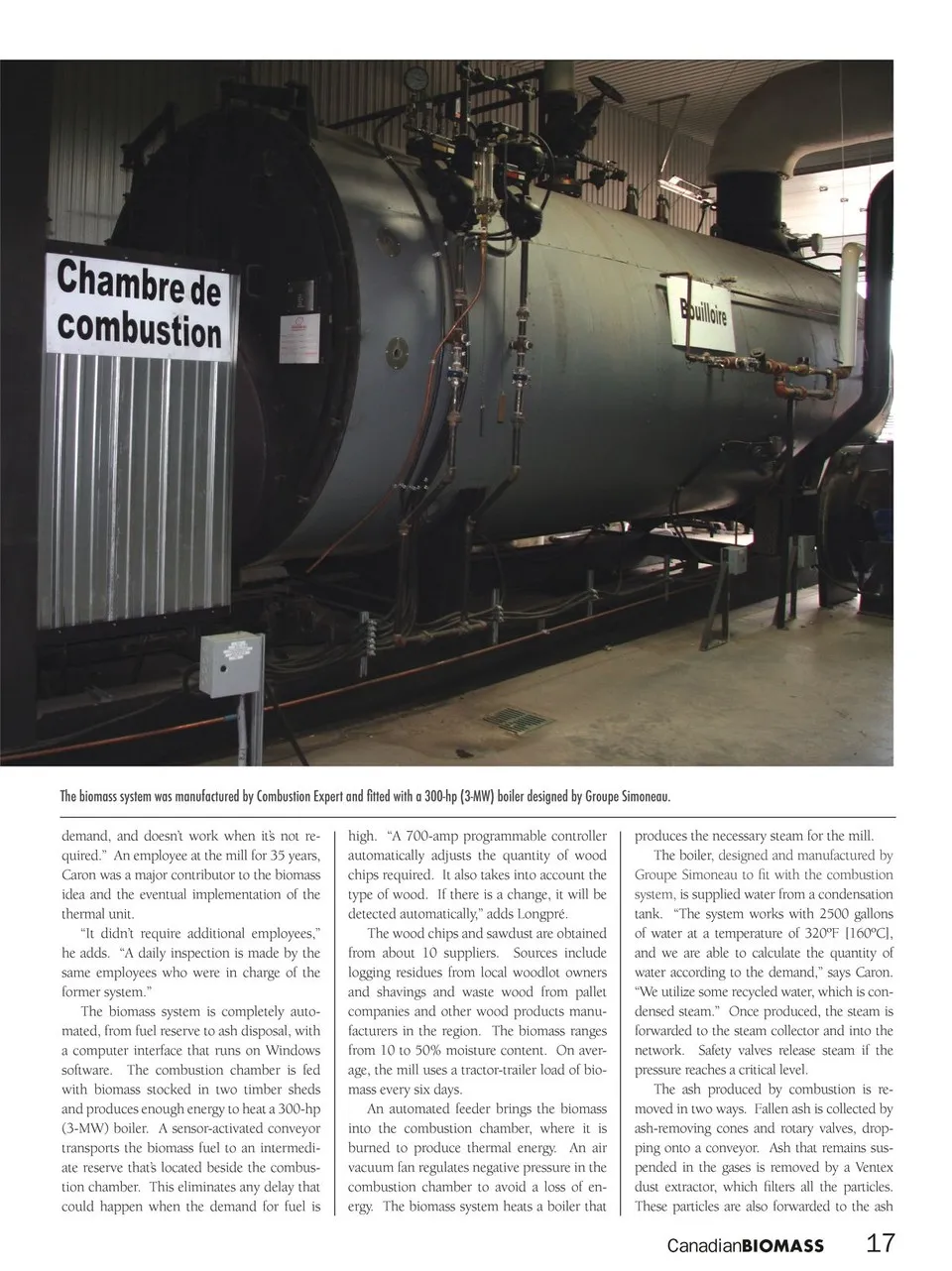
Energy Extraction Fuel for Feed Long used for heat and power at sawmills, woody biomass now powers a mill of a different kind. By Martine Frigon the Groupe Dynaco Agri-Food Cooperative has been reaping the benefits of biomass power for almost a year now. The co-op’s feed mill, located in Saint-Philippe-de-Néri in eastern Quebec, is the first in the province, and pos- sibly all of Canada, to use biomass as energy for livestock feed processing. According to the mill’s managers, the new biomass energy system has resulted in savings of at least 80% of the energy costs in propane, and totally eliminates the use of fuel oil. Groupe Dynaco Co-op is involved with various agricultural sectors, including poul- try producers, hog producers, vegetable producers, and milk transport and quality, as well as the feed mill. About 650 of the co- op’s 1,500 members are crop and livestock producers. The co-op also has a hardware chain and businesses specializing in sales of fuel and farm machinery. It is ranked the 10th most important employer in Quebec, employing 490 people in 30 locations with- in 20 villages and towns in eastern Quebec. The mill has had Hazard Analysis Criti- cal Control Point certification since 2002 and produces on average 45,000 tonnes/ year of compressed and textured livestock feed. The mill’s new biomass thermal power system burns wood chips and sawdust to produce steam. “What it means specifically is that we not only heat the mill with the system, but it produces enough energy to run our production,” says Céline Boisvert, marketing and communications director at Dynaco. In all, the installation of the biomass system was a $1.5-million investment, with $650,000 of that going to purchase the com- bustion system itself. “We expect to realize a return on our investment within a range of four to eight years, depending on the price of fuel oil,” says Daniel Roy, executive director of the mill. “We use 250,000 to 300,000 gallons of fuel oil per year, plus 100,000 litres of propane. Apart from the fact that we will not need to use fuel oil anymore, we will also de- crease our consumption of propane.” gettiNg iN the game The idea to convert to a biomass sys- tem came in 2007, when management was faced with ever-increasing costs for fuel oil. At the same time, the mill was operating with a boiler that was 15 years old. “We have to be competitive with other mills, and especially those located in areas where natural gas is The mill’s executive director and manager, Daniel Roy (left) and Jean-Claude Caron (middle), respectively, led the biomass project. Jean-Yves Lavoie (right) is executive director of Groupe Dynaco. 16 canadianBIOMASS used, because this form of energy is unavail- able in our village,” says Roy. Roy had been at the co-op for six years when he started the project with colleague and mill manager Jean- Claude Caron. Once the decision was made to go with the biomass system, seven different manufac- turers were considered for the job. Combus- tion Expert’s ST series system was chosen from amongst them. “The same model was installed in Foresbec, located in Drummondville, in 2006, and a team from Dynaco went there to see how it was working,” says Réjean Longpré, president of Combustion Expert, which is lo- cated in Trois-Rivières, Quebec. Installation of the biomass system began in August 2008, and the work was completed in December of that year. “Combustion Expert sells models that run on a continuous mode,” explains Caron. “We wanted a system that works like an oil-fired boiler system, which means that it runs according to the steam SepteMBeR/OctOBeR 2009
Canadian Biomass September/October 2009: Page 16