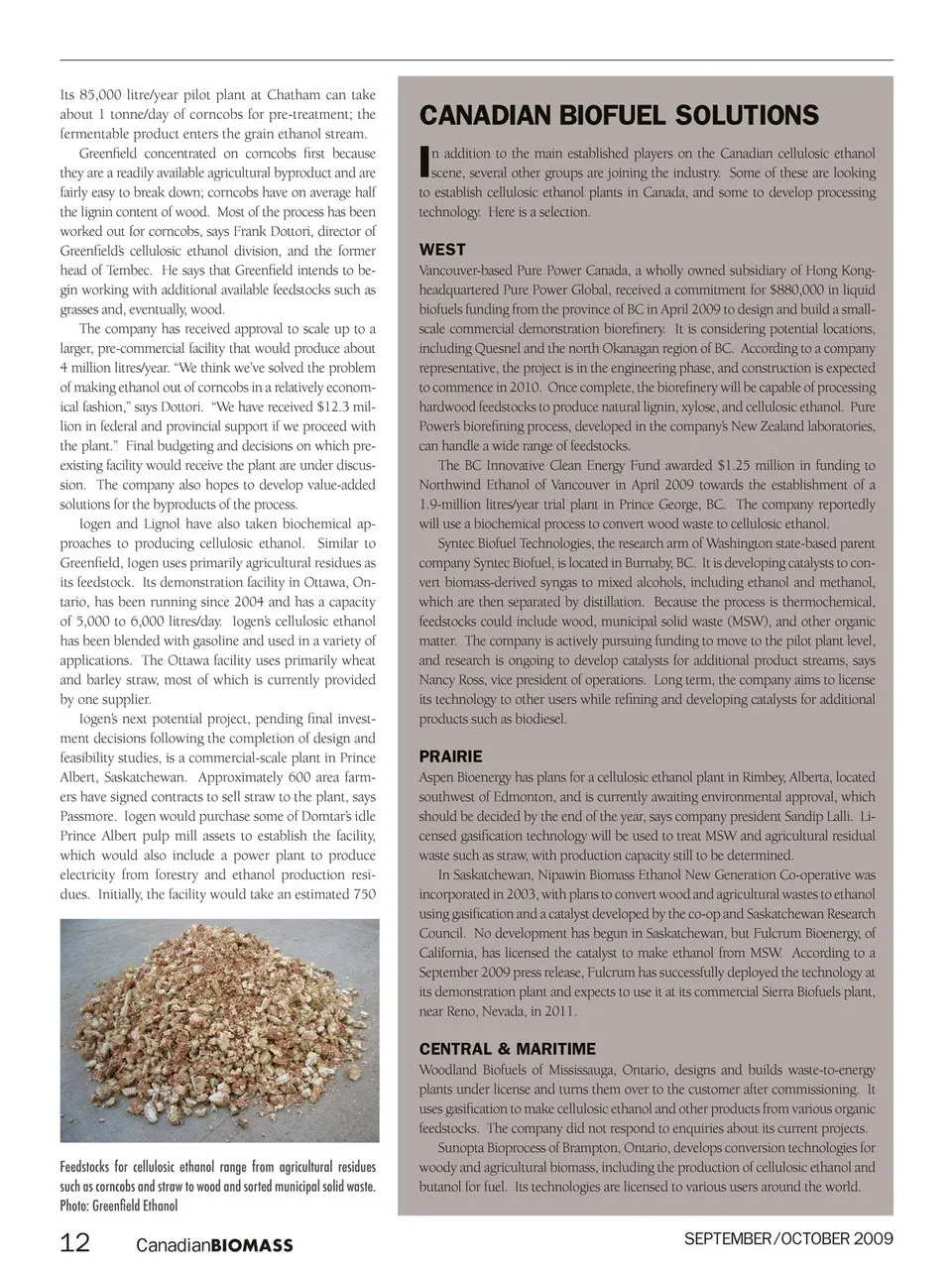
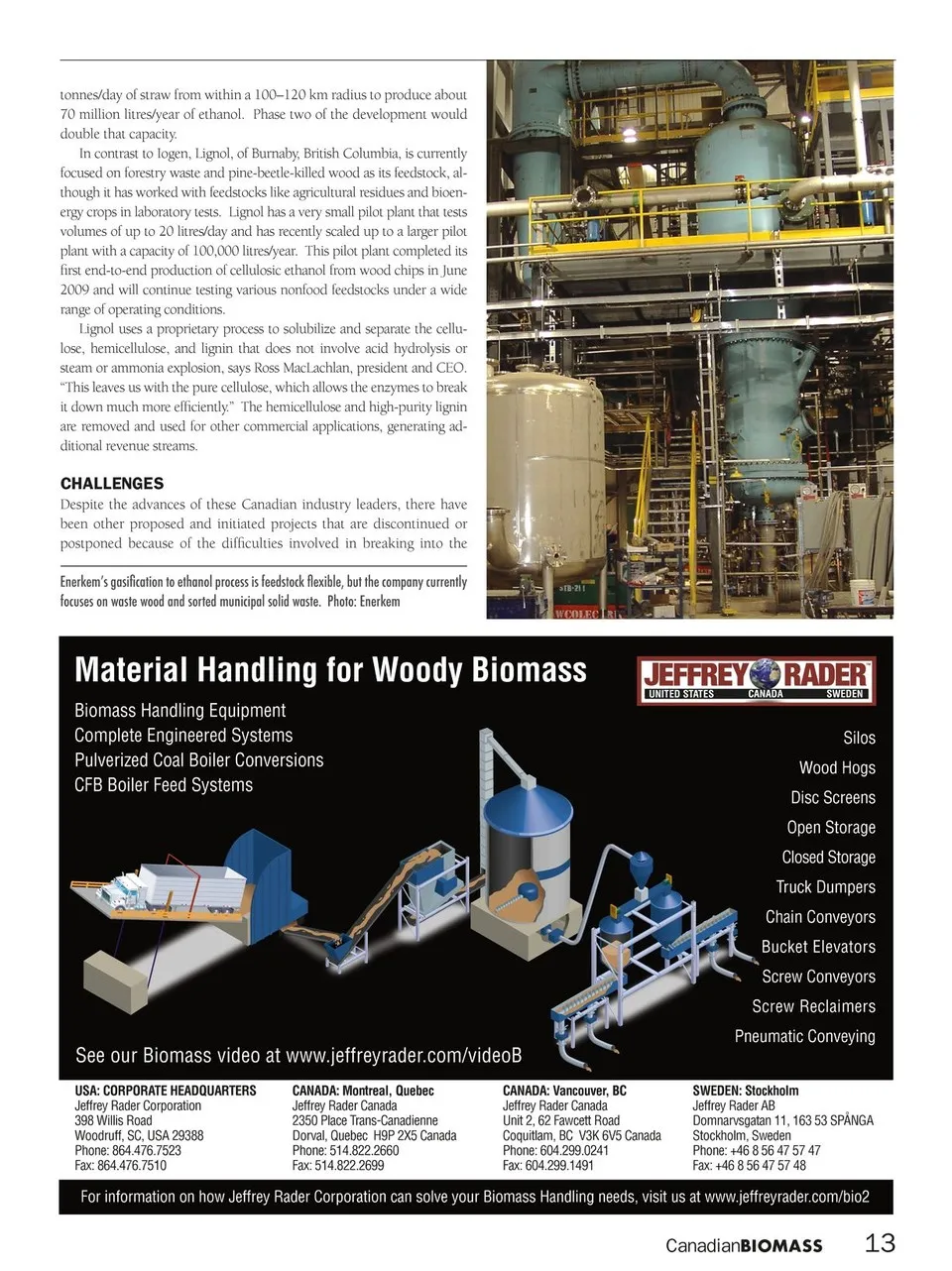
Its 85,000 litre/year pilot plant at Chatham can take about 1 tonne/day of corncobs for pre-treatment; the fermentable product enters the grain ethanol stream. Greenfield concentrated on corncobs first because they are a readily available agricultural byproduct and are fairly easy to break down; corncobs have on average half the lignin content of wood. Most of the process has been worked out for corncobs, says Frank Dottori, director of Greenfield’s cellulosic ethanol division, and the former head of Tembec. He says that Greenfield intends to be- gin working with additional available feedstocks such as grasses and, eventually, wood. The company has received approval to scale up to a larger, pre-commercial facility that would produce about 4 million litres/year. “We think we’ve solved the problem of making ethanol out of corncobs in a relatively econom- ical fashion,” says Dottori. “We have received $12.3 mil- lion in federal and provincial support if we proceed with the plant.” Final budgeting and decisions on which pre- existing facility would receive the plant are under discus- sion. The company also hopes to develop value-added solutions for the byproducts of the process. Iogen and Lignol have also taken biochemical ap- proaches to producing cellulosic ethanol. Similar to Greenfield, Iogen uses primarily agricultural residues as its feedstock. Its demonstration facility in Ottawa, On- tario, has been running since 2004 and has a capacity of 5,000 to 6,000 litres/day. Iogen’s cellulosic ethanol has been blended with gasoline and used in a variety of applications. The Ottawa facility uses primarily wheat and barley straw, most of which is currently provided by one supplier. Iogen’s next potential project, pending final invest- ment decisions following the completion of design and feasibility studies, is a commercial-scale plant in Prince Albert, Saskatchewan. Approximately 600 area farm- ers have signed contracts to sell straw to the plant, says Passmore. Iogen would purchase some of Domtar’s idle Prince Albert pulp mill assets to establish the facility, which would also include a power plant to produce electricity from forestry and ethanol production resi- dues. Initially, the facility would take an estimated 750 CaNadiaN BiofueL soLutioNs to establish cellulosic ethanol plants in Canada, and some to develop processing technology. Here is a selection. I west Vancouver-based Pure Power Canada, a wholly owned subsidiary of Hong Kong- headquartered Pure Power Global, received a commitment for $880,000 in liquid biofuels funding from the province of BC in April 2009 to design and build a small- scale commercial demonstration biorefinery. It is considering potential locations, including Quesnel and the north Okanagan region of BC. According to a company representative, the project is in the engineering phase, and construction is expected to commence in 2010. Once complete, the biorefinery will be capable of processing hardwood feedstocks to produce natural lignin, xylose, and cellulosic ethanol. Pure Power’s biorefining process, developed in the company’s New Zealand laboratories, can handle a wide range of feedstocks. The BC Innovative Clean Energy Fund awarded $1.25 million in funding to Northwind Ethanol of Vancouver in April 2009 towards the establishment of a 1.9-million litres/year trial plant in Prince George, BC. The company reportedly will use a biochemical process to convert wood waste to cellulosic ethanol. Syntec Biofuel Technologies, the research arm of Washington state-based parent company Syntec Biofuel, is located in Burnaby, BC. It is developing catalysts to con- vert biomass-derived syngas to mixed alcohols, including ethanol and methanol, which are then separated by distillation. Because the process is thermochemical, feedstocks could include wood, municipal solid waste (MSW), and other organic matter. The company is actively pursuing funding to move to the pilot plant level, and research is ongoing to develop catalysts for additional product streams, says Nancy Ross, vice president of operations. Long term, the company aims to license its technology to other users while refining and developing catalysts for additional products such as biodiesel. prairie Aspen Bioenergy has plans for a cellulosic ethanol plant in Rimbey, Alberta, located southwest of Edmonton, and is currently awaiting environmental approval, which should be decided by the end of the year, says company president Sandip Lalli. Li- censed gasification technology will be used to treat MSW and agricultural residual waste such as straw, with production capacity still to be determined. In Saskatchewan, Nipawin Biomass Ethanol New Generation Co-operative was incorporated in 2003, with plans to convert wood and agricultural wastes to ethanol using gasification and a catalyst developed by the co-op and Saskatchewan Research Council. No development has begun in Saskatchewan, but Fulcrum Bioenergy, of California, has licensed the catalyst to make ethanol from MSW. According to a September 2009 press release, Fulcrum has successfully deployed the technology at its demonstration plant and expects to use it at its commercial Sierra Biofuels plant, near Reno, Nevada, in 2011. CeNtraL & maritime Woodland Biofuels of Mississauga, Ontario, designs and builds waste-to-energy plants under license and turns them over to the customer after commissioning. It uses gasification to make cellulosic ethanol and other products from various organic feedstocks. The company did not respond to enquiries about its current projects. Sunopta Bioprocess of Brampton, Ontario, develops conversion technologies for Feedstocks for cellulosic ethanol range from agricultural residues such as corncobs and straw to wood and sorted municipal solid waste. Photo: Greenfield Ethanol 12 canadianBIOMASS woody and agricultural biomass, including the production of cellulosic ethanol and butanol for fuel. Its technologies are licensed to various users around the world. SepteMBeR/OctOBeR 2009 n addition to the main established players on the Canadian cellulosic ethanol scene, several other groups are joining the industry. Some of these are looking
Canadian Biomass September/October 2009: Page 12