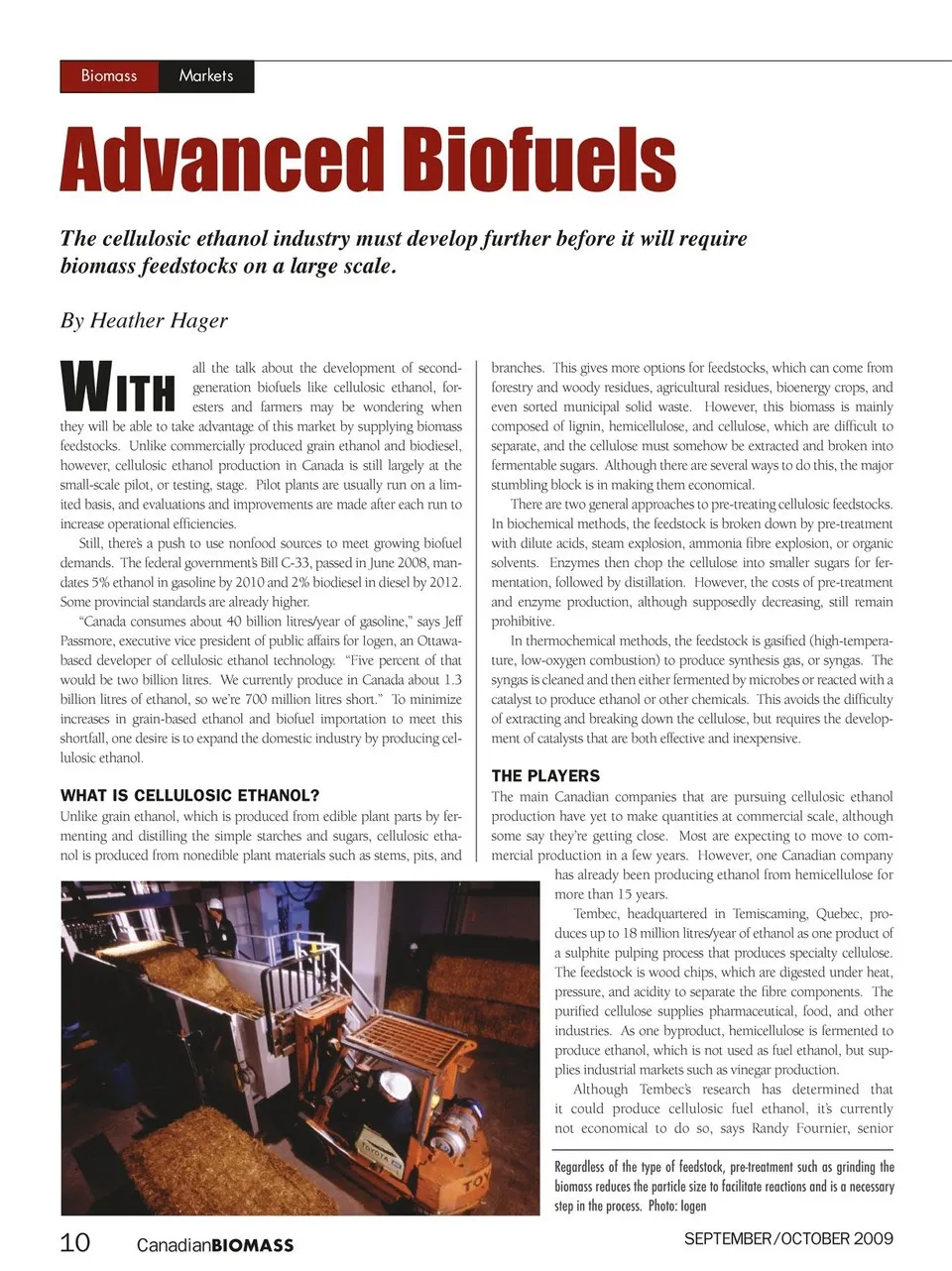
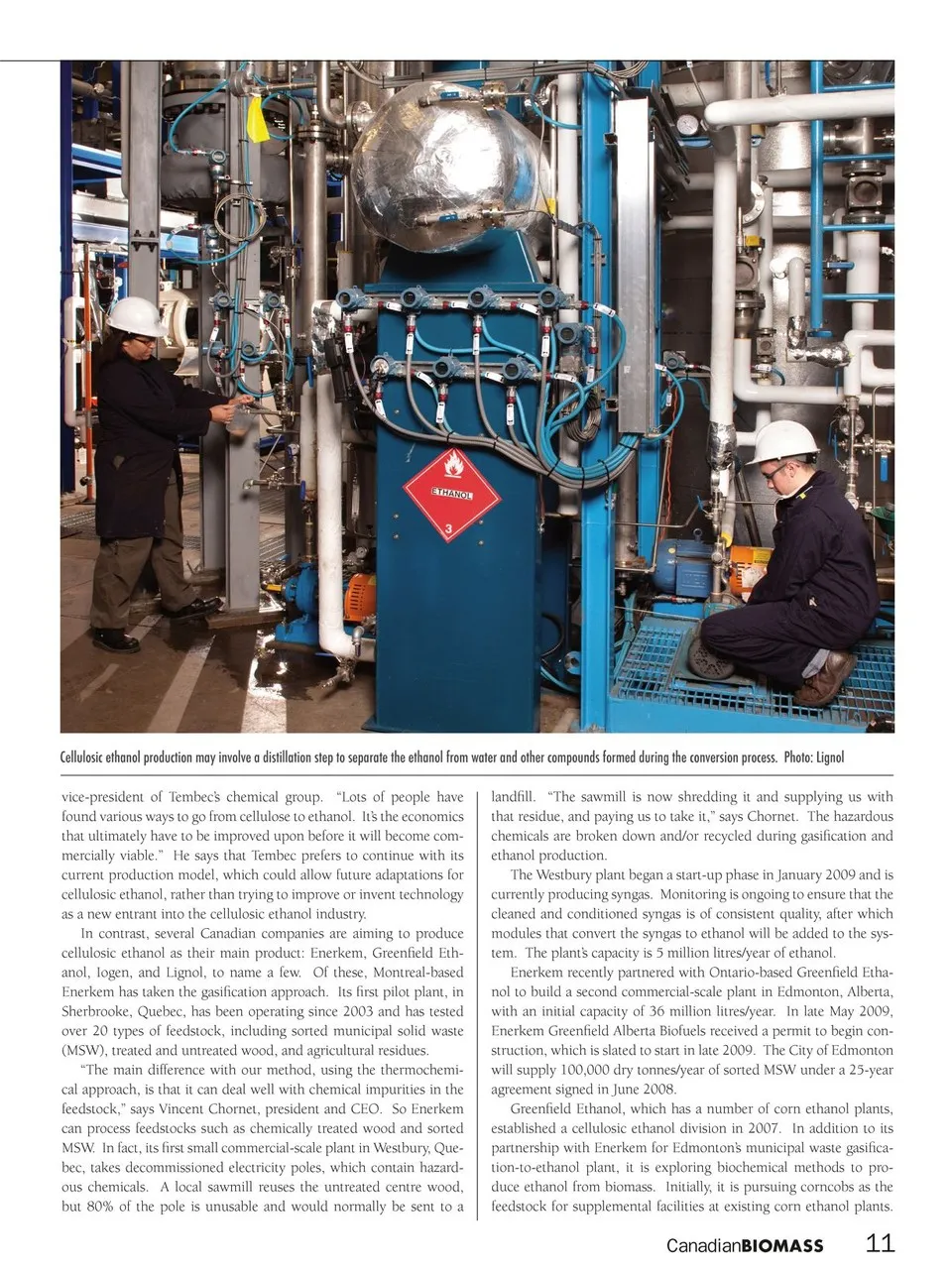
Cellulosic ethanol production may involve a distillation step to separate the ethanol from water and other compounds formed during the conversion process. Photo: Lignol vice-president of Tembec’s chemical group. “Lots of people have found various ways to go from cellulose to ethanol. It’s the economics that ultimately have to be improved upon before it will become com- mercially viable.” He says that Tembec prefers to continue with its current production model, which could allow future adaptations for cellulosic ethanol, rather than trying to improve or invent technology as a new entrant into the cellulosic ethanol industry. In contrast, several Canadian companies are aiming to produce cellulosic ethanol as their main product: Enerkem, Greenfield Eth- anol, Iogen, and Lignol, to name a few. Of these, Montreal-based Enerkem has taken the gasification approach. Its first pilot plant, in Sherbrooke, Quebec, has been operating since 2003 and has tested over 20 types of feedstock, including sorted municipal solid waste (MSW), treated and untreated wood, and agricultural residues. “The main difference with our method, using the thermochemi- cal approach, is that it can deal well with chemical impurities in the feedstock,” says Vincent Chornet, president and CEO. So Enerkem can process feedstocks such as chemically treated wood and sorted MSW. In fact, its first small commercial-scale plant in Westbury, Que- bec, takes decommissioned electricity poles, which contain hazard- ous chemicals. A local sawmill reuses the untreated centre wood, but 80% of the pole is unusable and would normally be sent to a landfill. “The sawmill is now shredding it and supplying us with that residue, and paying us to take it,” says Chornet. The hazardous chemicals are broken down and/or recycled during gasification and ethanol production. The Westbury plant began a start-up phase in January 2009 and is currently producing syngas. Monitoring is ongoing to ensure that the cleaned and conditioned syngas is of consistent quality, after which modules that convert the syngas to ethanol will be added to the sys- tem. The plant’s capacity is 5 million litres/year of ethanol. Enerkem recently partnered with Ontario-based Greenfield Etha- nol to build a second commercial-scale plant in Edmonton, Alberta, with an initial capacity of 36 million litres/year. In late May 2009, Enerkem Greenfield Alberta Biofuels received a permit to begin con- struction, which is slated to start in late 2009. The City of Edmonton will supply 100,000 dry tonnes/year of sorted MSW under a 25-year agreement signed in June 2008. Greenfield Ethanol, which has a number of corn ethanol plants, established a cellulosic ethanol division in 2007. In addition to its partnership with Enerkem for Edmonton’s municipal waste gasifica- tion-to-ethanol plant, it is exploring biochemical methods to pro- duce ethanol from biomass. Initially, it is pursuing corncobs as the feedstock for supplemental facilities at existing corn ethanol plants. canadianBIOMASS 11
Canadian Biomass September/October 2009: Page 11