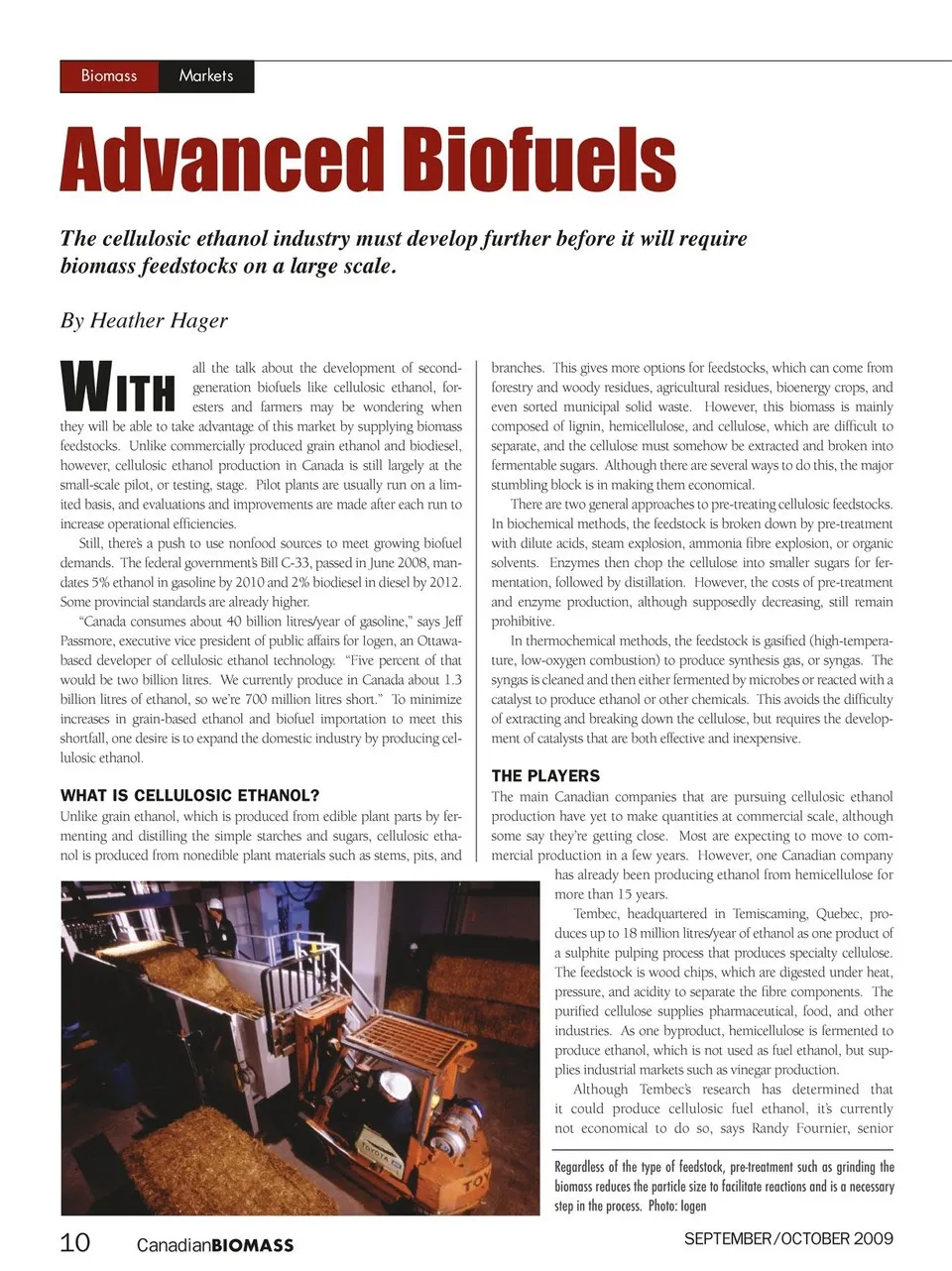
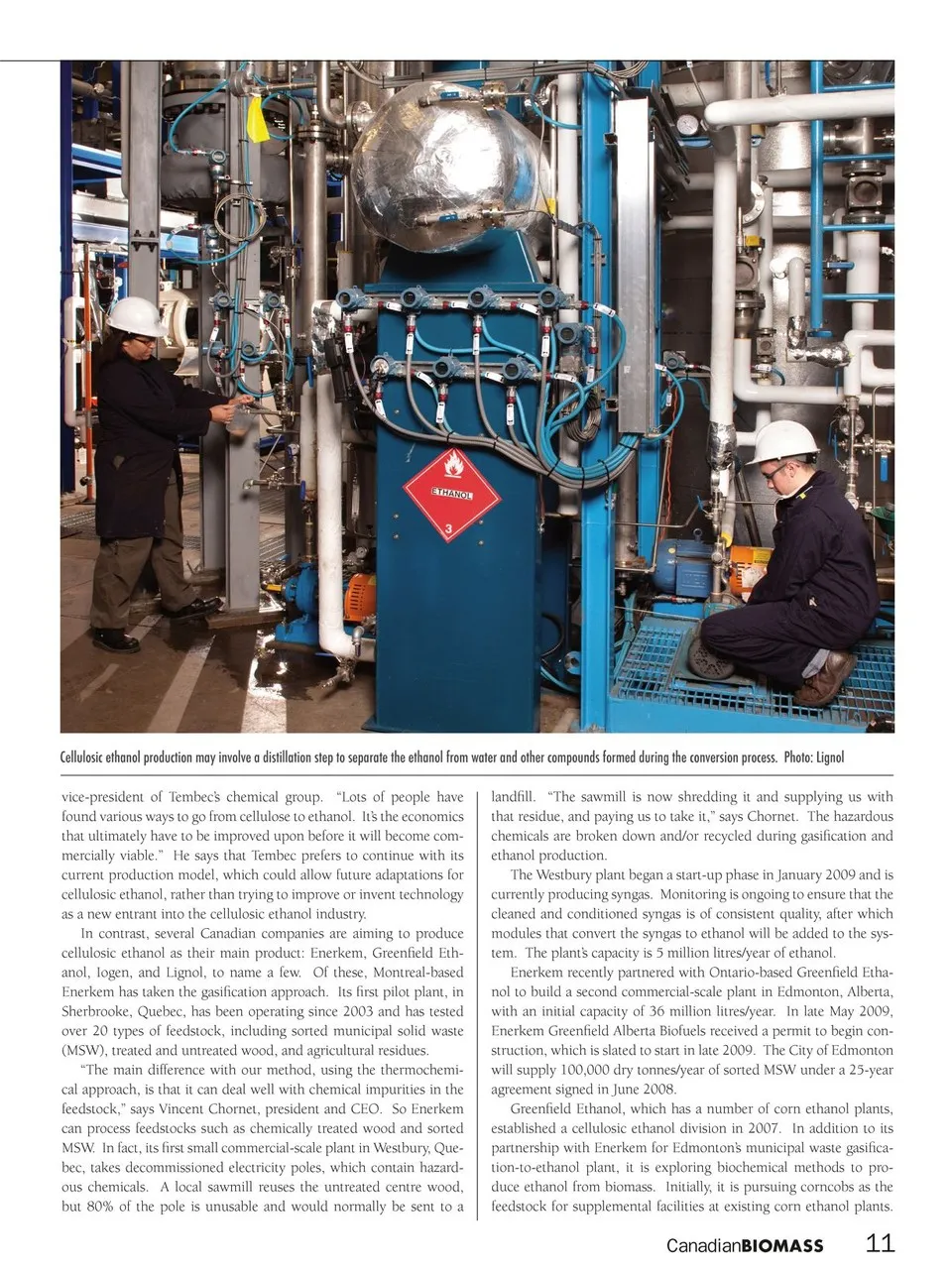
Biomass Markets Advanced Biofuels The cellulosic ethanol industry must develop further before it will require biomass feedstocks on a large scale. By Heather Hager they will be able to take advantage of this market by supplying biomass feedstocks. Unlike commercially produced grain ethanol and biodiesel, however, cellulosic ethanol production in Canada is still largely at the small-scale pilot, or testing, stage. Pilot plants are usually run on a lim- ited basis, and evaluations and improvements are made after each run to increase operational efficiencies. Still, there’s a push to use nonfood sources to meet growing biofuel With demands. The federal government’s Bill C-33, passed in June 2008, man- dates 5% ethanol in gasoline by 2010 and 2% biodiesel in diesel by 2012. Some provincial standards are already higher. “Canada consumes about 40 billion litres/year of gasoline,” says Jeff Passmore, executive vice president of public affairs for Iogen, an Ottawa- based developer of cellulosic ethanol technology. “Five percent of that would be two billion litres. We currently produce in Canada about 1.3 billion litres of ethanol, so we’re 700 million litres short.” To minimize increases in grain-based ethanol and biofuel importation to meet this shortfall, one desire is to expand the domestic industry by producing cel- lulosic ethanol. what is CeLLuLosiC ethaNoL? Unlike grain ethanol, which is produced from edible plant parts by fer- menting and distilling the simple starches and sugars, cellulosic etha- nol is produced from nonedible plant materials such as stems, pits, and all the talk about the development of second- generation biofuels like cellulosic ethanol, for- esters and farmers may be wondering when branches. This gives more options for feedstocks, which can come from forestry and woody residues, agricultural residues, bioenergy crops, and even sorted municipal solid waste. However, this biomass is mainly composed of lignin, hemicellulose, and cellulose, which are difficult to separate, and the cellulose must somehow be extracted and broken into fermentable sugars. Although there are several ways to do this, the major stumbling block is in making them economical. There are two general approaches to pre-treating cellulosic feedstocks. In biochemical methods, the feedstock is broken down by pre-treatment with dilute acids, steam explosion, ammonia fibre explosion, or organic solvents. Enzymes then chop the cellulose into smaller sugars for fer- mentation, followed by distillation. However, the costs of pre-treatment and enzyme production, although supposedly decreasing, still remain prohibitive. In thermochemical methods, the feedstock is gasified (high-tempera- ture, low-oxygen combustion) to produce synthesis gas, or syngas. The syngas is cleaned and then either fermented by microbes or reacted with a catalyst to produce ethanol or other chemicals. This avoids the difficulty of extracting and breaking down the cellulose, but requires the develop- ment of catalysts that are both effective and inexpensive. the pLayers The main Canadian companies that are pursuing cellulosic ethanol production have yet to make quantities at commercial scale, although some say they’re getting close. Most are expecting to move to com- mercial production in a few years. However, one Canadian company has already been producing ethanol from hemicellulose for more than 15 years. Tembec, headquartered in Temiscaming, Quebec, pro- duces up to 18 million litres/year of ethanol as one product of a sulphite pulping process that produces specialty cellulose. The feedstock is wood chips, which are digested under heat, pressure, and acidity to separate the fibre components. The purified cellulose supplies pharmaceutical, food, and other industries. As one byproduct, hemicellulose is fermented to produce ethanol, which is not used as fuel ethanol, but sup- plies industrial markets such as vinegar production. Although Tembec’s research has determined that it could produce cellulosic fuel ethanol, it’s currently not economical to do so, says Randy Fournier, senior Regardless of the type of feedstock, pre-treatment such as grinding the biomass reduces the particle size to facilitate reactions and is a necessary step in the process. Photo: Iogen 10 canadianBIOMASS SepteMBeR/OctOBeR 2009
Canadian Biomass September/October 2009: Page 10