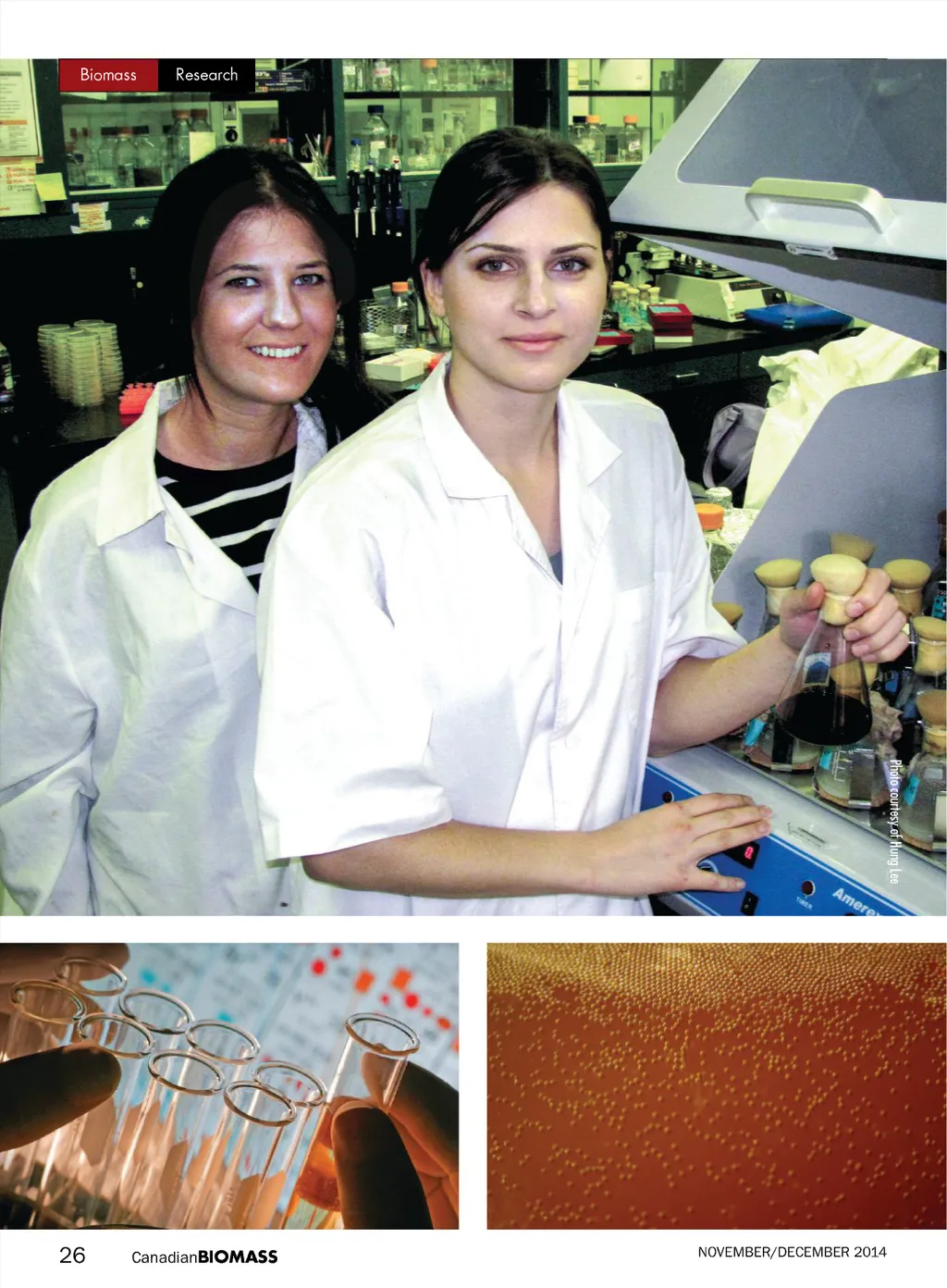
Better yield from yeast Microbiologists manipulate genetics to boost the efficiency of ethanol production. By Annie Webb Like all industrial pro-cesses, the creation of pulp leaves a residue of waste. To the Canadian for-est-products company Tembec, this waste has spawned a sideline business. Long before the current biorefinery craze, Tembec decided to convert the waste into something of value: ethanol (ethyl alco-hol), the two-carbon molecule that gives alcoholic beverages their kick and has a wide variety of commercial uses. Nestled in the rugged Temiscaming re-gion of Quebec, Tembec’s pulp and paper mill incorporates an ethanol production facility, which produces high-purity eth-anol from natural wood sugars extracted from the residue of the pulping process. It wasn’t long before Tembec became a leading supplier of high-grade etha-nol to Eastern Canada and the Northern U.S., with customers in a broad swath of industries. It didn’t hurt that the federal government’s Bill C-33, passed in 2008, mandated that ethanol comprise five per cent of gasoline by 2010. There’s just one problem: the conver-sion process leaves much to be desired in terms of efficiency – and profitability. Tembec produces the ethanol from spent sulfite liquor (SSL), a by-product of pulping. Rich in lignin and hemicel-lulose, compounds extruded from wood chips during the pulping process, SSL re-tains one ton of lignocellulosic material for every ton of paper fibre produced. The plant has been using the common baker’s yeast, Saccharomyces cerevisiae, to ferment SSL and produce ethanol. While the yeast does a fine job of converting the hexose sugars in the mix – chiefly glucose and mannose – into ethanol, it falls short in fermenting pentose sugars such as xy-lose. If this constraint could be surmount-ed, the plant could produce as much as 25 per cent more alcohol. As all entrepre-neurs know, a 25-per cent difference can make or break a business venture. Well aware of the problem, microbiol-ogists have been trying to engineer yeast strains capable of fermenting both glucose and xylose to ethanol. Most of them have focused on tinkering with the S. cerevisiae strain to enable it to ferment xylose. A team of BioFuelNet researchers has taken a different tack: improving the na-tive pentose-fermenting yeasts Scheffer-somyces stipitis and Pachysolen tannoph-ilus. While these strains can also ferment hexose sugars, they have several unfortu-nate properties that limit the efficiency of the process, says team lead Dr. Hung Lee, a professor in the School of Environmen-tal Sciences at the University of Guelph. For one thing, they’re highly sensitive to inhibitory substances in the SSL --such as acetic acid and furfural – that put the brakes on yeast cell growth and fermen-tation. The strains are also susceptible to glucose repression, meaning that glucose can prevent the yeast from fermenting the other sugars. Finally, these yeasts have a very low ethanol tolerance, so that even low concentrations of ethanol can stop the fermentation process in its tracks. “The key challenge is to develop eth-anol-producing microorganisms that are tolerant to all the inhibitory compounds generated during the wood-pulping pro-cess,” Dr. Lee explains. “The organism must also be able to ferment all the sug-ars, including pentoses, into ethanol.” (It should be noted that these inhibitory compounds are found not only in the SSL produced by Tembec, but also in the “lig-nocellulosic hydrolysates” produced by other companies seeking to convert bio-mass substrate into fuels or chemicals.) In hopes of producing such strains, Dr. Lee’s team used simple genetic tools such as random mutagenesis and genome shuffling. They started by testing their genetically-engineered strains on SSL supplied by Tembec. Next, they put the strains to work on lignocellulosic hydro-lysates supplied by BP Biofuels, FPInno-vations, GreenField Ethanol, Lignol, and Mascoma Canada, among other partners. The effort paid off in spades: “We found that our modified strains ferment the sug-ars in the hydrolysates more efficiently than the native strains,” says Dr. Lee. Dr. Lee feels confident that this cut-ting-edge research has commercial value. “We’ve had very encouraging results in terms of ethanol yield, and some com-panies have shown strong interest in our inhibitor-tolerant yeast strains,” he says. Building on this success, the team plans to conduct similar genetic refine-ments on other pentose-fermenting yeasts. Dr. Lee’s team has also been col-laborating with Mount Sinai Hospital in Toronto to sequence the entire genome of the improved yeasts to locate the genes responsible for inhibitor tolerance. Dr. Lee is the first to admit that the venture might never have seen the light of day without funding from BioFuelNet. Along with financial backing, the organi-zation provided contacts and networking opportunities. “Such connections can make the difference between a project stalling and getting off the ground,” he reflects, “getting the right people working together is how the magic happens.” • MAIN: -Nicole Harner (PhD student) and Terri Richardson (MSc student) check the status of the fermenting yeast cultures. BOTTOM LEFT: The research team set out to develop ethanol-producing microorganisms that are more tolerant. BOTTOM RIGHT: The organism must also produce a better yield. Canadian BIOMASS 27
Canadian Biomass November - December 2014: Page 27