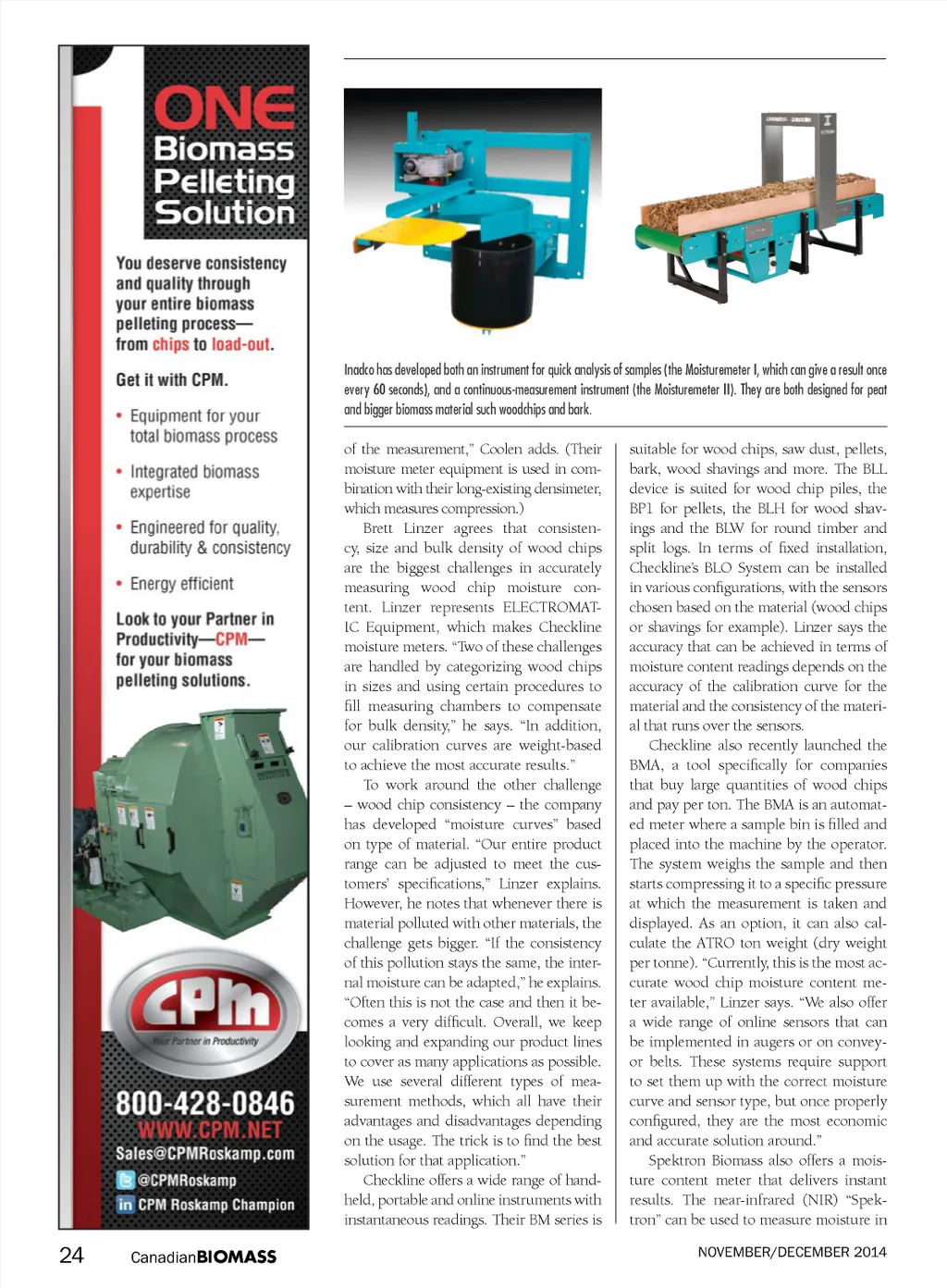
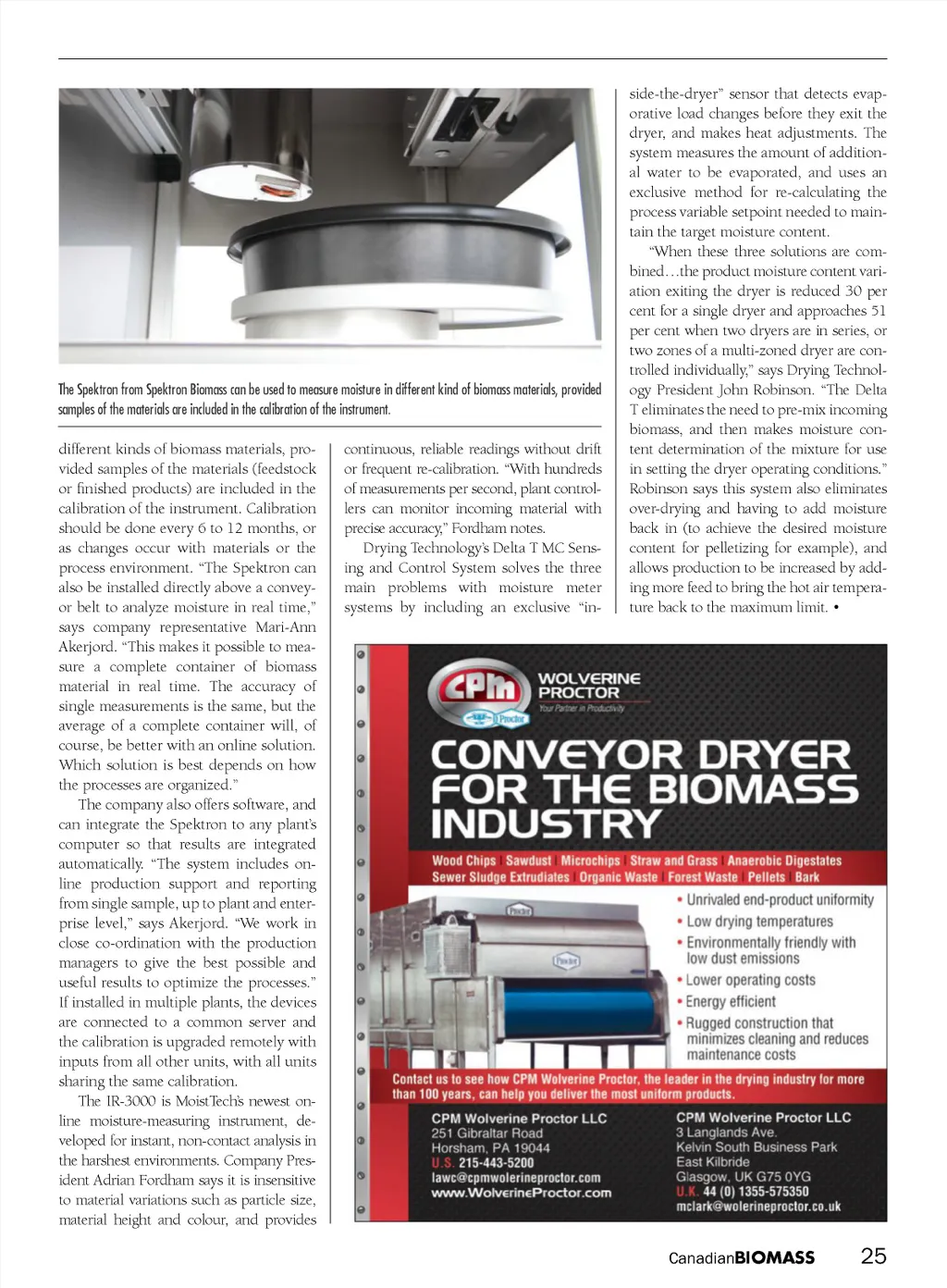
Inadco has developed both an instrument for quick analysis of samples (the Moisturemeter I, which can give a result once every 60 seconds), and a continuous-measurement instrument (the Moisturemeter II). They are both designed for peat and bigger biomass material such woodchips and bark. of the measurement,” Coolen adds. (Their moisture meter equipment is used in com-bination with their long-existing densimeter, which measures compression.) Brett Linzer agrees that consisten-cy, size and bulk density of wood chips are the biggest challenges in accurately measuring wood chip moisture con-tent. Linzer represents ELECTROMAT-IC Equipment, which makes Checkline moisture meters. “Two of these challenges are handled by categorizing wood chips in sizes and using certain procedures to fill measuring chambers to compensate for bulk density,” he says. “In addition, our calibration curves are weight-based to achieve the most accurate results.” To work around the other challenge – wood chip consistency – the company has developed “moisture curves” based on type of material. “Our entire product range can be adjusted to meet the cus-tomers’ specifications,” Linzer explains. However, he notes that whenever there is material polluted with other materials, the challenge gets bigger. “If the consistency of this pollution stays the same, the inter-nal moisture can be adapted,” he explains. “Often this is not the case and then it be-comes a very difficult. Overall, we keep looking and expanding our product lines to cover as many applications as possible. We use several different types of mea-surement methods, which all have their advantages and disadvantages depending on the usage. The trick is to find the best solution for that application.” Checkline offers a wide range of hand-held, portable and online instruments with instantaneous readings. Their BM series is suitable for wood chips, saw dust, pellets, bark, wood shavings and more. The BLL device is suited for wood chip piles, the BP1 for pellets, the BLH for wood shav-ings and the BLW for round timber and split logs. In terms of fixed installation, Checkline’s BLO System can be installed in various configurations, with the sensors chosen based on the material (wood chips or shavings for example). Linzer says the accuracy that can be achieved in terms of moisture content readings depends on the accuracy of the calibration curve for the material and the consistency of the materi-al that runs over the sensors. Checkline also recently launched the BMA, a tool specifically for companies that buy large quantities of wood chips and pay per ton. The BMA is an automat-ed meter where a sample bin is filled and placed into the machine by the operator. The system weighs the sample and then starts compressing it to a specific pressure at which the measurement is taken and displayed. As an option, it can also cal-culate the ATRO ton weight (dry weight per tonne). “Currently, this is the most ac-curate wood chip moisture content me-ter available,” Linzer says. “We also offer a wide range of online sensors that can be implemented in augers or on convey-or belts. These systems require support to set them up with the correct moisture curve and sensor type, but once properly configured, they are the most economic and accurate solution around.” Spektron Biomass also offers a mois-ture content meter that delivers instant results. The near-infrared (NIR) “Spek-tron” can be used to measure moisture in NOVEMBER/DECEMBER 2014 24 Canadian BIOMASS
Canadian Biomass November - December 2014: Page 24