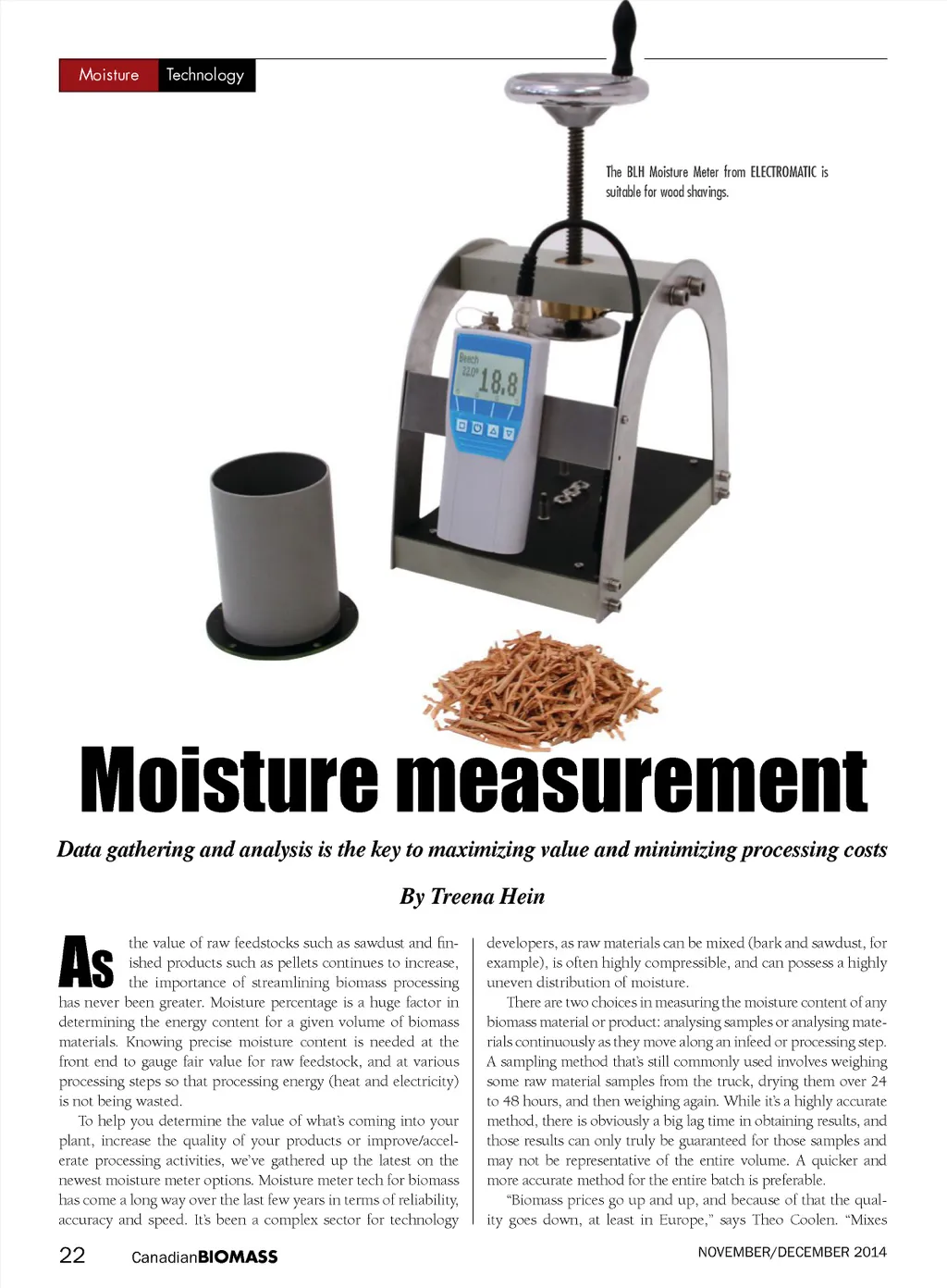
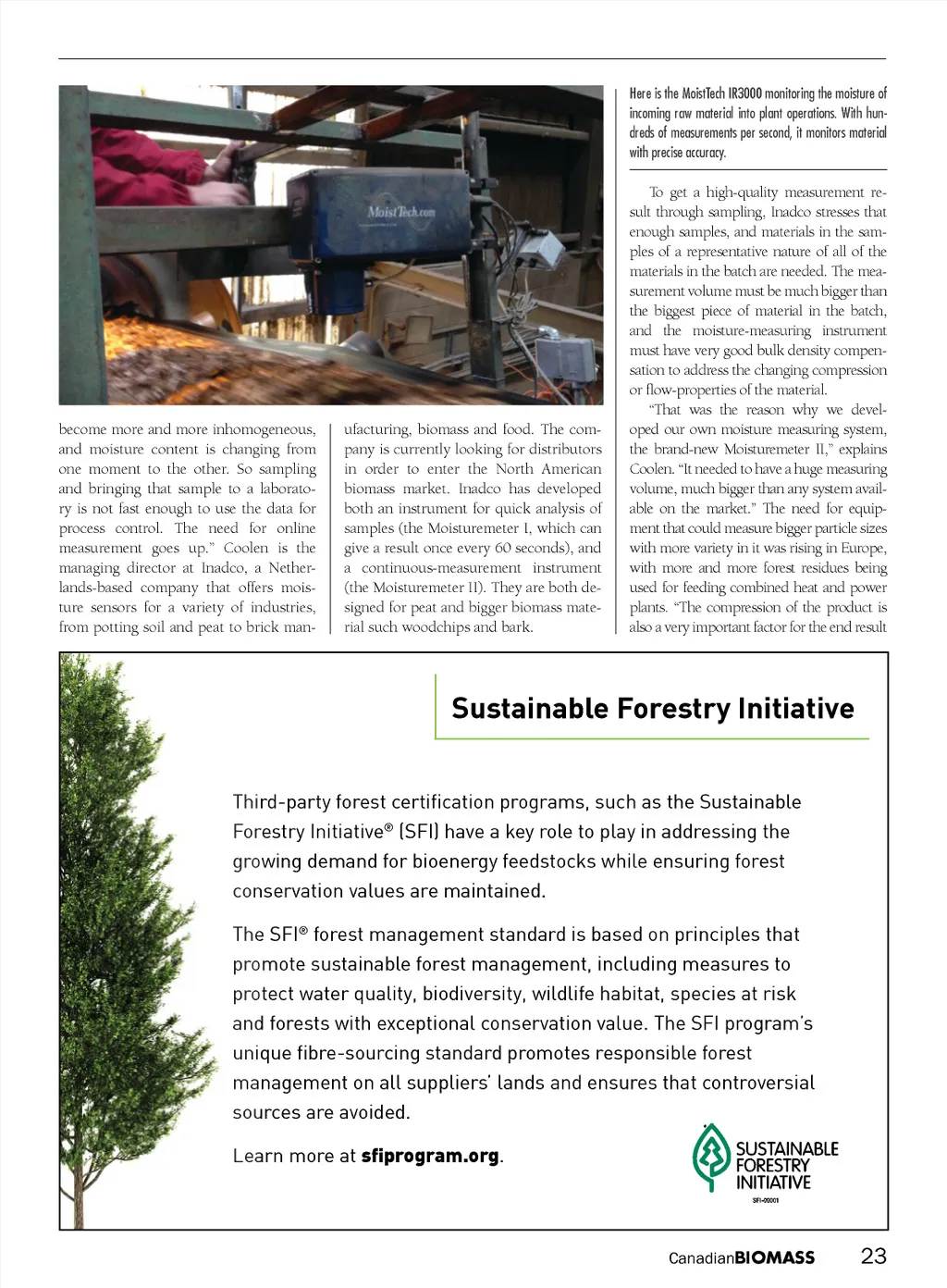
Here is the MoistTech IR3000 monitoring the moisture of incoming raw material into plant operations. With hun-dreds of measurements per second, it monitors material with precise accuracy. become more and more inhomogeneous, and moisture content is changing from one moment to the other. So sampling and bringing that sample to a laborato-ry is not fast enough to use the data for process control. The need for online measurement goes up.” Coolen is the managing director at Inadco, a Nether-lands-based company that offers mois-ture sensors for a variety of industries, from potting soil and peat to brick man-ufacturing, biomass and food. The com-pany is currently looking for distributors in order to enter the North American biomass market. Inadco has developed both an instrument for quick analysis of samples (the Moisturemeter I, which can give a result once every 60 seconds), and a continuous-measurement instrument (the Moisturemeter II). They are both de-signed for peat and bigger biomass mate-rial such woodchips and bark. To get a high-quality measurement re-sult through sampling, Inadco stresses that enough samples, and materials in the sam-ples of a representative nature of all of the materials in the batch are needed. The mea-surement volume must be much bigger than the biggest piece of material in the batch, and the moisture-measuring instrument must have very good bulk density compen-sation to address the changing compression or flow-properties of the material. “That was the reason why we devel-oped our own moisture measuring system, the brand-new Moisturemeter II,” explains Coolen. “It needed to have a huge measuring volume, much bigger than any system avail-able on the market.” The need for equip-ment that could measure bigger particle sizes with more variety in it was rising in Europe, with more and more forest residues being used for feeding combined heat and power plants. “The compression of the product is also a very important factor for the end result Sustainable Forestry Initiative Third-party forest certifi cation programs, such as the Sustainable Forestry Initiative ® (SFI) have a key role to play in addressing the growing demand for bioenergy feedstocks while ensuring forest conservation values are maintained. The SFI ® forest management standard is based on principles that promote sustainable forest management, including measures to protect water quality, biodiversity, wildlife habitat, species at risk and forests with exceptional conservation value. The SFI program’s unique fi bre-sourcing standard promotes responsible forest management on all suppliers’ lands and ensures that controversial sources are avoided. Learn more at sfi program.org . SFI_Canadian_Biomass_Ad_Nov2014_Final.indd 1 Canadian BIOMASS 2014-11-13 12:01 PM 23
Canadian Biomass November - December 2014: Page 23