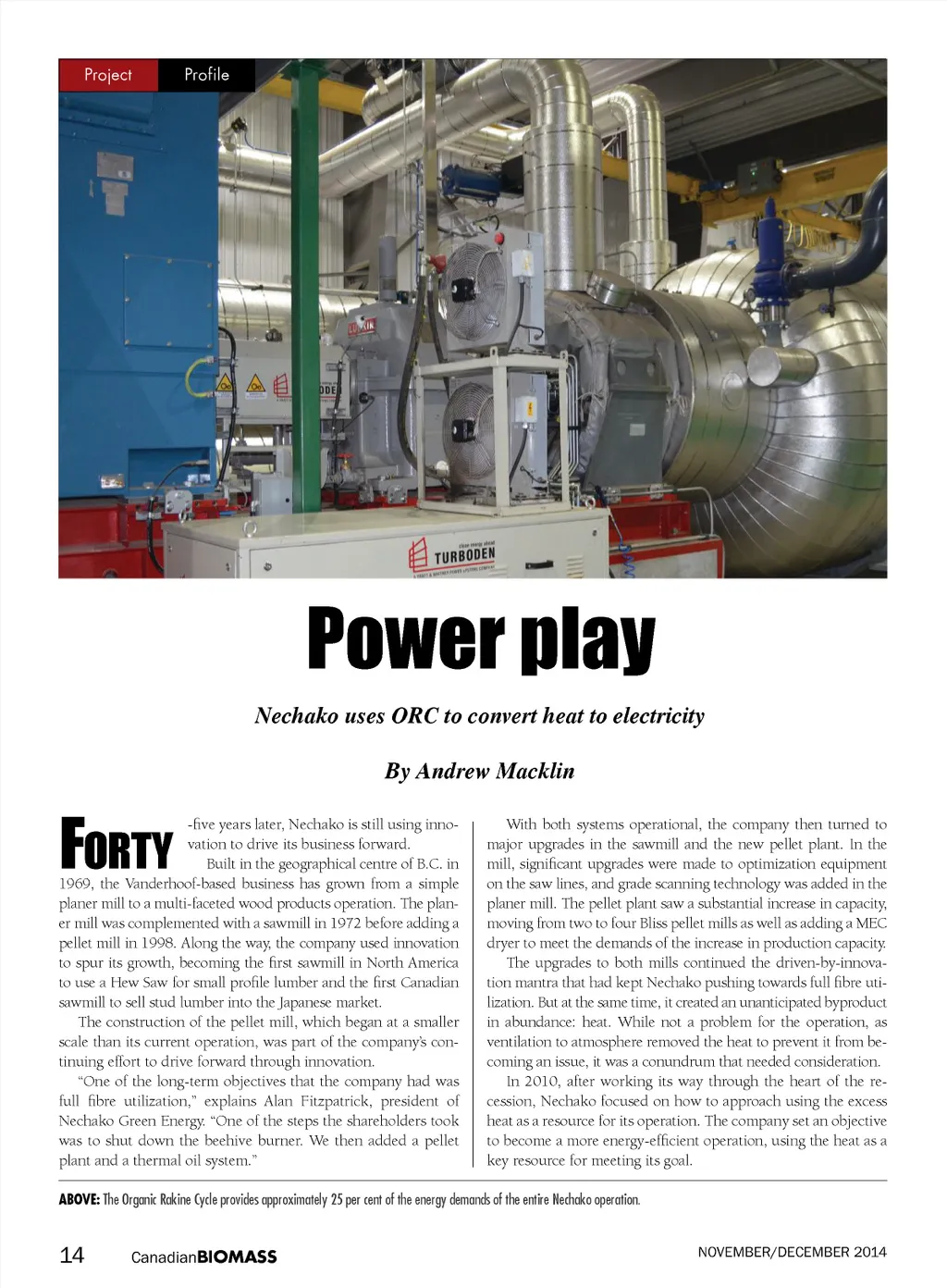
After significant due diligence lasting nearly two years, Nechako decided that the best system to invest in was an Organ-ic Rankine Cycle. The ORC uses an organic fluid that vapourizes at a lower temperature than the change from water to steam. The vapour then passes through a turbine to generate electricity. To complete the cycle, the fluid is cooled, condensed and brought back into the beginning of the loop. Nechako’s research into the ORC technology led them to Ita-ly-based Turboden, one of a handful of global manufacturers of the system. “Turboden’s technology was the one that best fit what our operation was,” says Fitzpatrick. “The Turboden ORC is a very efficient form of electricity creation.” GRANT OPPORTUNITIES In 2010, around the same time that Nechako began its research into what to do with excess heat, the Government of Canada announced the creation of the IFIT program. The Investments in Forest Industry Transformation program was an initiative of the Ministry of Natural Resources, providing $100 million in non-repayable contributions of up to 50 per cent for capital investment in new technologies over four years. The first and second call combined (Nechako applied during the first call) produced 107 applications from across the country. Based on the strength of its application and, presumably, the company’s track record of innovation, Nechako was successful in its bid to receive IFIT funding to cover part of the cost of the ac-quisition, transport and building infrastructure cost of the ORC. The release sent in regards to Nechako’s successful application stated that the technology being incorporated by the company has “significant potential for replication across the industry.” In total, Nechako was given $2.1 million of the budgeted $6.8 mil-lion project. Construction and installation of the ORC began in July of 2012 and was completed in March of 2013. The project was completed both on time and on budget. Day-to-day operation of the ORC in-volves two staff per shift, who monitor the system’s performance through an electronic tracking system, spitting out real-time data on a computer located in a secondary office adjacent to the ORC. At current operation levels, the ORC provides approximately 25 per cent of the energy demands of the entire Nechako oper-ation. That’s enough electricity generation to offset most of the energy demands of operating the pellet plant, which produces upwards of 180,000 tonnes of pellets per year. Monetarily, the cost savings of using the ORC are significant for the operation. Even more so now, as the B.C. Government announced a 15.6 per cent hike in power rates over a two-year period back in November of 2013. That rate could jump even higher if demand continues to rise in the province and the gov-ernment leans on energy rates to help pay off increasing debt. In addition to the financial benefits of the installation of the ORC, Nechako is also experiencing a positive bump in its repu-tation both in the community and in the forestry sector. 20141110 -Ad Canadian Biomass Dec 2014.pdf 1 10-11-2014 17:00:00 “It reinforced our position in the industry as a leader in in-MOISTURE MEASUREMENT EQUIPMENT Moisturemeter II Now also continuous measurement in Biomass With integrated beltweigher Ideal for realtime calculation of the calorific value C Patent-pending M Y Moisturemeter I Moisturemeasurement by filling the measuringcylinder with samples taken out of a shoot Fully automatic results CM MY CY CMY K Mobile Moisturemeter Determining moisturecontent by filling the measuringcylinder manually For more information look at : www.moisturemeasuring.eu Canadian BIOMASS DEVELOPER OF MEASURING-EQUIPMENT 15
Canadian Biomass November - December 2014: Page 15