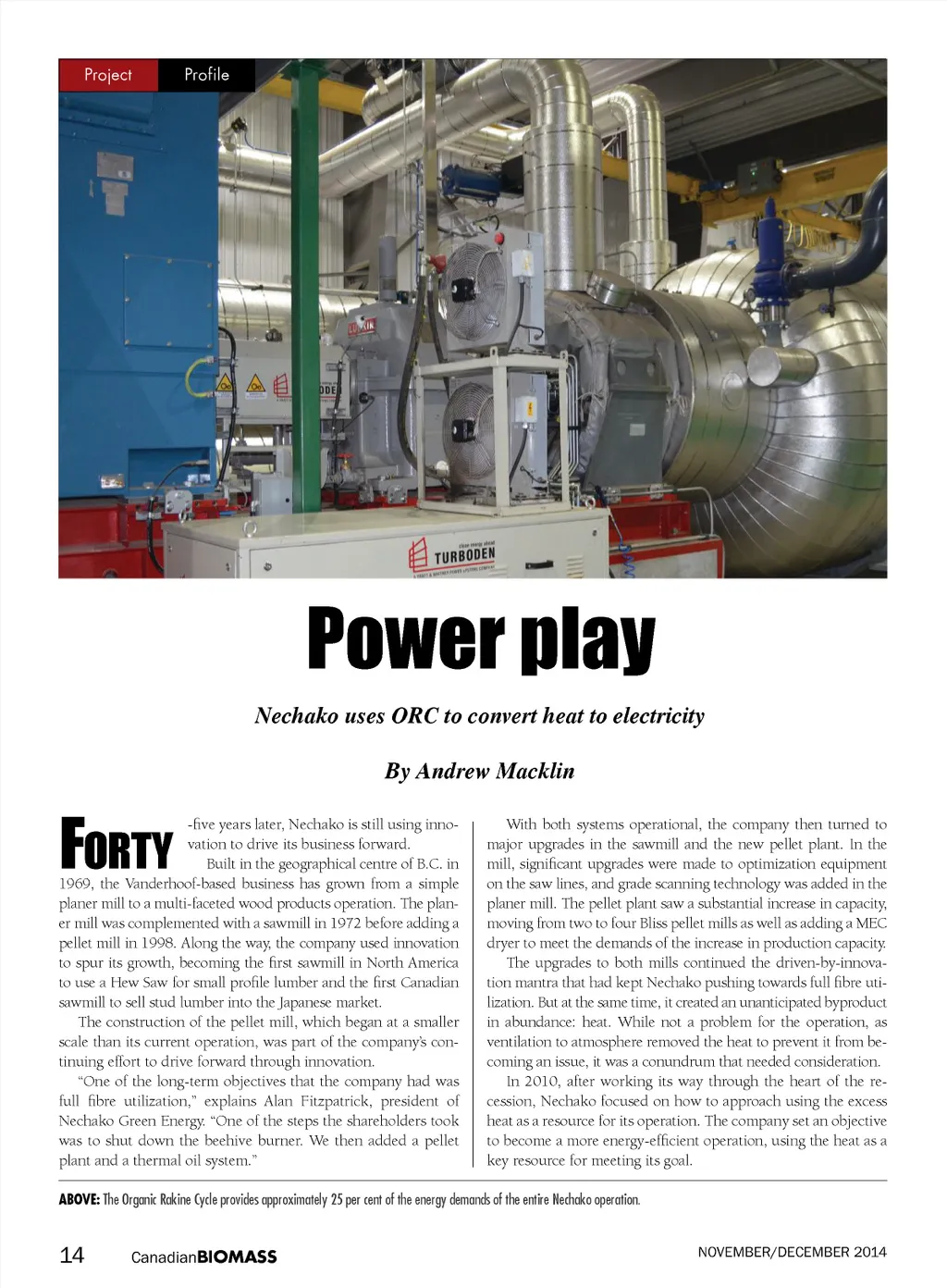
Project Profile Power play Nechako uses ORC to convert heat to electricity By Andrew Macklin F orTy -five years later, Nechako is still using inno-vation to drive its business forward. Built in the geographical centre of B.C. in 1969, the Vanderhoof-based business has grown from a simple planer mill to a multi-faceted wood products operation. The plan-er mill was complemented with a sawmill in 1972 before adding a pellet mill in 1998. Along the way, the company used innovation to spur its growth, becoming the first sawmill in North America to use a Hew Saw for small profile lumber and the first Canadian sawmill to sell stud lumber into the Japanese market. The construction of the pellet mill, which began at a smaller scale than its current operation, was part of the company’s con-tinuing effort to drive forward through innovation. “One of the long-term objectives that the company had was full fibre utilization,” explains Alan Fitzpatrick, president of Nechako Green Energy. “One of the steps the shareholders took was to shut down the beehive burner. We then added a pellet plant and a thermal oil system.” With both systems operational, the company then turned to major upgrades in the sawmill and the new pellet plant. In the mill, significant upgrades were made to optimization equipment on the saw lines, and grade scanning technology was added in the planer mill. The pellet plant saw a substantial increase in capacity, moving from two to four Bliss pellet mills as well as adding a MEC dryer to meet the demands of the increase in production capacity. The upgrades to both mills continued the driven-by-innova-tion mantra that had kept Nechako pushing towards full fibre uti-lization. But at the same time, it created an unanticipated byproduct in abundance: heat. While not a problem for the operation, as ventilation to atmosphere removed the heat to prevent it from be-coming an issue, it was a conundrum that needed consideration. In 2010, after working its way through the heart of the re-cession, Nechako focused on how to approach using the excess heat as a resource for its operation. The company set an objective to become a more energy-efficient operation, using the heat as a key resource for meeting its goal. ABOVE: The Organic Rakine Cycle provides approximately 25 per cent of the energy demands of the entire Nechako operation. 14 Canadian BIOMASS NOVEMBER/DECEMBER 2014
Canadian Biomass November - December 2014: Page 14