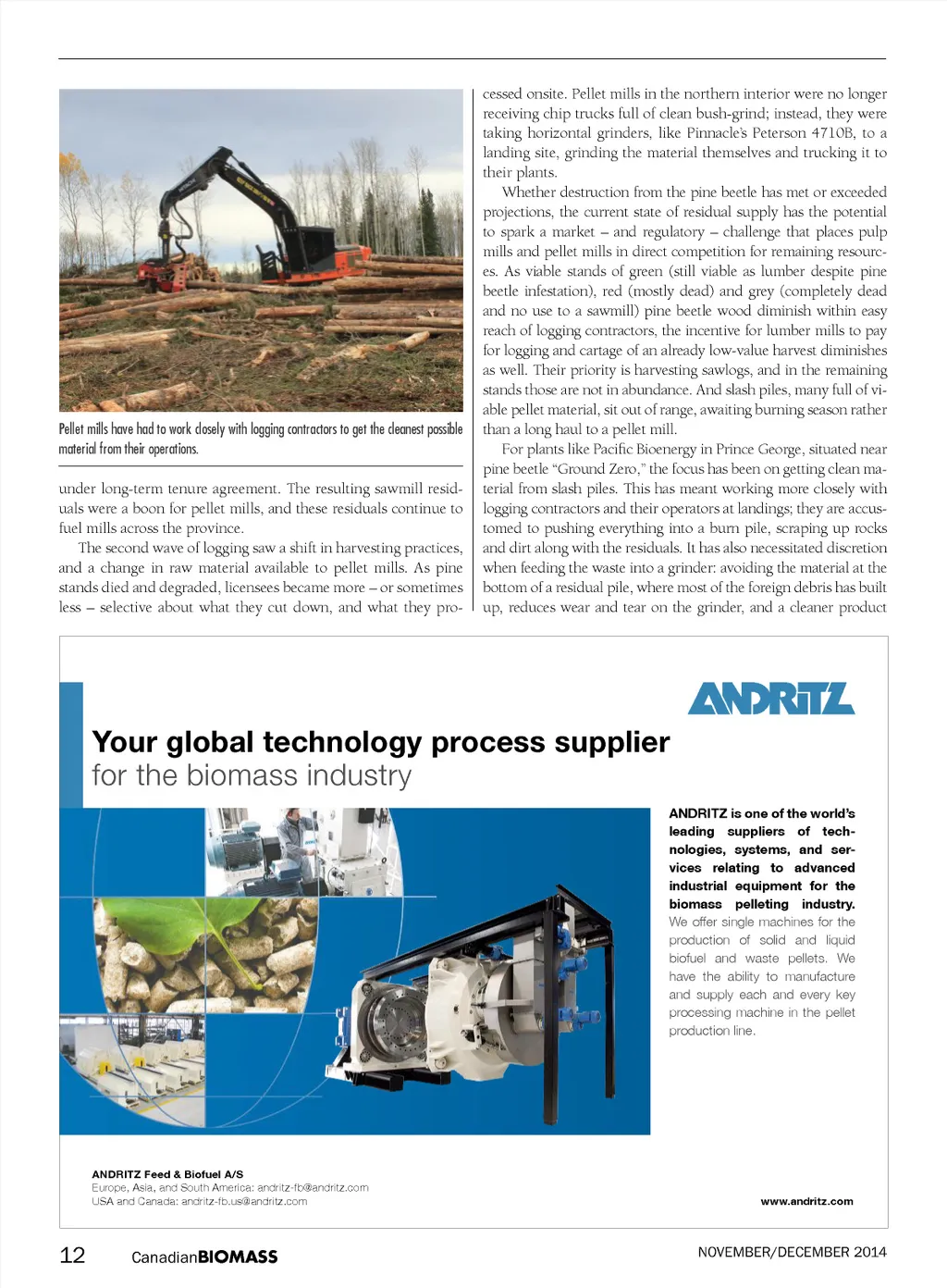
Pellet mills have had to work closely with logging contractors to get the cleanest possible material from their operations. under long-term tenure agreement. The resulting sawmill resid-uals were a boon for pellet mills, and these residuals continue to fuel mills across the province. The second wave of logging saw a shift in harvesting practices, and a change in raw material available to pellet mills. As pine stands died and degraded, licensees became more – or sometimes less – selective about what they cut down, and what they pro-cessed onsite. Pellet mills in the northern interior were no longer receiving chip trucks full of clean bush-grind; instead, they were taking horizontal grinders, like Pinnacle’s Peterson 4710B, to a landing site, grinding the material themselves and trucking it to their plants. Whether destruction from the pine beetle has met or exceeded projections, the current state of residual supply has the potential to spark a market – and regulatory – challenge that places pulp mills and pellet mills in direct competition for remaining resourc-es. As viable stands of green (still viable as lumber despite pine beetle infestation), red (mostly dead) and grey (completely dead and no use to a sawmill) pine beetle wood diminish within easy reach of logging contractors, the incentive for lumber mills to pay for logging and cartage of an already low-value harvest diminishes as well. Their priority is harvesting sawlogs, and in the remaining stands those are not in abundance. And slash piles, many full of vi-able pellet material, sit out of range, awaiting burning season rather than a long haul to a pellet mill. For plants like Pacific Bioenergy in Prince George, situated near pine beetle “Ground Zero,” the focus has been on getting clean ma-terial from slash piles. This has meant working more closely with logging contractors and their operators at landings; they are accus-tomed to pushing everything into a burn pile, scraping up rocks and dirt along with the residuals. It has also necessitated discretion when feeding the waste into a grinder: avoiding the material at the bottom of a residual pile, where most of the foreign debris has built up, reduces wear and tear on the grinder, and a cleaner product Your global technology process supplier for the biomass industry ANDRITZ is one of the world’s leading suppliers of tech-nologies, systems, and ser-vices relating to advanced industrial equipment for the biomass pelleting industry. We offer single machines for the production of solid and liquid biofuel and waste pellets. We have the ability to manufacture and supply each and every key processing machine in the pellet production line. ANDRITZ Feed & Biofuel A/S Europe, Asia, and South America: [email protected] USA and Canada: [email protected] www.andritz.com 12 Canadian BIOMASS NOVEMBER/DECEMBER 2014
Canadian Biomass November - December 2014: Page 12