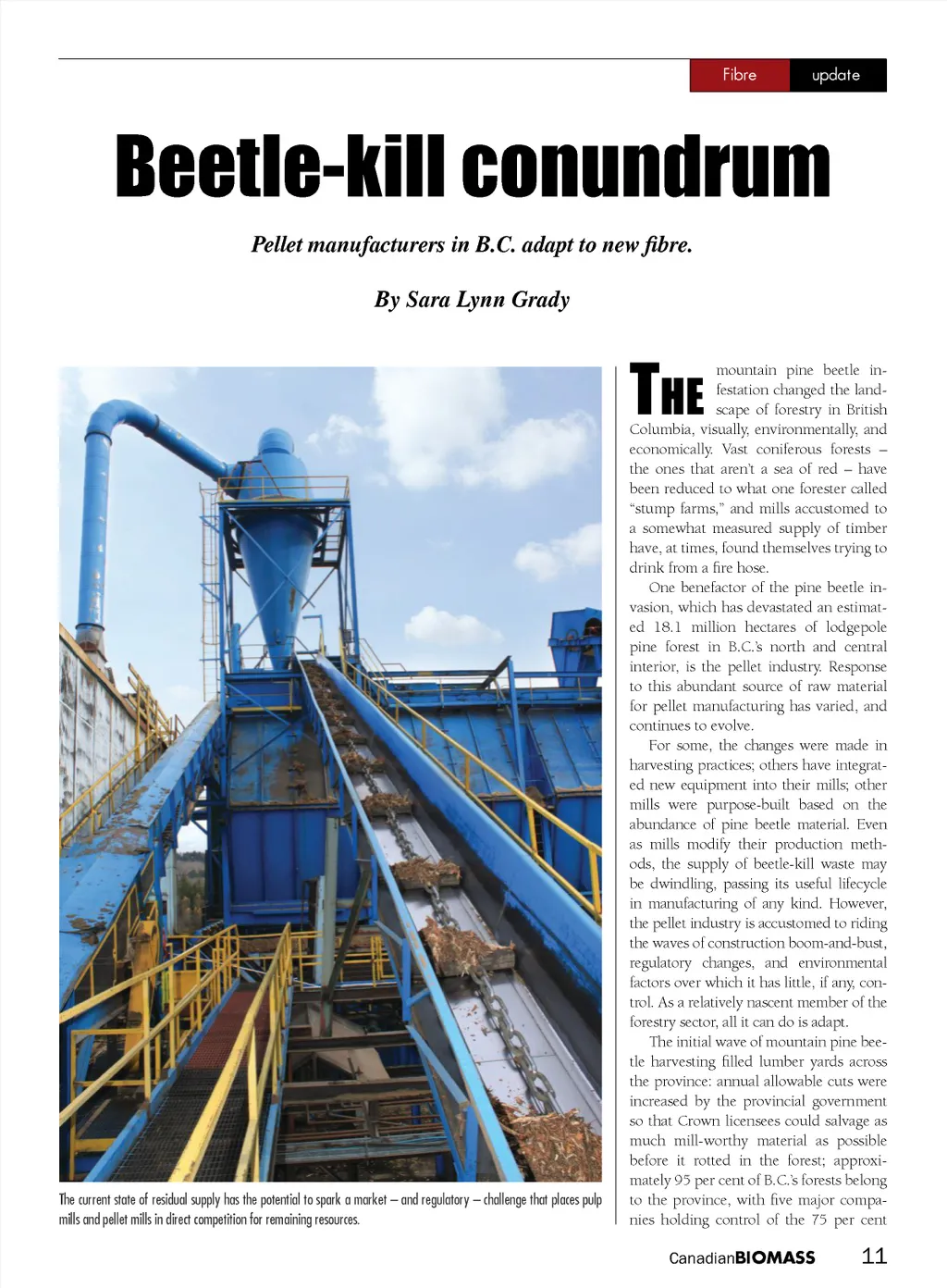
Fibre update Beetle-kill conundrum Pellet manufacturers in B.C. adapt to new fibre. By Sara Lynn Grady T he The current state of residual supply has the potential to spark a market – and regulatory – challenge that places pulp mills and pellet mills in direct competition for remaining resources. mountain pine beetle in-festation changed the land-scape of forestry in British Columbia, visually, environmentally, and economically. Vast coniferous forests – the ones that aren’t a sea of red – have been reduced to what one forester called “stump farms,” and mills accustomed to a somewhat measured supply of timber have, at times, found themselves trying to drink from a fire hose. One benefactor of the pine beetle in-vasion, which has devastated an estimat-ed 18.1 million hectares of lodgepole pine forest in B.C.’s north and central interior, is the pellet industry. Response to this abundant source of raw material for pellet manufacturing has varied, and continues to evolve. For some, the changes were made in harvesting practices; others have integrat-ed new equipment into their mills; other mills were purpose-built based on the abundance of pine beetle material. Even as mills modify their production meth-ods, the supply of beetle-kill waste may be dwindling, passing its useful lifecycle in manufacturing of any kind. However, the pellet industry is accustomed to riding the waves of construction boom-and-bust, regulatory changes, and environmental factors over which it has little, if any, con-trol. As a relatively nascent member of the forestry sector, all it can do is adapt. The initial wave of mountain pine bee-tle harvesting filled lumber yards across the province: annual allowable cuts were increased by the provincial government so that Crown licensees could salvage as much mill-worthy material as possible before it rotted in the forest; approxi-mately 95 per cent of B.C.’s forests belong to the province, with five major compa-nies holding control of the 75 per cent Canadian BIOMASS 11
Canadian Biomass November - December 2014: Page 11