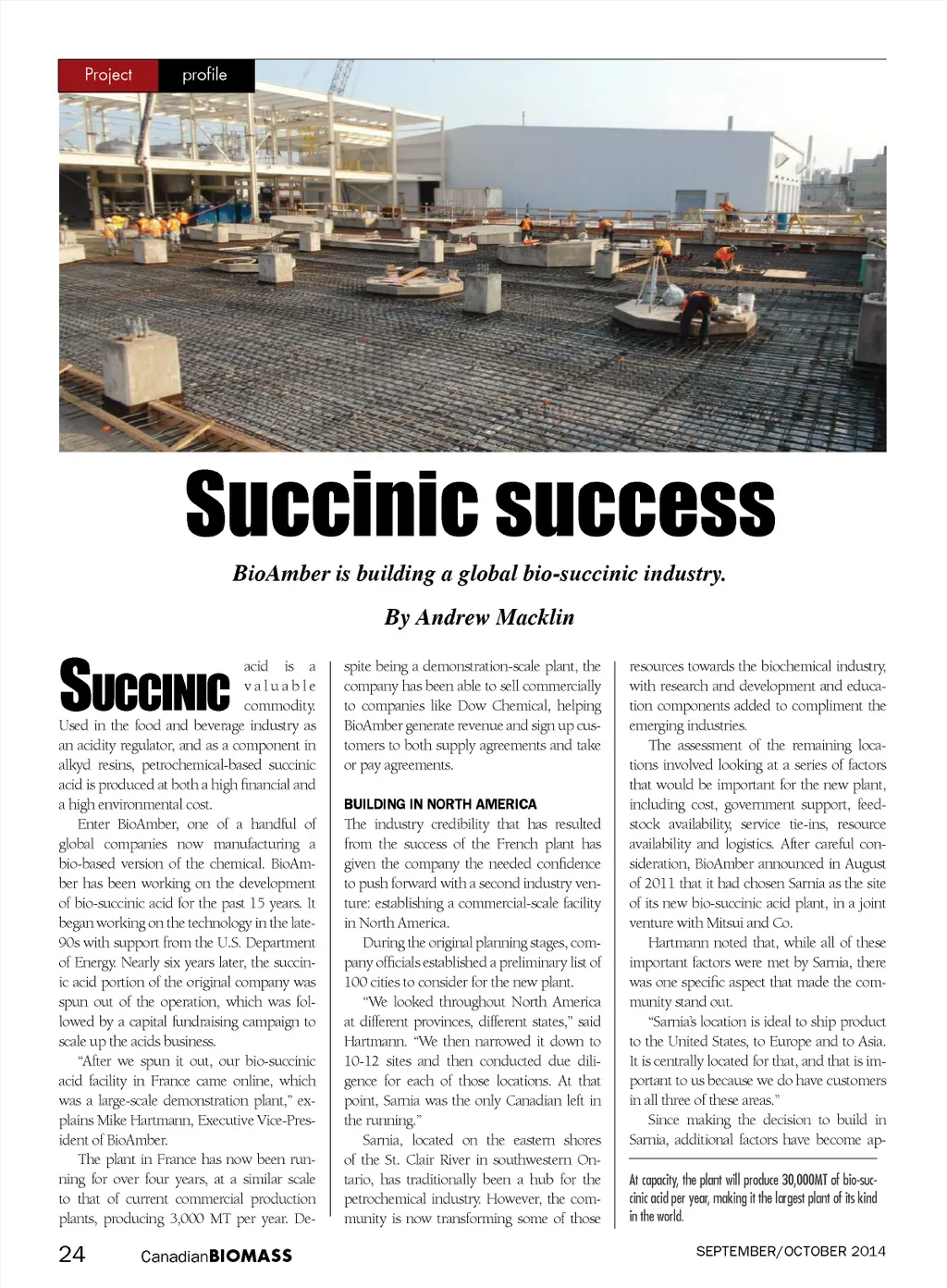
parent that did not gain appreciable consid-eration during the decision-making process, but now have become keys to the success of the project. “The personnel in Sarnia, the history of building large chemical facilities and the abundance of qualified workers were also factors that we didn’t appreciate as much as we should have,” noted Hartmann. The commercial-scale bio-succinic pro-duction plant in Sarnia is a US $125-million project. The plant is located in a bioindus-trial park purchased from Lanxess, which produces synthetic rubber for Butyl Rubber. The site is located in the chemical core of Sarnia, surrounded by massive petrochem-ical producers such as DuPont, Suncor, Imperial Oil, Shell Canada and Praxair. At capacity, the plant will produce 30,000MT of bio-succinic acid per year, making it the largest plant of its kind in the world. BIO VERSUS PETRO convert sugars into succinic acid. “From a pound of sugar, the theoretical yield is actually more than a pound of prod-uct,” explains Hartmann. “That’s because we sequester the CO 2 and part of the carbon for the bio-succinic comes from the CO 2 .” But what makes the increased commer-cialization of bio-succinic acid more im-portant is the environmental impact of its production. Bio-succinic acid produces zero carbon emissions. Petroleum-based produc-tion emits seven pounds of CO 2 gas for every pound of succinic acid produced. This is a potential game-changer for the biochemical industry, producing a chemical superior to its petroleum equivalent while producing no greenhouse gas emissions. Hartmann expects that this will result in the end of global production of succinic acid from petroleum in a few years very similar to what has happened for citric acid MOVING TOWARDS PRODUCTION 014 has been a year full of important 2 benchmarks for BioAmber and its Sarnia bio-succinic facility. Here is a look at the significant announcements the company has made so far this year. BIOAMBER IN 2014 FEBRUARY 20TH Awarded a $10-million, inter-est-free loan from Agriculture Canada for the construction of the Sarnia plant. MAY 1ST Announced its first take-or-pay contract for the plant, signing a three-year contract for 14,000MT per year with PTTMCC Biochem Company Limited. JUNE 23RD Secured a $20-million loan from a financial consortium led by Export Development Canada. Succinic acid would have traditionally been made in a chemical valley similar to Sarnia. But the discovery of the bio-based version of the acid has changed the production focus away from petroleum. Both the petroleum and bio versions of succinic acid have the same chemical for-mula -C4H6O4. The variation between the two acids is just a few parts per million at production scale. The cost of producing bio-based succin-ic acid is significantly cheaper than that of the petroleum-based product. Hartmann estimates that bio-succinic acid uses two-thirds less energy to produce than petroleum succinic acid. That cost difference makes bio-succinic acid, essentially, “the best mole-cule for the biotech/bioindustrial route.” The reason for the savings is that the biorefining process has a strong ability to Construction of the Sarnia facility continues to move forward on schedule. AMEC was hired on as the primary engineer for the plant, and they have been successful with the design, engineering and procurement of the needed materials for the site. As a result, BioAmber is still targeting early 2015 for completion of construction. BioAmber has implemented a scale of attainable production targets for the bio-suc-cinic plant. The plan includes 50 per cent production by the end of 2015, 85 per cent production by the end of 2016 and 100 per cent production by the end of 2017. “It has been a multi-year process to get to where we are today,” says Hartmann. “We are very excited to continue construction and get the facility ready. As of right now, we are very optimistic and really looking for-ward to having the plant start up.” • JULY 2ND Received a $7-million loan from Sustainable Development and Technology Canada. JULY 8TH Signs a 15-year take-or-pay con-tract with Vinmar International for 10,000MT per year from Sarnia and 80 per cent offtake from two additional plants yet to be built JULY 15TH Announced a successful second-ary public offering of 2.8 million shares of common stock. Canadian BIOMASS 25
Canadian Biomass September October 2014: Page 25