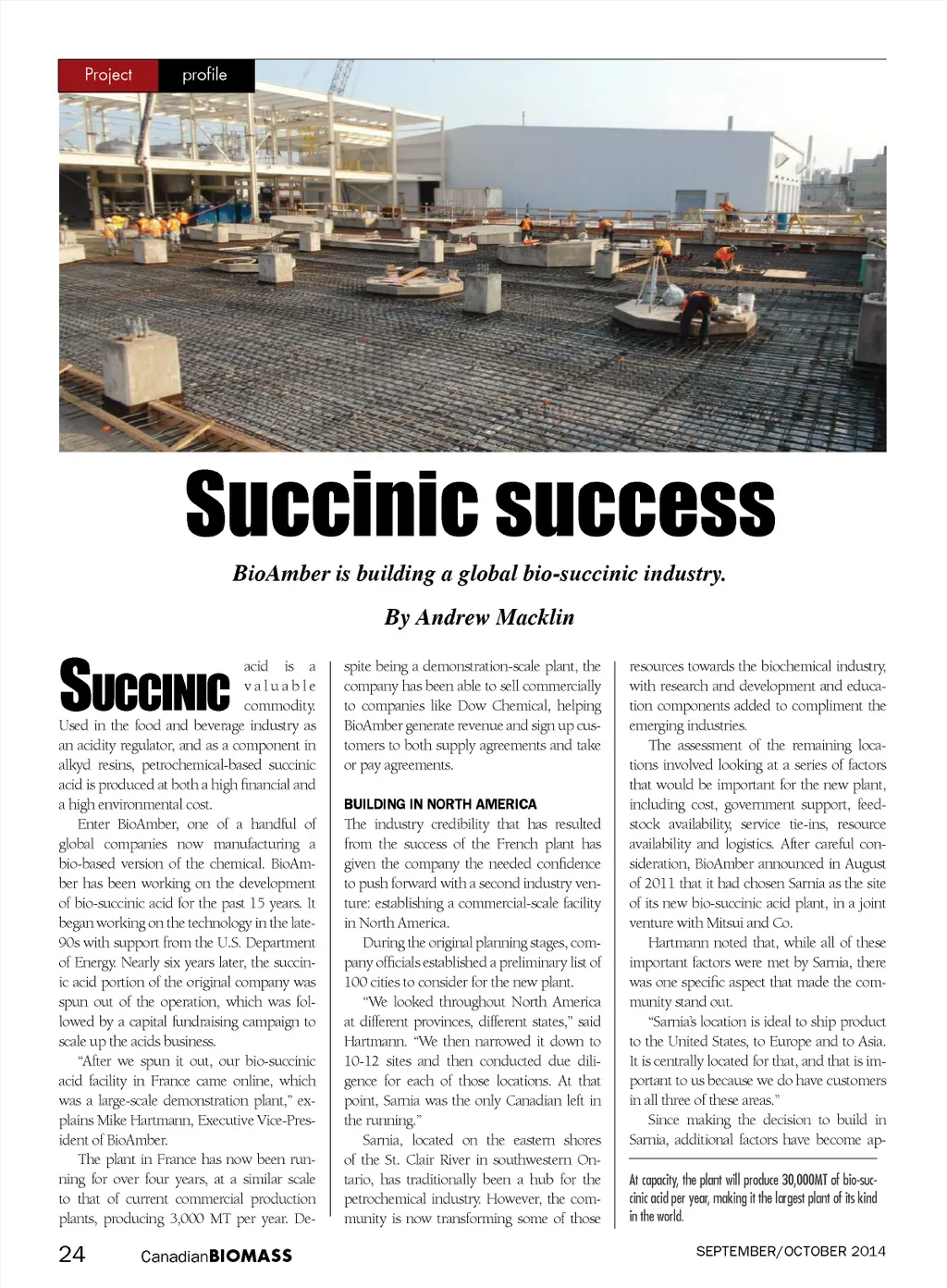
Project profile Succinic success BioAmber is building a global bio-succinic industry. By Andrew Macklin acid is a valuable commodity. Used in the food and beverage industry as an acidity regulator, and as a component in alkyd resins, petrochemical-based succinic acid is produced at both a high financial and a high environmental cost. Enter BioAmber, one of a handful of global companies now manufacturing a bio-based version of the chemical. BioAm-ber has been working on the development of bio-succinic acid for the past 15 years. It began working on the technology in the late-90s with support from the U.S. Department of Energy. Nearly six years later, the succin-ic acid portion of the original company was spun out of the operation, which was fol-lowed by a capital fundraising campaign to scale up the acids business. “After we spun it out, our bio-succinic acid facility in France came online, which was a large-scale demonstration plant,” ex-plains Mike Hartmann, Executive Vice-Pres-ident of BioAmber. The plant in France has now been run-ning for over four years, at a similar scale to that of current commercial production plants, producing 3,000 MT per year. De-S uccinic spite being a demonstration-scale plant, the company has been able to sell commercially to companies like Dow Chemical, helping BioAmber generate revenue and sign up cus-tomers to both supply agreements and take or pay agreements. BUILDING IN NORTH AMERICA The industry credibility that has resulted from the success of the French plant has given the company the needed confidence to push forward with a second industry ven-ture: establishing a commercial-scale facility in North America. During the original planning stages, com-pany officials established a preliminary list of 100 cities to consider for the new plant. “We looked throughout North America at different provinces, different states,” said Hartmann. “We then narrowed it down to 10-12 sites and then conducted due dili-gence for each of those locations. At that point, Sarnia was the only Canadian left in the running.” Sarnia, located on the eastern shores of the St. Clair River in southwestern On-tario, has traditionally been a hub for the petrochemical industry. However, the com-munity is now transforming some of those resources towards the biochemical industry, with research and development and educa-tion components added to compliment the emerging industries. The assessment of the remaining loca-tions involved looking at a series of factors that would be important for the new plant, including cost, government support, feed-stock availability, service tie-ins, resource availability and logistics. After careful con-sideration, BioAmber announced in August of 2011 that it had chosen Sarnia as the site of its new bio-succinic acid plant, in a joint venture with Mitsui and Co. Hartmann noted that, while all of these important factors were met by Sarnia, there was one specific aspect that made the com-munity stand out. “Sarnia’s location is ideal to ship product to the United States, to Europe and to Asia. It is centrally located for that, and that is im-portant to us because we do have customers in all three of these areas.” Since making the decision to build in Sarnia, additional factors have become ap-At capacity, the plant will produce 30,000MT of bio-suc-cinic acid per year, making it the largest plant of its kind in the world. SEPTEMBER/OCTOBER 2014 24 Canadian BIOMASS
Canadian Biomass September October 2014: Page 24