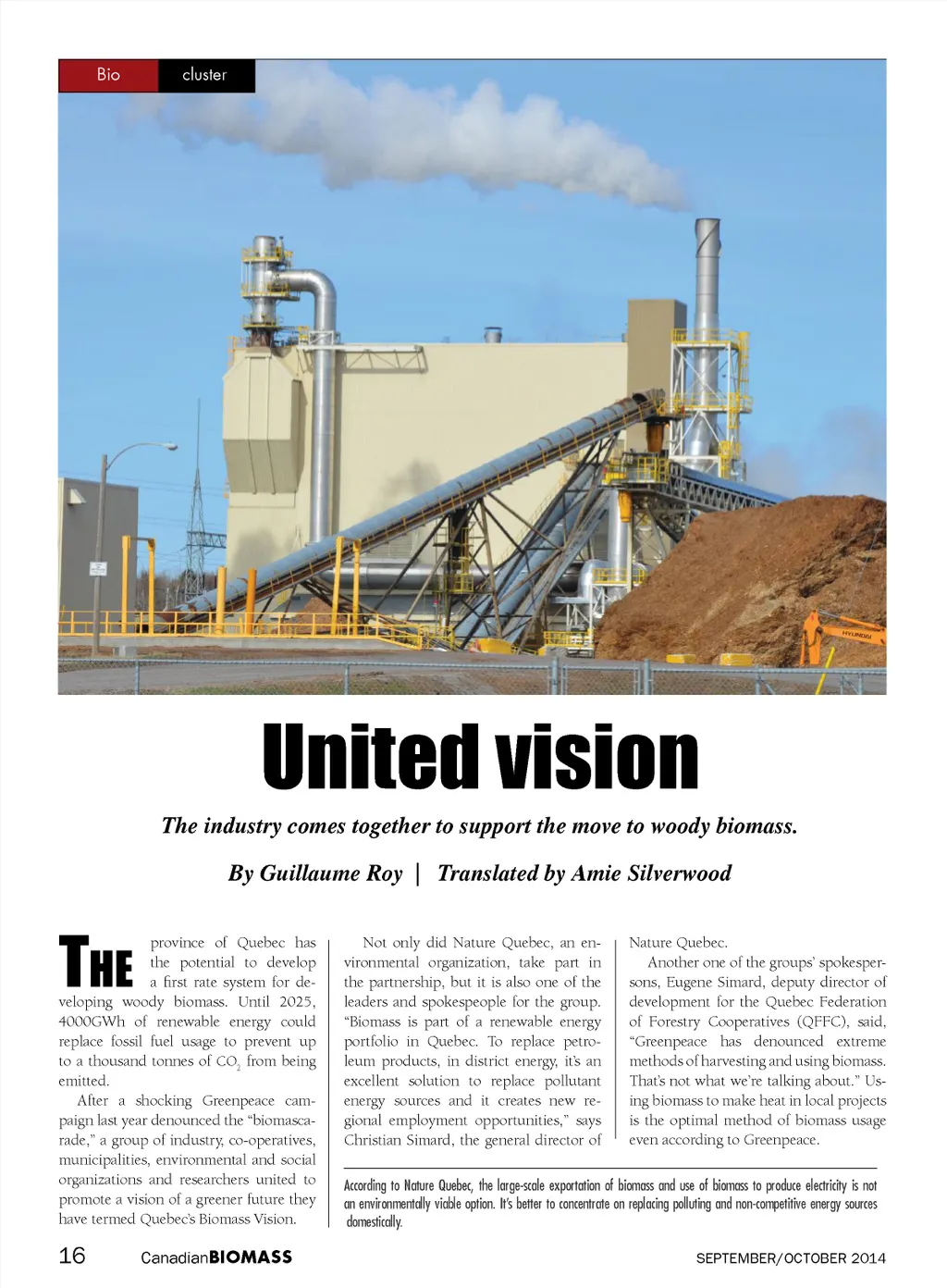
“To achieve a breakthrough in public acceptance, any biomass system must be held to the highest environmental standards in harvesting and usage,” ex-plains Christian Simard. To build the best projects and to assure social acceptance, Quebec’s Biomass Vision is focused on projects that have an interesting environ-mental scope. When it comes to harvest-ing, fixed limits are set (according to the soil type and stands). Also, emphasis is put on using logging and sawmill residu-als – forget about harvesting full trees to make biomass. According to Nature Quebec, the large-scale exportation of biomass and use of biomass to produce electricity is not an environmentally viable option. It’s better to concentrate on replacing pollut-ing and non-competitive energy sources domestically. (Biomass wouldn’t initially replace natural gas in projections.) The potential to use biomass is enor-mous even if the industry concentrates on replacing oil and propane energy sources. In Quebec, the total potential for substitution in commercial, institutional and industrial buildings totals 11,848 GWh, while the supply of residual woody biomass amounts to 21,456 GWh (4.29 BDMT, million) according to the research done by Ecoressources for the QFFC. Concentrating on substituting the two sources of nonrenewable energy, Quebec has the potential to produce 4000 GWh of renewable energy by 2025. Within the industrial sector, the goal is to increase the use of biomass from 9750 GWh to 12,750 GWh, which is an increase from 19.5 per cent to 25.5 per cent of total energy consumed, excluding electricity. Even more significant gains could be realized in the institutional and commercial sector where consumption could be increased tenfold from 150 GWh to 1150 GWh by 2025. If these stats are achieved, biomass would occu-py 9.9 per cent of the energy used in the institutional and commercial sector (ex-cluding electricity). POINTS WORTH MAKING wood pellets ($12.83/GJ) (prices are from 2010). And forecasts suggest these price differences will increase over time. Rather than import nonrenewable resources and generate a commercial balance deficit, Quebec could produce renewable energy and create a local in-dustry producing heat from forestry residuals. One 4000 GWh conversion would allow the province to improve the import balance by $225 million and pre-vent one million tonnes of CO 2 . On top of that, these investments in the biomass industry could create 12,500 jobs during the construction phase and 3,600 long-term employment positions. REGIONAL BENEFITS In terms of long-term development, the use of forestry biomass for energy pro-duction has an added edge because this renewable energy creates a lot more jobs than any other form of energy produc-tion. “The use of biomass brings social, economic and environmental benefits. For a small forestry community, the sys-tem could create many jobs and generate important economic benefits,” explains Simard. But it’s in the rural regions of Quebec that developing a biomass system gener-ates the most interest. And it’s for this rea-son that many municipal partners have signed onto Quebec’s Biomass Vision. “It’s a nice way to support municipalities because it allows them to make the best use of their resources,” Dany Rousseau from the Quebec Municipality Federation points out. Coop fédérée, a co-operation repre-senting more than 100,000 members, has been interested in biomass since 2008. “We had studied different energy systems and we came to the conclusion that the use of residual woody biomass to make heat is a solution worth promoting. In the context of long-term development, it’s the source of renewable energy that has cre-ated the most value,” says Cyril Neron, the director of growth and innovation for Coop fédérée. The Coop fédérée energy branch, Sonic, hopes to profit from the opportunities linked with the develop-ment of a biomass industry cluster. THE BLUE BRUISER GRINDS LOGS INTO SPLINTERS. 2009T Tub Grinder • CAT 312 Track System • CAT C9 325 hp Tier III diesel engine • Grinder functions controlled by remote control Call today or visit us online to learn more. View products in action on our YouTube channel! • Self-cleaning air intake system and enclosed engine compartment • PT-Tech HPTO-12 Clutch There are numerous reasons to make the substitution. On one hand, fossil fuel en-ergy sources like light fuel oils ($30.52/ GJ), heavy fuel oil ($17.63/GJ) and pro-pane ($31.01/GJ) are much more ex-pensive than briquettes ($8.76$/GJ) or 888-402-4638 www.duratech.info Canadian BIOMASS 17
Canadian Biomass September October 2014: Page 17