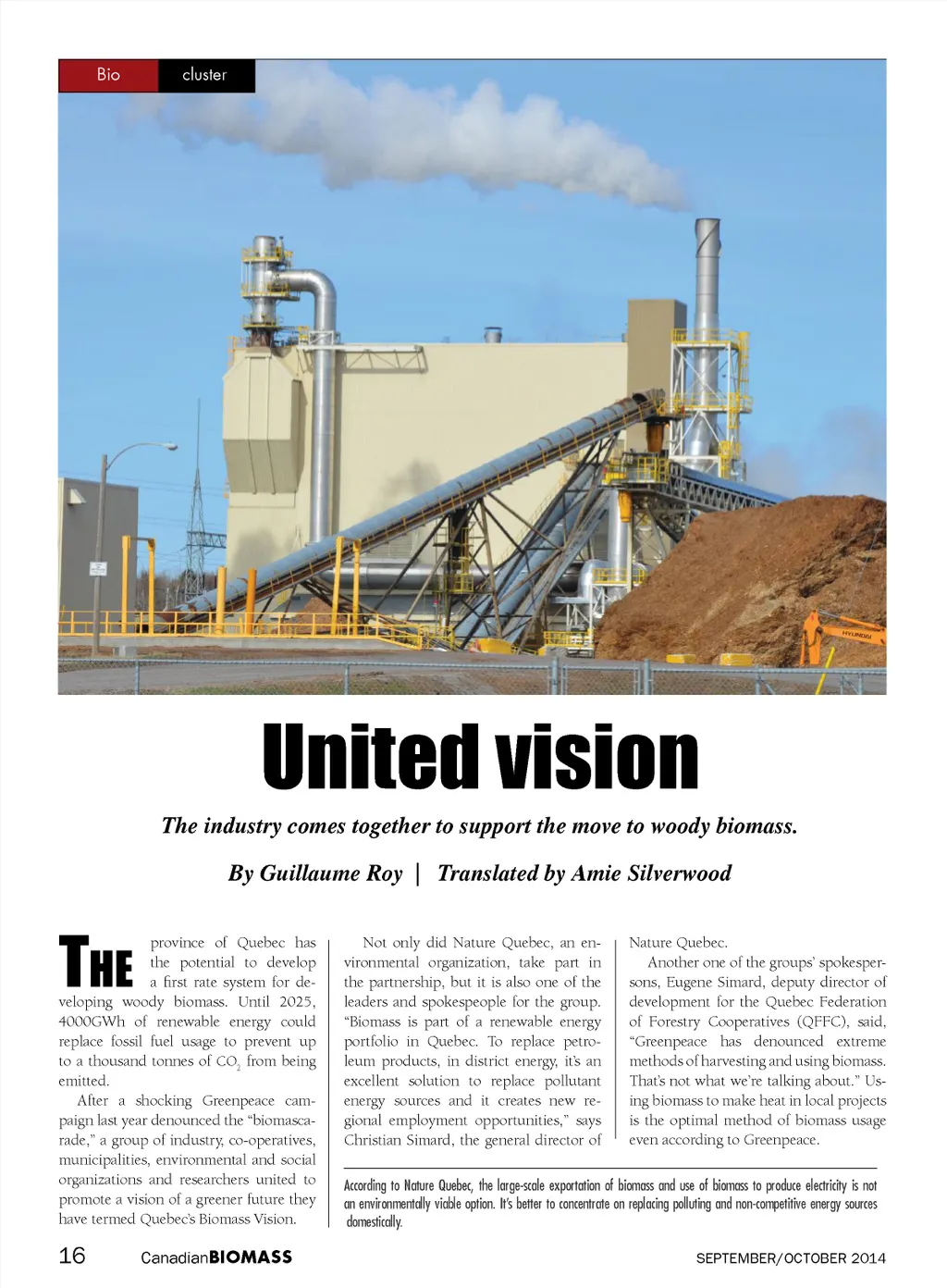
Bio cluster The industry comes together to support the move to woody biomass. By Guillaume Roy | Translated by Amie Silverwood province of Quebec has the potential to develop a first rate system for de-veloping woody biomass. Until 2025, 4000GWh of renewable energy could replace fossil fuel usage to prevent up to a thousand tonnes of CO 2 from being emitted. After a shocking Greenpeace cam-paign last year denounced the “biomasca-rade,” a group of industry, co-operatives, municipalities, environmental and social organizations and researchers united to promote a vision of a greener future they have termed Quebec’s Biomass Vision. United vision Not only did Nature Quebec, an en-vironmental organization, take part in the partnership, but it is also one of the leaders and spokespeople for the group. “Biomass is part of a renewable energy portfolio in Quebec. To replace petro-leum products, in district energy, it’s an excellent solution to replace pollutant energy sources and it creates new re-gional employment opportunities,” says Christian Simard, the general director of T he Nature Quebec. Another one of the groups’ spokesper-sons, Eugene Simard, deputy director of development for the Quebec Federation of Forestry Cooperatives (QFFC), said, “Greenpeace has denounced extreme methods of harvesting and using biomass. That’s not what we’re talking about.” Us-ing biomass to make heat in local projects is the optimal method of biomass usage even according to Greenpeace. According to Nature Quebec, the large-scale exportation of biomass and use of biomass to produce electricity is not an environmentally viable option. It’s better to concentrate on replacing polluting and non-competitive energy sources domestically. SEPTEMBER/OCTOBER 2014 16 Canadian BIOMASS
Canadian Biomass September October 2014: Page 16