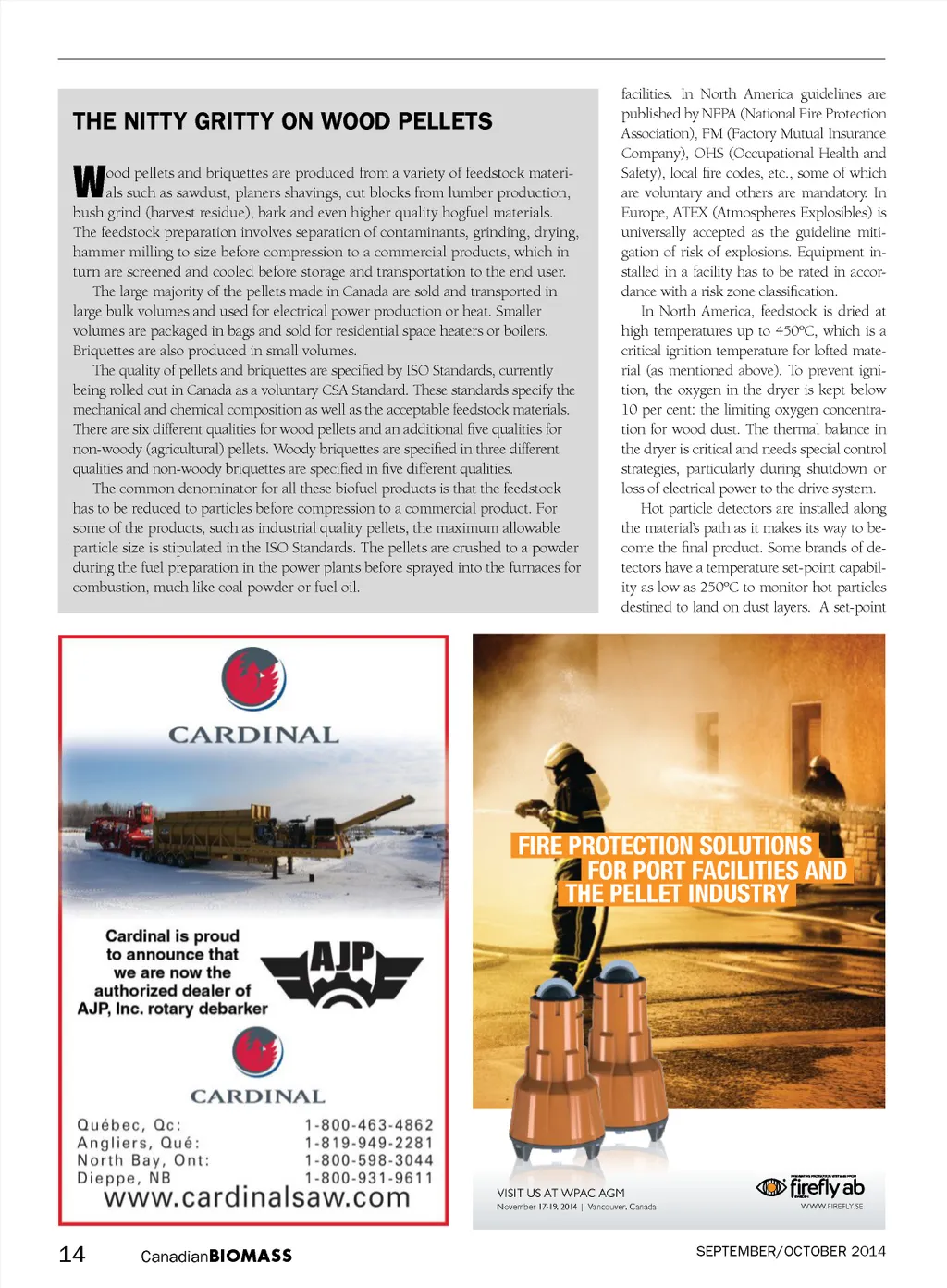
temperature of 400ºC is used to monitor lofted particles in areas of high dust con-centrations. Besides the risk of fires and explosions caused by dust, there is also the risk of self-heating followed by fire when the feedstock and the final product is in storage. LESSON LEARNED Dust on beams and rafters is usually not visible and will participate in the secondary explosions sometimes experienced in large manufacturing plants. The top of the beams are now gradually retrofitted with 45 degree brackets to avoid dust accumulation. After the severe and fatal accidents in the Babine and the Lakeland sawmills in Brit-ish Columbia in 2012, WorkSafeBC and BC Forest Safety Council implemented a strict inspection regime in British Co-lumbia for all woodworking facilities, including pellet plants. Safety audits are conducted based on a very strict protocol on a regular basis. Citations and even fines are issued for more serious or repeated non-compliance. Some surprise audits and work-stop orders can be issued. An inspection of a typical plant usually takes two days. Employers are mandated to provide training regarding the risks and proce-dures for mitigating risk. Hot work guide-lines, ignition source identification and housekeeping are at the heart of the train-ing program. Workers have the right to initiate work-stop if conditions are consid-ered risky. Special guidelines are stipulated for contractors temporarily doing work in a plant. Each plant needs to have a written procedure for managing change involving manpower, equipment and procedures to make sure safety is always paramount. NEW SAFETY GUIDELINES ACROSS THE COUNTRY The safety inspection scheme in British Columbia is likely to expand to other manufacturing facilities over time. A worksafe certification is likely to become a selling tool for the manufacturers since it minimizes the risk of non-performance by the suppliers and may in fact over time be-come a contractual obligation by key pellet consumers. ISO Technical Committee 238 for Sol-id Biofuels is coming out with guidelines for safe handling and storage of pellets in residential as well as in large-scale in-dustrial applications within the next two years. Also, fire prevention and firefighting guidelines for pellet silos are under devel-opment. In addition, protocols for labora-tory testing of off-gassing and self-heating characteristics for pellets will be published by ISO. Safety is gradually becoming the overriding management tool for our in-dustry – and dust will gradually become less of a menace. • KAHL Wood Pelleting Plants Quality worldwide. AMANDUS KAHL GmbH & Co. KG, SARJ Equipment Corp., Mr. Rick B. MacArthur, 29 Golfview Blvd., Bradford, Ontario L3Z 2A6 Phone: 905-778-0073, Fax: 905-778-9613, [email protected] www.akahl.de Canadian BIOMASS 15
Canadian Biomass September October 2014: Page 15