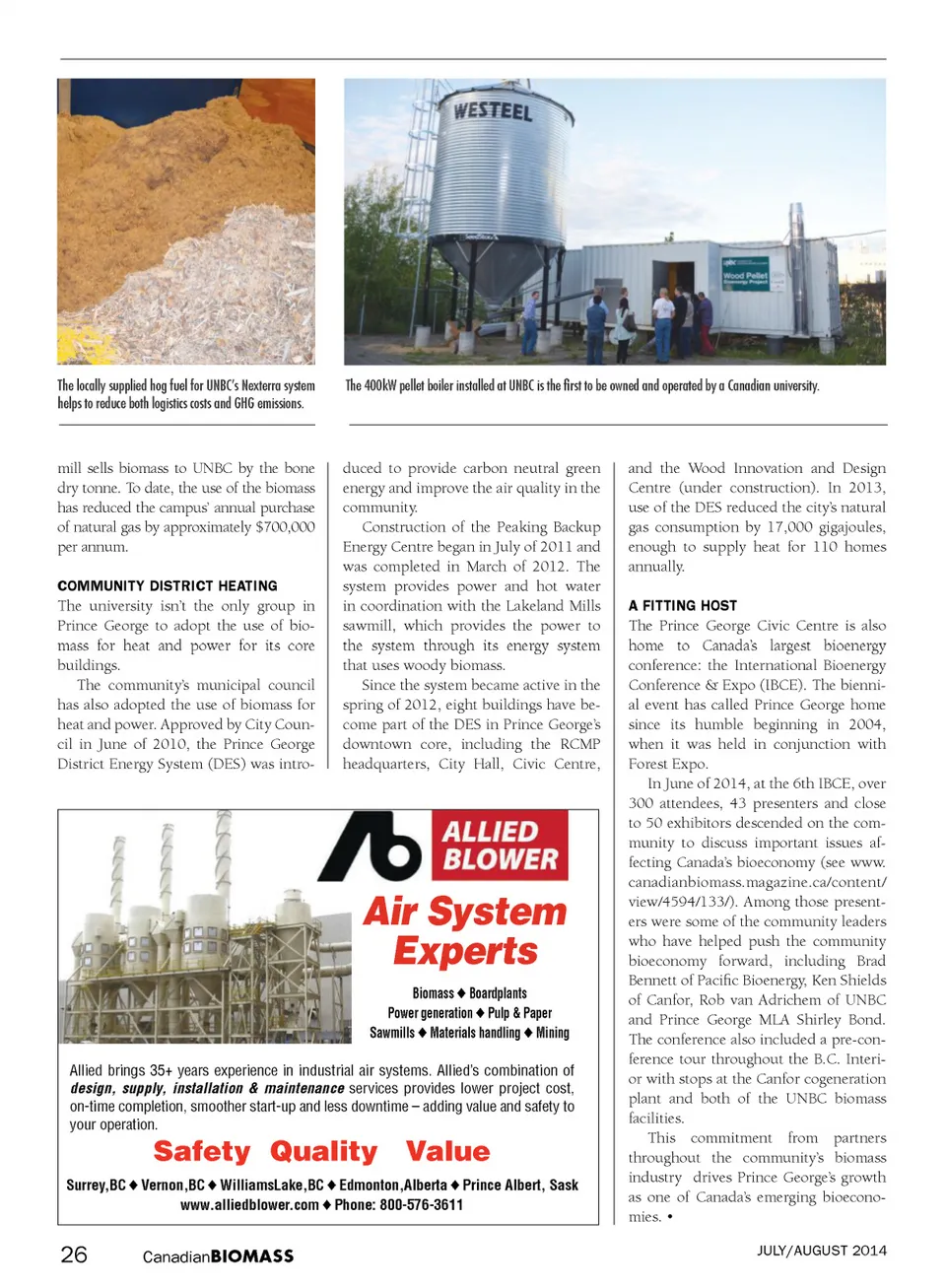
CONTINUED FROM PAGE 19 the warmth of the people in the buildings themselves. Canadian Biomass visited Hammarby Sjöstad, Stockholm’s largest urban con-struction project, which is on a former brownfield between the inner city and suburbs; it was transformed to house 26,000 people by 2017. Designed to be a model of sustainable housing, it has been a popular destination for city planners and politicians worldwide. From the moment of the author’s ar-rival in the neighbourhood, it was evident that Hammarby Sjöstad is more vibrant than most urban densification projects. The population on the street in early June was primarily young parents and their children who were enjoying the green public spaces between residences (chil-dren aged 0-5 make up 13 per cent of the area’s population). This generation of parents makes an obvious fit for a neigh-bourhood designed to preserve the natu-ral resources for the next generation, but diapers and picky eaters generate a great deal of waste regardless of a parent’s good intentions. The waste generated in Hammarby Sjöstad is not wasted, however, it is the fuel that powers the neighbourhood. Waste is separated into organic, com-bustible and newspaper and transported underground through a waste vacuum system to a nearby handling facility. Other waste is collected onsite and recycled so that there is no waste bound for landfills. Combustible waste that has no other use is burned and the heat and electricity is fed back into the district’s grid. Following the success and lessons learned from the construction of Ham-marby Sjöstad, the Stockholm Royal Sea-port has been designed with similar values in mind to produce 10,000 homes and 30,000 offices, to be built by 2025. City planners have gained enough experience and confidence to aim to build this new development into a fossil fuel-free zone in 2030 and to reduce the CO2 emissions produced to less than 1.5 tonnes per per-son by 2025. Waste is transported underground through a waste vacuum system and processed at a nearby facility. Some areas of focus for the develop-ment team include: wave power, pyroly-sis oil, advancing the rapid adoption of electric vehicles, district heating, nucle-ar CHP, and the NURES liquid treatment system for radioactive liquids. There will be methods for individuals to monitor their uses of heating, waste and electric-ity and benchmarks they’re expected to meet. This neighbourhood is being built to support innovation with extra space allot-ted to educating visitors on the sustain-able technology being developed, schools, daycares and a former gas container re-constructed for an opera house. As cities around the world look for best practices for remediation of brownfields and industrial lands and as we look for places for our cities to grow without di-minishing our parks and nature preserves, Stockholm has taken up the gauntlet to lead the way. Sweden has proven that a fossil-free future is not only within reach, it is within our means. • For new deveopments in bioenergy go to www.canadianbiomassmagazine.ca. Canadian BIOMASS 27
Canadian Biomass July August 2014: Page 27