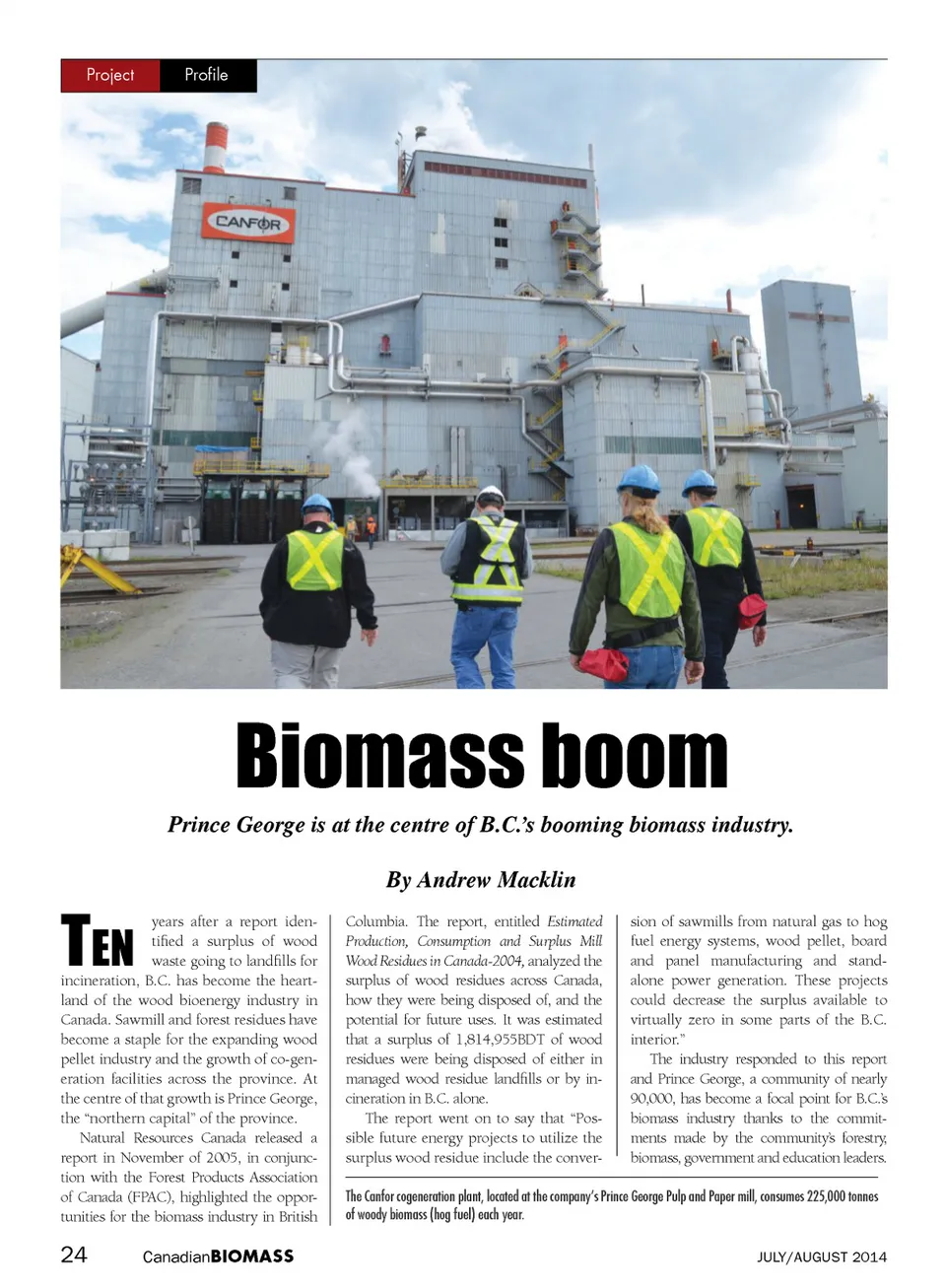
Project Profile Prince George is at the centre of B.C.’s booming biomass industry. Biomass boom By Andrew Macklin Columbia. The report, entitled Estimated Production, Consumption and Surplus Mill Wood Residues in Canada-2004, analyzed the surplus of wood residues across Canada, how they were being disposed of, and the potential for future uses. It was estimated that a surplus of 1,814,955BDT of wood residues were being disposed of either in managed wood residue landfills or by in-cineration in B.C. alone. The report went on to say that “Pos-sible future energy projects to utilize the surplus wood residue include the conver-T en years after a report iden-tified a surplus of wood waste going to landfills for incineration, B.C. has become the heart-land of the wood bioenergy industry in Canada. Sawmill and forest residues have become a staple for the expanding wood pellet industry and the growth of co-gen-eration facilities across the province. At the centre of that growth is Prince George, the “northern capital” of the province. Natural Resources Canada released a report in November of 2005, in conjunc-tion with the Forest Products Association of Canada (FPAC), highlighted the oppor-tunities for the biomass industry in British sion of sawmills from natural gas to hog fuel energy systems, wood pellet, board and panel manufacturing and stand-alone power generation. These projects could decrease the surplus available to virtually zero in some parts of the B.C. interior.” The industry responded to this report and Prince George, a community of nearly 90,000, has become a focal point for B.C.’s biomass industry thanks to the commit-ments made by the community’s forestry, biomass, government and education leaders. The Canfor cogeneration plant, located at the company’s Prince George Pulp and Paper mill, consumes 225,000 tonnes of woody biomass (hog fuel) each year. JULY/AUGUST 2014 24 Canadian BIOMASS
Canadian Biomass July August 2014: Page 24