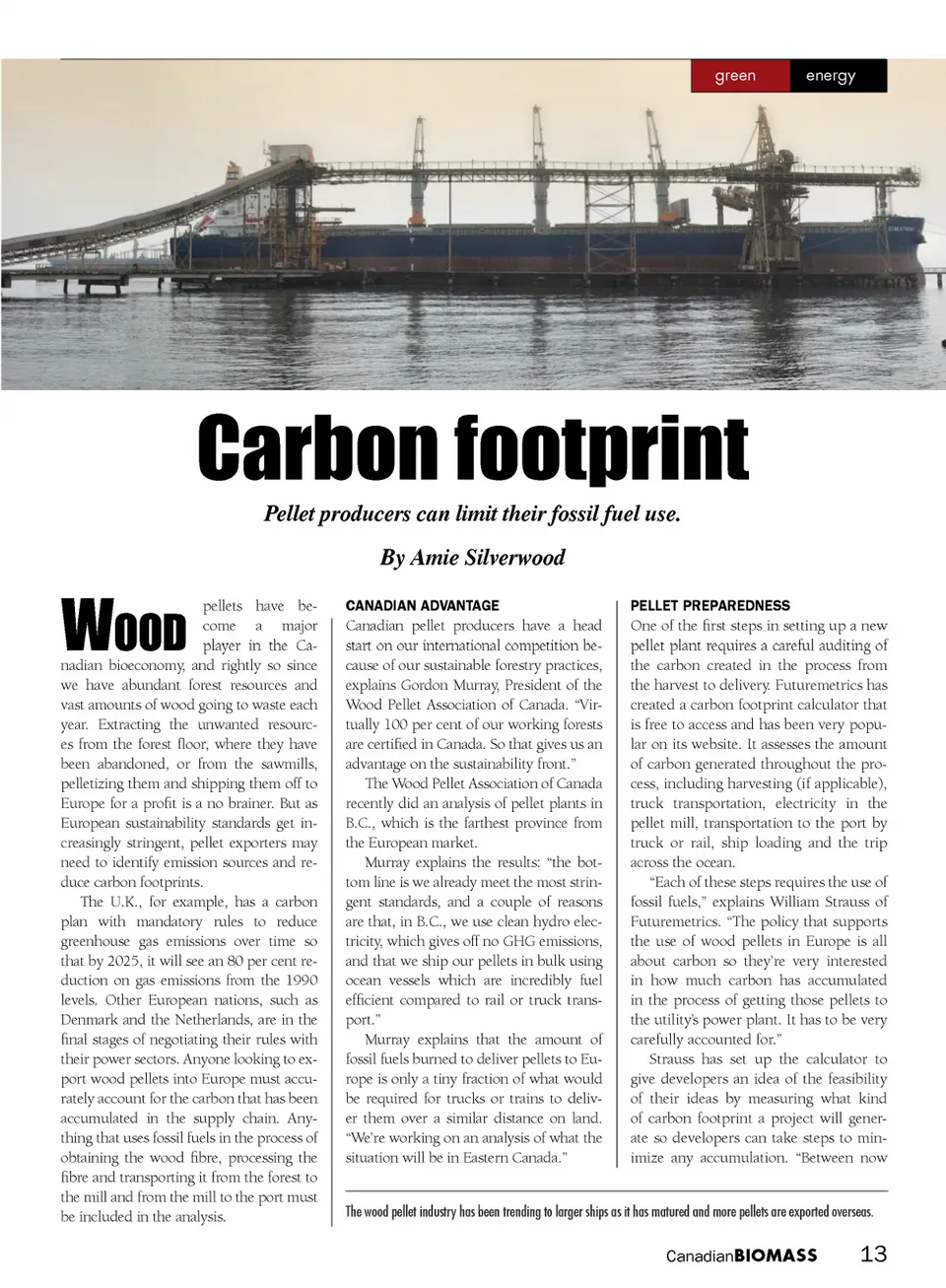
green energy Carbon footprint Pellet producers can limit their fossil fuel use. By Amie Silverwood pellets have be-come a major player in the Ca-nadian bioeconomy, and rightly so since we have abundant forest resources and vast amounts of wood going to waste each year. Extracting the unwanted resourc-es from the forest floor, where they have been abandoned, or from the sawmills, pelletizing them and shipping them off to Europe for a profit is a no brainer. But as European sustainability standards get in-creasingly stringent, pellet exporters may need to identify emission sources and re-duce carbon footprints. The U.K., for example, has a carbon plan with mandatory rules to reduce greenhouse gas emissions over time so that by 2025, it will see an 80 per cent re-duction on gas emissions from the 1990 levels. Other European nations, such as Denmark and the Netherlands, are in the final stages of negotiating their rules with their power sectors. Anyone looking to ex-port wood pellets into Europe must accu-rately account for the carbon that has been accumulated in the supply chain. Any-thing that uses fossil fuels in the process of obtaining the wood fibre, processing the fibre and transporting it from the forest to the mill and from the mill to the port must be included in the analysis. W ood CANADIAN ADVANTAGE PELLET PREPAREDNESS Canadian pellet producers have a head start on our international competition be-cause of our sustainable forestry practices, explains Gordon Murray, President of the Wood Pellet Association of Canada. “Vir-tually 100 per cent of our working forests are certified in Canada. So that gives us an advantage on the sustainability front.” The Wood Pellet Association of Canada recently did an analysis of pellet plants in B.C., which is the farthest province from the European market. Murray explains the results: “the bot-tom line is we already meet the most strin-gent standards, and a couple of reasons are that, in B.C., we use clean hydro elec-tricity, which gives off no GHG emissions, and that we ship our pellets in bulk using ocean vessels which are incredibly fuel efficient compared to rail or truck trans-port.” Murray explains that the amount of fossil fuels burned to deliver pellets to Eu-rope is only a tiny fraction of what would be required for trucks or trains to deliv-er them over a similar distance on land. “We’re working on an analysis of what the situation will be in Eastern Canada.” One of the first steps in setting up a new pellet plant requires a careful auditing of the carbon created in the process from the harvest to delivery. Futuremetrics has created a carbon footprint calculator that is free to access and has been very popu-lar on its website. It assesses the amount of carbon generated throughout the pro-cess, including harvesting (if applicable), truck transportation, electricity in the pellet mill, transportation to the port by truck or rail, ship loading and the trip across the ocean. “Each of these steps requires the use of fossil fuels,” explains William Strauss of Futuremetrics. “The policy that supports the use of wood pellets in Europe is all about carbon so they’re very interested in how much carbon has accumulated in the process of getting those pellets to the utility’s power plant. It has to be very carefully accounted for.” Strauss has set up the calculator to give developers an idea of the feasibility of their ideas by measuring what kind of carbon footprint a project will gener-ate so developers can take steps to min-imize any accumulation. “Between now The wood pellet industry has been trending to larger ships as it has matured and more pellets are exported overseas. Canadian BIOMASS 13
Canadian Biomass July August 2014: Page 13