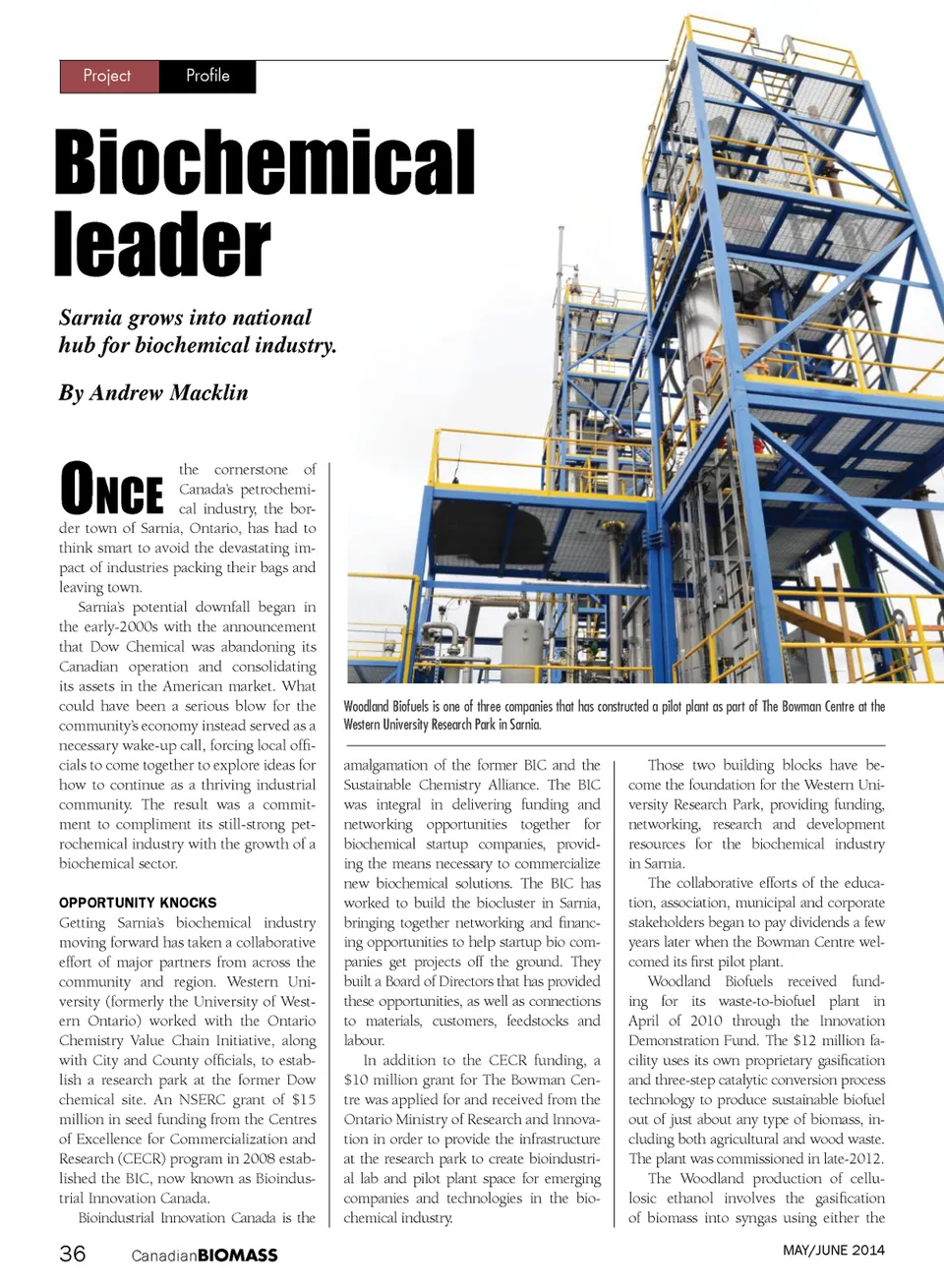
air-blown or steam-blown gasifier. The syngas is conditioned and compressed before transferring to the ethanol reactor where catalytic chemical reactions convert the syngas to ethanol. The company then uses a well-established distillation process to purify the ethanol. The second company to install a pilot facility in the Bowman Centre at the re-search park was KmX Corporation, which began operations in October of 2012. KmX incorporated in 2004 after ac-quiring the rights to a pervaporation mem-brane technology. The company acquired a solvent recycling plant in New Church, Virginia, the headquarters for its U.S. sub-sidiary, KmX Chemical Corporation, and a demonstration facility for its membrane technologies. At the Bowman Centre in Sarnia, the company is working on a fermentation and filtration system that will produce butanol. Fermenting biomass sugars into butanol can create a cellulosic biofuel that has the potential to be a gasoline substi-tute. Using biomass sugars to create bio-chemicals and biofuels is a current focus for the BIC. The third company involved in the Bowman Centre is GreenCore Compos-ites. In February of 2013, GreenCore announced that it was moving its manu-facturing facility from Mississauga to the Bowman Centre at the Western University research park. According to GreenCore president and CEO Geoff Clarke, “the move gives us space to install the new production line which we did not have at our previous location. It also allows us to configure the lines for greater productivity and locates us near the U.S. markets where we expect rapid growth.” GreenCore’s technology involves ex-tracting nano fibres from various species of wood in the production of thermoplas-tic materials. In some cases, the fibres are being used to replace glass fibres to cre-ate recyclable plastics. The automotive and sports equipment industries are just a few examples of industrial sectors test-ing with GreenCore at the Bowman Centre pilot plant. education oPPoRtunities The development of the research park has provided Lambton College and Western University with opportunities to provide complimentary education opportunities for their students. Lambton College began an applied re-search program in 2004-2005, focusing on synthetic and polymer-based materials. As the school expanded on its research ca-pabilities, they began engaging local and regional companies to look for research opportunities that would benefit both the school and the companies involved. It was at this time that Lambton began working with GreenField Specialty Alcohols, who were interested in research involving biomaterials. The result of work-ing with GreenField, and the expanding research capabilities at Lambton College, was an increase in projects involving the biosector. “We felt that there was a demand, there was a need for a certain kind of expertise,” says Dr. Mehdi Sheikhza-deh, Dean of Applied Research and BiomassAd v1.0 final outlines.indd 1 Canadian BIOMASS 5/29/2014 2:57:01 PM 37
Canadian Biomass May June 2014: Page 37