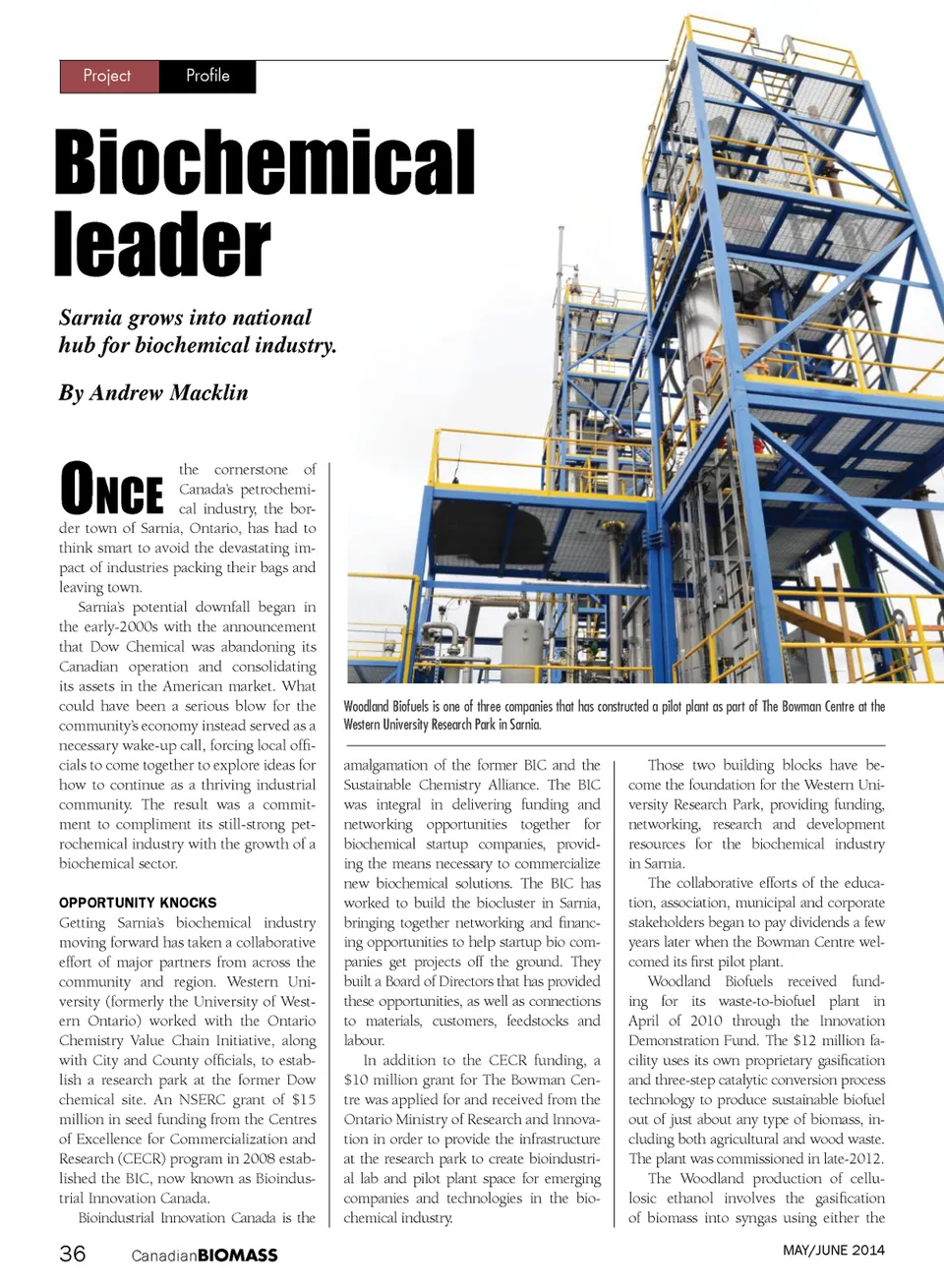
Project Profile Biochemical leader Sarnia grows into national hub for biochemical industry. By Andrew Macklin O nce the cornerstone of Canada’s petrochemi-cal industry, the bor-der town of Sarnia, Ontario, has had to think smart to avoid the devastating im-pact of industries packing their bags and leaving town. Sarnia’s potential downfall began in the early-2000s with the announcement that Dow Chemical was abandoning its Canadian operation and consolidating its assets in the American market. What could have been a serious blow for the community’s economy instead served as a necessary wake-up call, forcing local offi-cials to come together to explore ideas for how to continue as a thriving industrial community. The result was a commit-ment to compliment its still-strong pet-rochemical industry with the growth of a biochemical sector. Woodland Biofuels is one of three companies that has constructed a pilot plant as part of The Bowman Centre at the Western University Research Park in Sarnia. oPPoRtunity KnocKs Getting Sarnia’s biochemical industry moving forward has taken a collaborative effort of major partners from across the community and region. Western Uni-versity (formerly the University of West-ern Ontario) worked with the Ontario Chemistry Value Chain Initiative, along with City and County officials, to estab-lish a research park at the former Dow chemical site. An NSERC grant of $15 million in seed funding from the Centres of Excellence for Commercialization and Research (CECR) program in 2008 estab-lished the BIC, now known as Bioindus-trial Innovation Canada. Bioindustrial Innovation Canada is the amalgamation of the former BIC and the Sustainable Chemistry Alliance. The BIC was integral in delivering funding and networking opportunities together for biochemical startup companies, provid-ing the means necessary to commercialize new biochemical solutions. The BIC has worked to build the biocluster in Sarnia, bringing together networking and financ-ing opportunities to help startup bio com-panies get projects off the ground. They built a Board of Directors that has provided these opportunities, as well as connections to materials, customers, feedstocks and labour. In addition to the CECR funding, a $10 million grant for The Bowman Cen-tre was applied for and received from the Ontario Ministry of Research and Innova-tion in order to provide the infrastructure at the research park to create bioindustri-al lab and pilot plant space for emerging companies and technologies in the bio-chemical industry. Those two building blocks have be-come the foundation for the Western Uni-versity Research Park, providing funding, networking, research and development resources for the biochemical industry in Sarnia. The collaborative efforts of the educa-tion, association, municipal and corporate stakeholders began to pay dividends a few years later when the Bowman Centre wel-comed its first pilot plant. Woodland Biofuels received fund-ing for its waste-to-biofuel plant in April of 2010 through the Innovation Demonstration Fund. The $12 million fa-cility uses its own proprietary gasification and three-step catalytic conversion process technology to produce sustainable biofuel out of just about any type of biomass, in-cluding both agricultural and wood waste. The plant was commissioned in late-2012. The Woodland production of cellu-losic ethanol involves the gasification of biomass into syngas using either the MAY/JUNE 2014 36 Canadian BIOMASS
Canadian Biomass May June 2014: Page 36