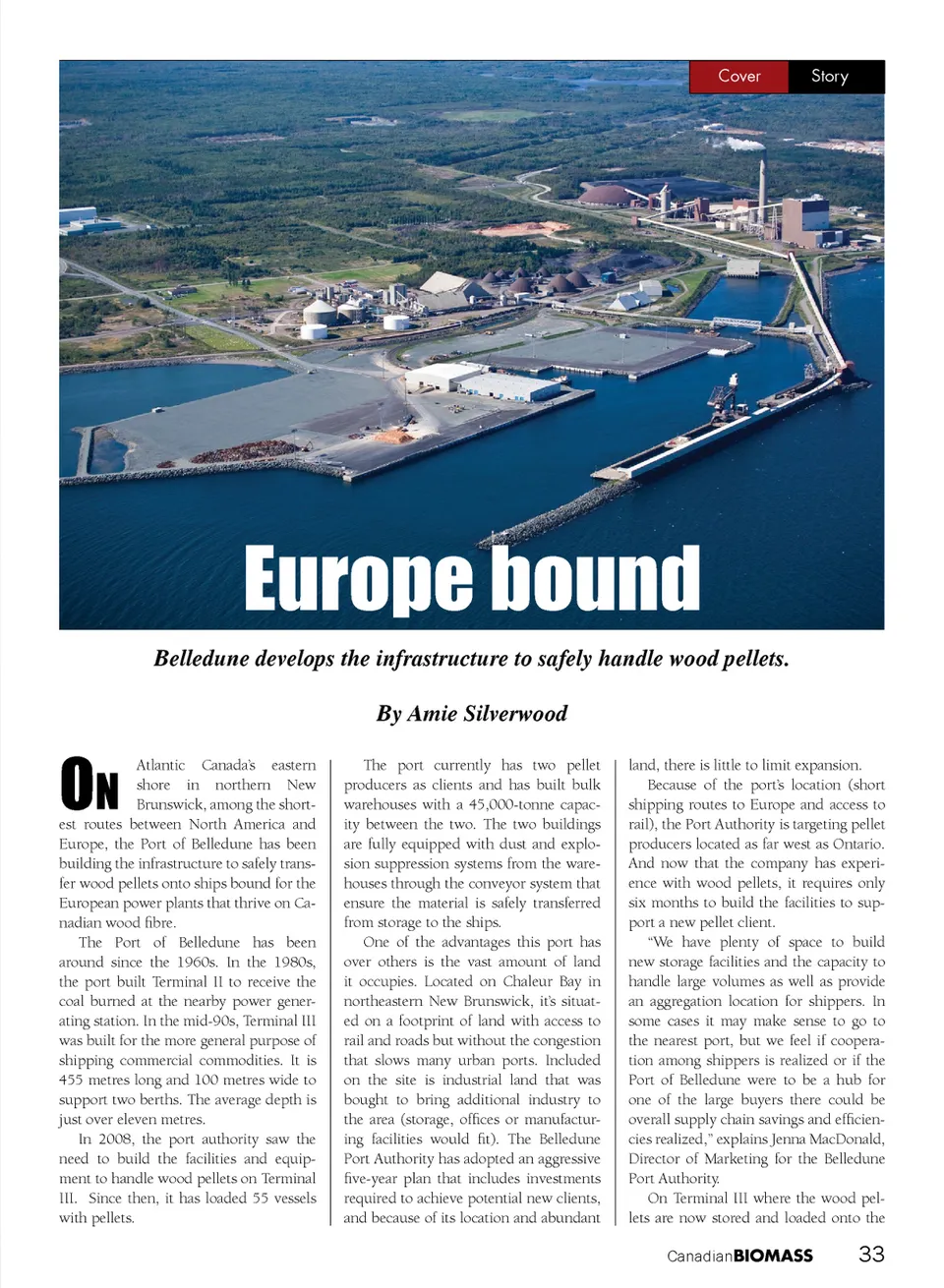
Cover Story Europe bound Belledune develops the infrastructure to safely handle wood pellets. By Amie Silverwood O n Atlantic Canada’s eastern shore in northern New Brunswick, among the short-est routes between North America and Europe, the Port of Belledune has been building the infrastructure to safely trans-fer wood pellets onto ships bound for the European power plants that thrive on Ca-nadian wood fibre. The Port of Belledune has been around since the 1960s. In the 1980s, the port built Terminal II to receive the coal burned at the nearby power gener-ating station. In the mid-90s, Terminal III was built for the more general purpose of shipping commercial commodities. It is 455 metres long and 100 metres wide to support two berths. The average depth is just over eleven metres. In 2008, the port authority saw the need to build the facilities and equip-ment to handle wood pellets on Terminal III. Since then, it has loaded 55 vessels with pellets. The port currently has two pellet producers as clients and has built bulk warehouses with a 45,000-tonne capac-ity between the two. The two buildings are fully equipped with dust and explo-sion suppression systems from the ware-houses through the conveyor system that ensure the material is safely transferred from storage to the ships. One of the advantages this port has over others is the vast amount of land it occupies. Located on Chaleur Bay in northeastern New Brunswick, it’s situat-ed on a footprint of land with access to rail and roads but without the congestion that slows many urban ports. Included on the site is industrial land that was bought to bring additional industry to the area (storage, offices or manufactur-ing facilities would fit). The Belledune Port Authority has adopted an aggressive five-year plan that includes investments required to achieve potential new clients, and because of its location and abundant land, there is little to limit expansion. Because of the port’s location (short shipping routes to Europe and access to rail), the Port Authority is targeting pellet producers located as far west as Ontario. And now that the company has experi-ence with wood pellets, it requires only six months to build the facilities to sup-port a new pellet client. “We have plenty of space to build new storage facilities and the capacity to handle large volumes as well as provide an aggregation location for shippers. In some cases it may make sense to go to the nearest port, but we feel if coopera-tion among shippers is realized or if the Port of Belledune were to be a hub for one of the large buyers there could be overall supply chain savings and efficien-cies realized,” explains Jenna MacDonald, Director of Marketing for the Belledune Port Authority. On Terminal III where the wood pel-lets are now stored and loaded onto the Canadian BIOMASS 33
Canadian Biomass May June 2014: Page 33