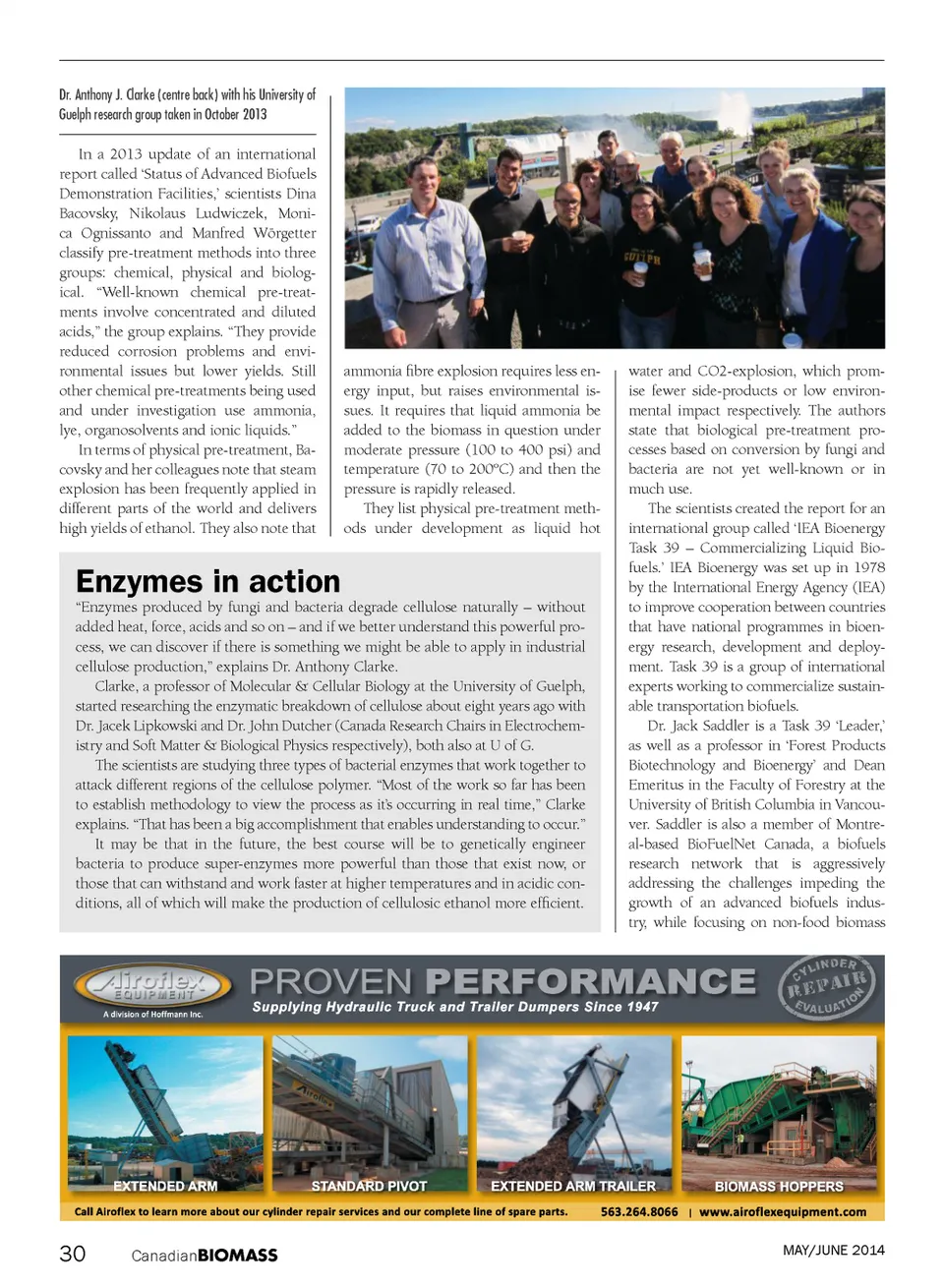
Dr. Anthony J. Clarke (centre back) with his University of Guelph research group taken in October 2013 In a 2013 update of an international report called ‘Status of Advanced Biofuels Demonstration Facilities,’ scientists Dina Bacovsky, Nikolaus Ludwiczek, Moni-ca Ognissanto and Manfred Wörgetter classify pre-treatment methods into three groups: chemical, physical and biolog-ical. “Well-known chemical pre-treat-ments involve concentrated and diluted acids,” the group explains. “They provide reduced corrosion problems and envi-ronmental issues but lower yields. Still other chemical pre-treatments being used and under investigation use ammonia, lye, organosolvents and ionic liquids.” In terms of physical pre-treatment, Ba-covsky and her colleagues note that steam explosion has been frequently applied in different parts of the world and delivers high yields of ethanol. They also note that ammonia fibre explosion requires less en-ergy input, but raises environmental is-sues. It requires that liquid ammonia be added to the biomass in question under moderate pressure (100 to 400 psi) and temperature (70 to 200°C) and then the pressure is rapidly released. They list physical pre-treatment meth-ods under development as liquid hot enzymes in action “Enzymes produced by fungi and bacteria degrade cellulose naturally – without added heat, force, acids and so on – and if we better understand this powerful pro-cess, we can discover if there is something we might be able to apply in industrial cellulose production,” explains Dr. Anthony Clarke. Clarke, a professor of Molecular & Cellular Biology at the University of Guelph, started researching the enzymatic breakdown of cellulose about eight years ago with Dr. Jacek Lipkowski and Dr. John Dutcher (Canada Research Chairs in Electrochem-istry and Soft Matter & Biological Physics respectively), both also at U of G. The scientists are studying three types of bacterial enzymes that work together to attack different regions of the cellulose polymer. “Most of the work so far has been to establish methodology to view the process as it’s occurring in real time,” Clarke explains. “That has been a big accomplishment that enables understanding to occur.” It may be that in the future, the best course will be to genetically engineer bacteria to produce super-enzymes more powerful than those that exist now, or those that can withstand and work faster at higher temperatures and in acidic con-ditions, all of which will make the production of cellulosic ethanol more efficient. water and CO2-explosion, which prom-ise fewer side-products or low environ-mental impact respectively. The authors state that biological pre-treatment pro-cesses based on conversion by fungi and bacteria are not yet well-known or in much use. The scientists created the report for an international group called ‘IEA Bioenergy Task 39 – Commercializing Liquid Bio-fuels.’ IEA Bioenergy was set up in 1978 by the International Energy Agency (IEA) to improve cooperation between countries that have national programmes in bioen-ergy research, development and deploy-ment. Task 39 is a group of international experts working to commercialize sustain-able transportation biofuels. Dr. Jack Saddler is a Task 39 ‘Leader,’ as well as a professor in ‘Forest Products Biotechnology and Bioenergy’ and Dean Emeritus in the Faculty of Forestry at the University of British Columbia in Vancou-ver. Saddler is also a member of Montre-al-based BioFuelNet Canada, a biofuels research network that is aggressively addressing the challenges impeding the growth of an advanced biofuels indus-try, while focusing on non-food biomass 30 Canadian BIOMASS MAY/JUNE 2014
Canadian Biomass May June 2014: Page 30