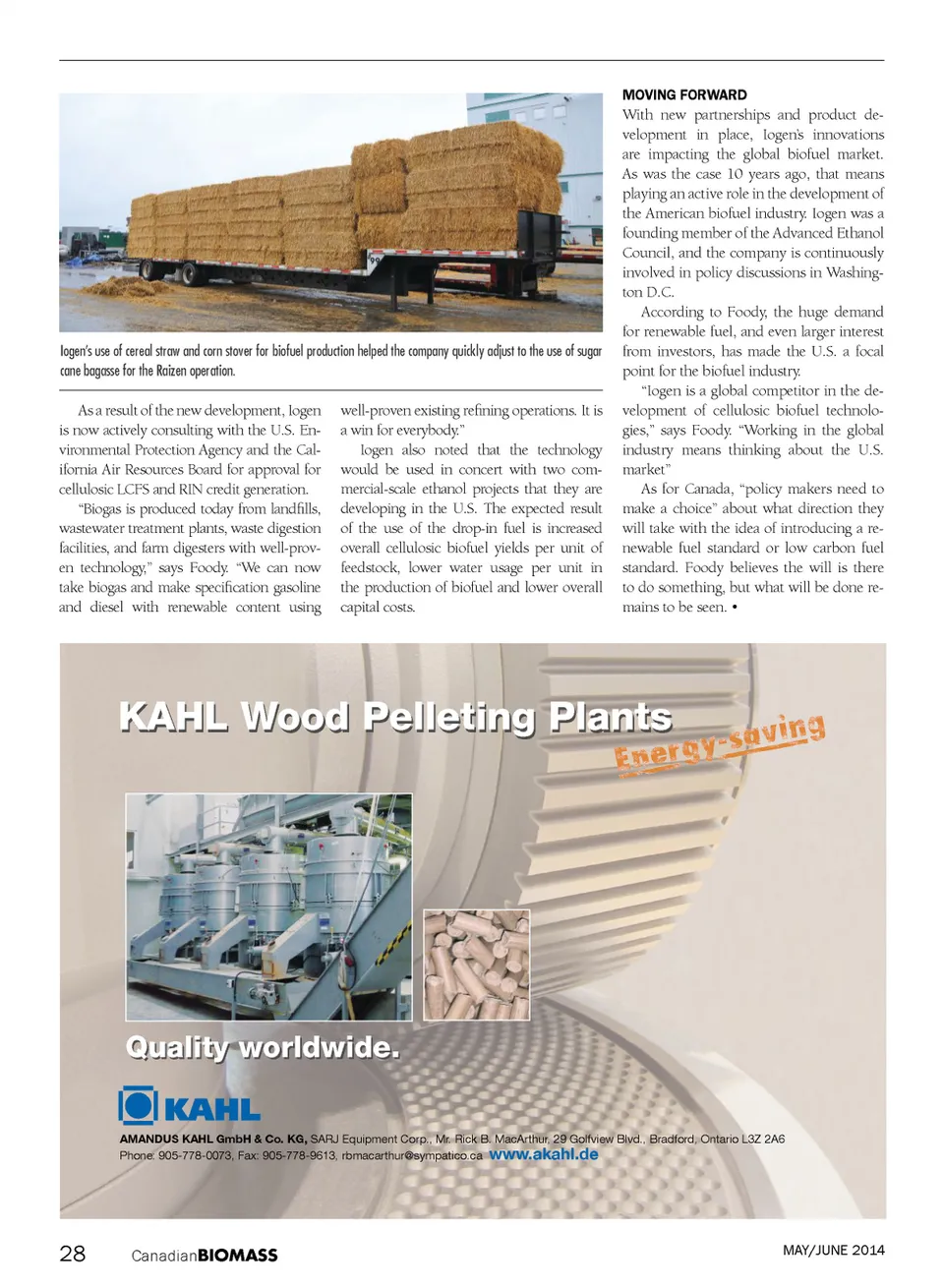
Enzyme Research Breaking down barriers to growth Canadian regulation holds the biofuel industry back as other countries benefit from advances in pre-treatments. By Treena Hein s Ince the 1970s when bio-fuel production be-gan, pre-treatment methods – and the powerful substances such as yeasts and enzymes used in these methods – have come a long way. “They have made an enormous differ-ence in achievable yield of ethanol,” says Canadian Renewable Fuel Association President W. Scott Thurlow. “Research and development has been in perpetual state of innovation. Pretreatment using substances such as yeasts and enzymes allow us to derive more and more fuel from the same volume of feedstock mate-rial. This also allows us as a society to get more food and more fuel from the same amount of land.” The efficiencies gained so far through pre-treatment processes have also made biofuel production greener. For example, water required in biofuel production has decreased consistently over the last de-cade, and this is partly due to the contri-bution of enzymes, Thurlow notes. Technological developments in pre-treatments have also led to better safety. New enzyme and yeast products are more pH-tolerant than those used in the past, and are being used to replace (much more dangerous) ammonia in front-end processing of ethanol. PRe-tReatment 101 (corn, silage, woody biomass, straw) to the subsequent hydrolysis steps, to de-crease the crystallinity of the cellulose and to increase its porosity. Only after pre-treatment are the sugar-containing materials accessible for hydrolysis, where lignin-free cellulosic material is split into sugars which are in turn fermented into biofuel. The main purpose of the pre-treatment is to increase the reactivity of the cellu-lose and hemicellulose feedstock material The fruits of some of the enzyme research and develop-ment occurring here in Canada are approved for use in other markets, but these same domestic products are not yet allowed for domestic biofuel production. Canadian BIOMASS 29
Canadian Biomass May June 2014: Page 29