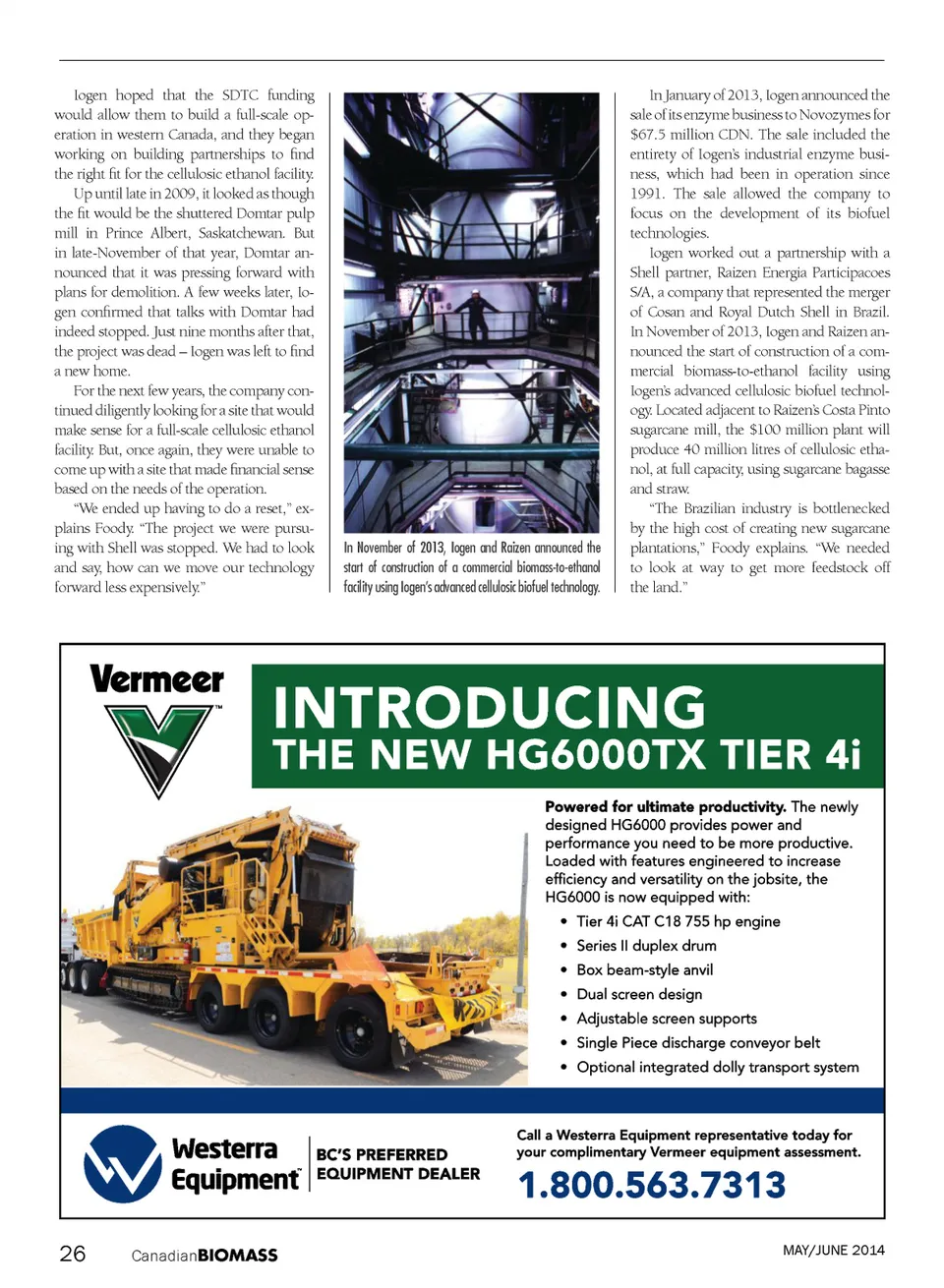
Iogen hoped that the SDTC funding would allow them to build a full-scale op-eration in western Canada, and they began working on building partnerships to find the right fit for the cellulosic ethanol facility. Up until late in 2009, it looked as though the fit would be the shuttered Domtar pulp mill in Prince Albert, Saskatchewan. But in late-November of that year, Domtar an-nounced that it was pressing forward with plans for demolition. A few weeks later, Io-gen confirmed that talks with Domtar had indeed stopped. Just nine months after that, the project was dead – Iogen was left to find a new home. For the next few years, the company con-tinued diligently looking for a site that would make sense for a full-scale cellulosic ethanol facility. But, once again, they were unable to come up with a site that made financial sense based on the needs of the operation. “We ended up having to do a reset,” ex-plains Foody. “The project we were pursu-ing with Shell was stopped. We had to look and say, how can we move our technology forward less expensively.” In November of 2013, Iogen and Raizen announced the start of construction of a commercial biomass-to-ethanol facility using Iogen’s advanced cellulosic biofuel technology. In January of 2013, Iogen announced the sale of its enzyme business to Novozymes for $67.5 million CDN. The sale included the entirety of Iogen’s industrial enzyme busi-ness, which had been in operation since 1991. The sale allowed the company to focus on the development of its biofuel technologies. Iogen worked out a partnership with a Shell partner, Raizen Energia Participacoes S/A, a company that represented the merger of Cosan and Royal Dutch Shell in Brazil. In November of 2013, Iogen and Raizen an-nounced the start of construction of a com-mercial biomass-to-ethanol facility using Iogen’s advanced cellulosic biofuel technol-ogy. Located adjacent to Raizen’s Costa Pinto sugarcane mill, the $100 million plant will produce 40 million litres of cellulosic etha-nol, at full capacity, using sugarcane bagasse and straw. “The Brazilian industry is bottlenecked by the high cost of creating new sugarcane plantations,” Foody explains. “We needed to look at way to get more feedstock off the land.” 26 Canadian BIOMASS MAY/JUNE 2014
Canadian Biomass May June 2014: Page 26