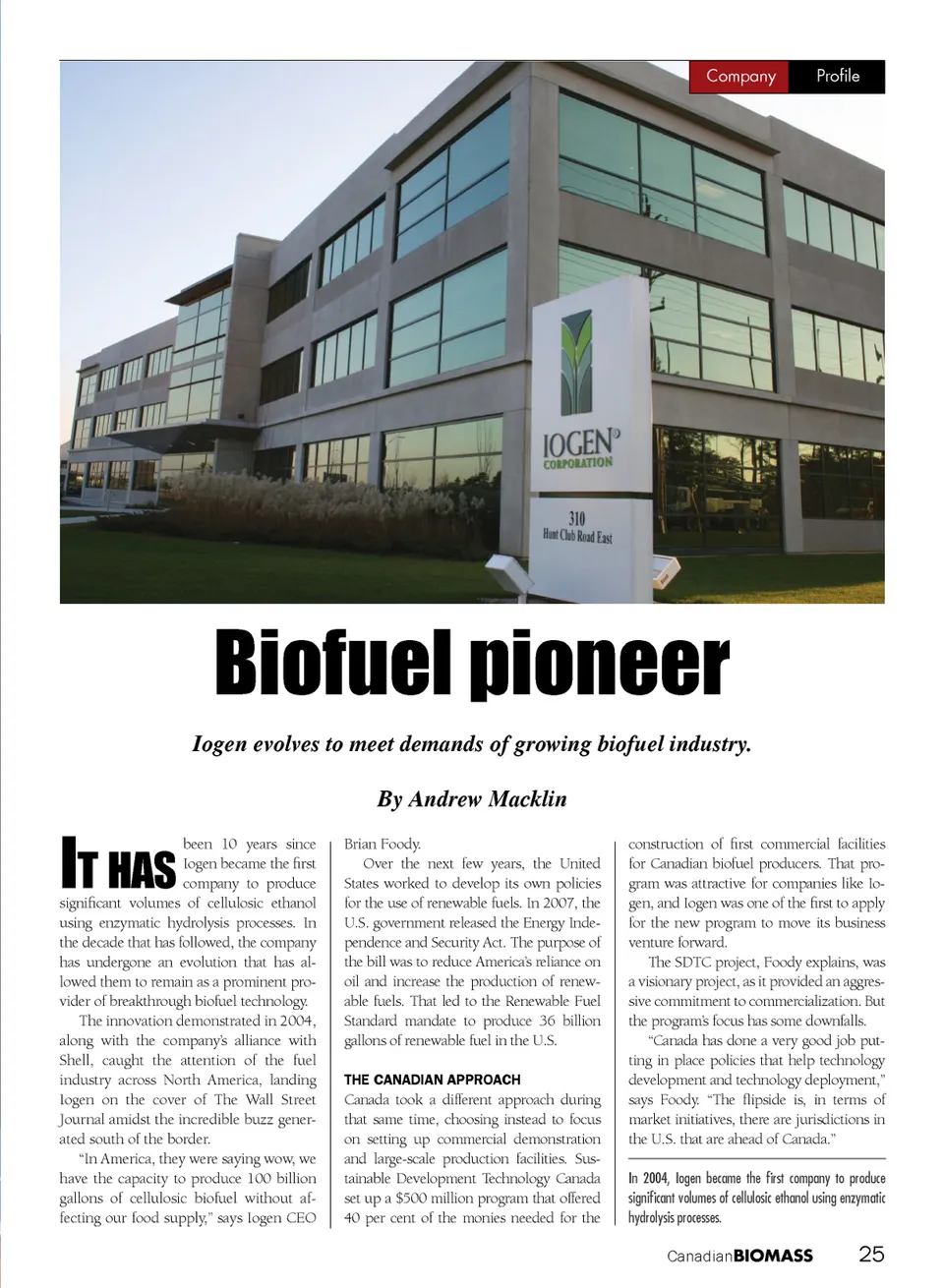
Company Profile Biofuel pioneer Iogen evolves to meet demands of growing biofuel industry. been 10 years since Iogen became the first company to produce significant volumes of cellulosic ethanol using enzymatic hydrolysis processes. In the decade that has followed, the company has undergone an evolution that has al-lowed them to remain as a prominent pro-vider of breakthrough biofuel technology. The innovation demonstrated in 2004, along with the company’s alliance with Shell, caught the attention of the fuel industry across North America, landing Iogen on the cover of The Wall Street Journal amidst the incredible buzz gener-ated south of the border. “In America, they were saying wow, we have the capacity to produce 100 billion gallons of cellulosic biofuel without af-fecting our food supply,” says Iogen CEO I T has By Andrew Macklin Brian Foody. Over the next few years, the United States worked to develop its own policies for the use of renewable fuels. In 2007, the U.S. government released the Energy Inde-pendence and Security Act. The purpose of the bill was to reduce America’s reliance on oil and increase the production of renew-able fuels. That led to the Renewable Fuel Standard mandate to produce 36 billion gallons of renewable fuel in the U.S. the canadian aPPRoach Canada took a different approach during that same time, choosing instead to focus on setting up commercial demonstration and large-scale production facilities. Sus-tainable Development Technology Canada set up a $500 million program that offered 40 per cent of the monies needed for the construction of first commercial facilities for Canadian biofuel producers. That pro-gram was attractive for companies like Io-gen, and Iogen was one of the first to apply for the new program to move its business venture forward. The SDTC project, Foody explains, was a visionary project, as it provided an aggres-sive commitment to commercialization. But the program’s focus has some downfalls. “Canada has done a very good job put-ting in place policies that help technology development and technology deployment,” says Foody. “The flipside is, in terms of market initiatives, there are jurisdictions in the U.S. that are ahead of Canada.” In 2004, Iogen became the first company to produce significant volumes of cellulosic ethanol using enzymatic hydrolysis processes. Canadian BIOMASS 25
Canadian Biomass May June 2014: Page 25